A compelling story

The substance of story is the gap that splits open between what a human being expects to happen when they take an action, and what does happen; the rift between expectation and result, probability and necessity. To build scenes, sequences and acts, we constantly break open these breaches in reality.

As a charge of electricity leaps from pole to pole in a magnet, so the spark of life ignites across the gap between the self and reality. With this flash of energy, we ignite the power of story.*
(Robert McKee)

Robert McKee outlines what is a writer is really up to when creating a compelling story.

A compelling story has the power to reveal to us things that are true about our lives but we may never see unless we enter these breaches in reality when they present themselves to us (order is but a thin veneer covering randomness), where new and surprising possibilities exist, often only encountered between where we are and where we want to be.

(*From Robert McKee’s blog: What is the Substance of a Story.)

The fear of being heard

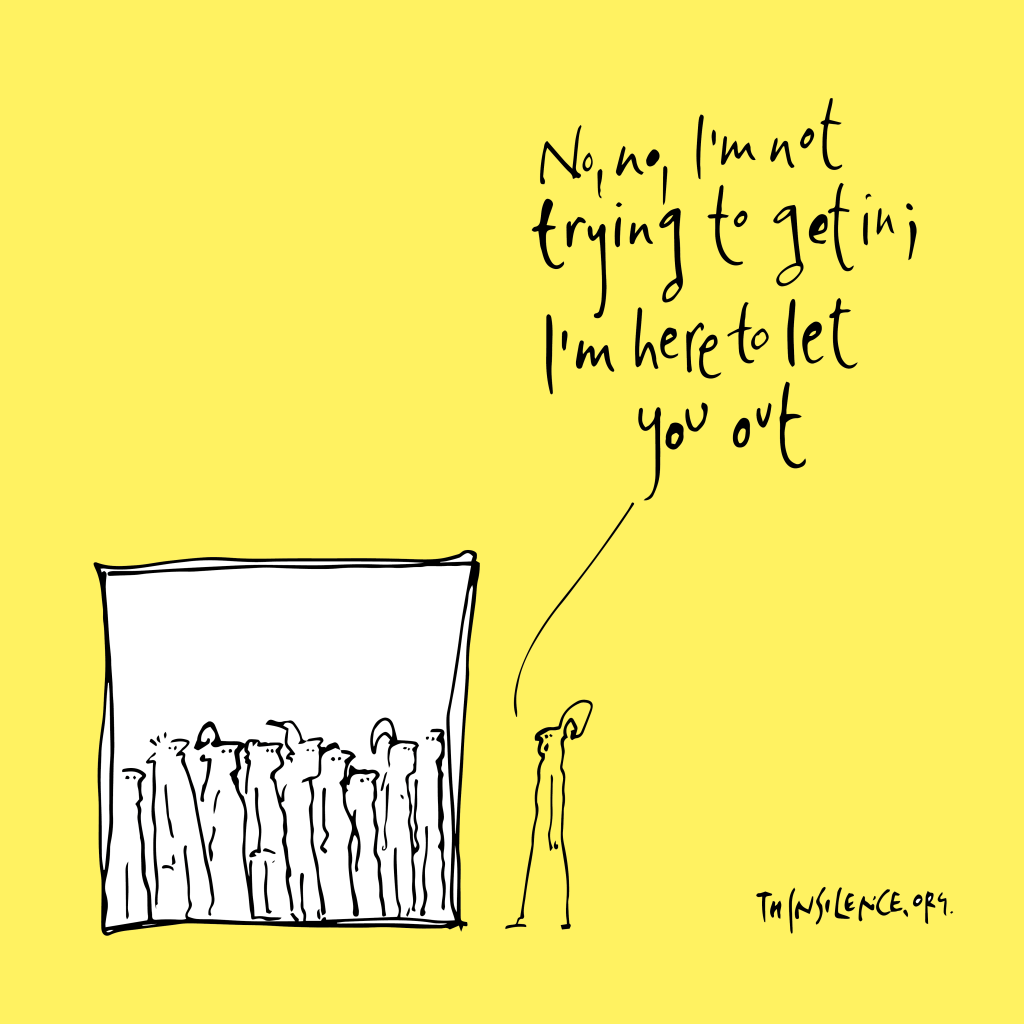
A listening person is your collaborator and your opponent. […] A listening person can reflect the crowd. He can do that without talking. He can do that merely by letting the talking person listen to himself.*
(Jordan Peterson)

Because without time, there could be not reactions to actions, no consequences. Without time, decisions need not be considered for their implications and effects. We had all been drifting in a comfortable void with responsibilities.**
(Alan Lightman)

It’s time to do something.

We can carry on through life as though we have “all the time in the world, and then we look again and it’s almost gone.

A true listener is one who helps us to make the most of our time before it vanishes.

They not only know how to listen but also how to ask questions.

A question when it’s important to explore why the thing they are sharing has come about.

A question to cut “across the bows” of is being shared because they’re direction needs to be interrupted.

A true listener also knows that most things are far more complex than we allow, and they are there for the long haul, willing to listen, with their questions, from the beginning to the end.

A true listener knows the person they are listening to has some amazing things to share, though that person does not know it, yet.

Only the questions will make it possible for these things to appear.

Of course, life is simpler if we don’t have anyone really listening.

(*From Jordan Peterson’s 12 Rules for Life.)
(**From Alan Lightman’s Mr g.)

Helping 2.0

What if real help is not what someone brings directly to us but what takes form in the space between the helper and the helpee.

We may say, “This is what I need,” but something more happens when the person helping listens deeply and begins to ask questions we’d never imagined.

Helping is an art.

All we have to work with

Each society and each individual usually explores only a tiny fraction of their horizon of possibilities.*
(Yuval Noah Harari)

a life of ease is how you get stuck and confused in life**
(Ben Hardy)

It’s not what’s on the outside that counts, it’s what’s on the inside and its potential is largely unexplored.

(*From Yuval Noah Harari’s Sapiens.)
(**From Ben Hardy’s These 20 Pictures Will Teach You More Than Reading 100 Books.)

Time for A&Q

Your real work is play.*
(Austin Kleon)

But reason falls in love with itself, and worse. It falls in love with its own productions. It elevates them, and worships then as absolutes. […] The totalitarian says, in essence, “You must rely on faith in what your already know.” But this is not what saves. What saves is the willingness to learn from what you don’t know.**
(Jordan Peterson)

As we got to the end of the book launch for Daphne Loads‘ Rich Pickings,^ there was a Q&A time. I found myself wondering about switching this around, being playful with an A&Q session: the audience coming up with answers for us, and Daphne and myself responding with a question.

Then the question came from my friend Glen in the audience. Had I ever tried doodling with my other hand?

I sensed a challenge.

I hadn’t. I usually encourage people to go with their strengths and to develop these, to see their other “hand” as supporting their preferred “hand.”

But what if Glen were offering me an answer and I had to pose a question in response?

Here goes?

It is critical to look beyond the familiar and the preferred:

See ever so far … there is limitless space outside of that,
Count ever so much … there is limitless time around that.^^

To be most playful, we need to encourage our lives to have borders rather than boundaries.

Boundary-dwellers focus life at the centre, the boundary is out there, not to be crossed.

Border-dwellers explore where their lives touch others and the Other:

To be playful is not to be trivial or frivolous. […] On the contrary, when we are playful to each other we relate as free persons and the relationship is open to surprise.*^

I include these words from James Carse because the surprise he anticipates is not only surprise in the other but also surprise at ourselves.

The border-dweller doesn’t wait for a border to appear but knows they can create one whenever they need to:

If you’re struggling to make a transition, create a defining moment that draws a dividing line between the Old You and the New You.^*

If this is all an answer, what’s your question?

Thank you to Daphne and Glen for encouraging the left-handed doodle from a right-handed doodler.

(*From Austin Kleon’s Keep Going.)
(**From Jordan Peterson’s 12 Rules for Life.)
(^See Daphne Loads’ Rich Pickings. Daphne asked me to illustrate her wonderful book about different ways to be playful with text – a fun experience in itself.)
(^^From Walt Whitman’s Leaves of Grass.)
(*^From James Carse’s Finite and Infinite Games.)
(^*From Chip and Dan Heath’s The Power of Moments.)

Any more questions?

I always think that the question is like a lantern. It illuminates new landscapes and new areas as it moves.*
(John O’Donohue)

The capacity of the rational mind to deceive, manipulate, scheme, trick, falsify, minimise, mislead, betray, prevaricate, deny, omit, rationalise, bias, exaggerate and obscure is so endless, so remarkable, that centuries of pre-scientific though, concentrating on clarifying the nature of moral endeavour, regarded it as positively demonic.**
(Jordan Peterson)

We know what Jordan Peterson says is true because, if we go through his list, we’ll come up with examples for each – though, hopefully small ones.

We need to question our thinking in an ongoing and consistent way.

We will be enabled in this if we gather a tribe of questioners to help, those who will help us pose the kind of questions that cut through all the garbage we can come up with. People who think differently to us, who throw us some koans each day and make us look differently at our own thinking and behaving.

Since the inauguration of printing, these people have not needed to be in the same room as us. This is truer now than ever, but people we can get together with and explore thinking with are the best kind of questioners of all.

(*John O’Donohue, quoted in Maria Popova’s Brain Pickings: A Gentle Corrective for the Epidemic of Identity Politics.)
(**From Jordan Peterson’s 12 Rules for Life – my main read for August.)

The true dilemma (fixing ourselves)

It is my firm belief that the best way to fix the world – a handyman’s dream if ever there was one – is to fix yourself. […] Anything else is presumptuous. Anything else risks harm, stemming from your ignorance and lack of skill.*
(Jordan Peterson)

But complexity consists of integration as well as differentiation. The task of the next decades and centuries is to realise this underdeveloped component of the mind. Just as we have learned to separate ourselves from each other and the environment, we now need to learn how to reunite ourselves with other entities around us without losing our hard-won individuality.**
(Mihaly Csikszentmihalyi)

Bernadette Jiwa asks three big questions of those developing their own businesses, though, the questions feel important for everyone:

What do you think is missing in the world?
What kind of work will you do to fix it?
How will you find the courage to stand out when the world is screaming at you to fit in?^

Our true dilemma lies in responding to the third question.

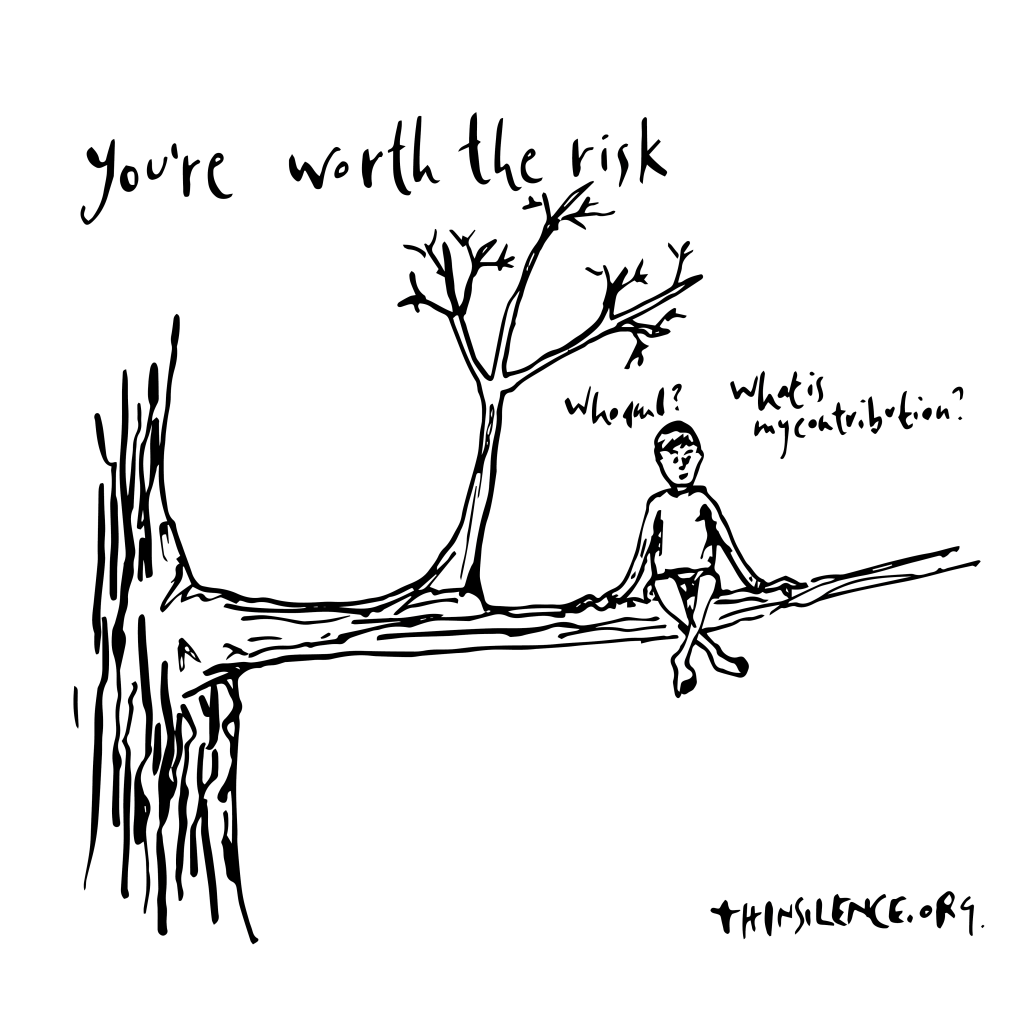
We will soon identify something that is needed or could be better in the world, we even have the abilities to bring this into being, but finding the courage to begin, to act is more difficult.

To identify what Martin Buber names our “self-sense,”^^ we must detach ourselves from others and from the world in order to move into our independence. We separate to know ourselves but must then reunite ourselves if we are to make our stronger contribution.

Mihaly Csikszentmihalyi sees this reuniting as our work into the future. We understand how we can we independent have to become explorers of a greater interdependence:

Recognising the limitations of human will, accepting a cooperative rather than a ruling role in the universe, we should feel the relief of the exile returning home. The problem of meaning will then be resolved as the individual’s purpose merges with the universal flow.**

Here are echoes of Frederick Buechners’s declaration that meaning is found where our deepest joy meets the world’s greatest need. Joseph Campbell named two critical myths: the personal myth which contains our “bliss,” our purpose, and the social myth which understands how we bring this into integration with others.

Each day, we can practice these: separate to know who we are and what we bring, reunite and bring our strongest self to serve others and our world.

(*From Jordan Peterson’s 12 Rules for Life.)
(**From Mihaly Csikszentmihalyi’s Flow.)
(^From Bernadette Jiwa’s The Story of Telling Monthly Update for August.)
(^^See Martin Buber’s I and Thou.)

More than activity and reflection

Activity and reflection should ideally complement and support each other. Action is blind, reflection impotent.*
(Mihaly Csikszentmihalyi)

But being creative is never an end; it is a means to something else.**
(Austin Kleon)

When activity and reflection are brought together there is the possibility of change.

A change of mind.

A change of heart,

A change of direction.

We can change.

Others can change.

Cultures can change.

The world can change.

Even our god can change.

The real product of today is not the activity or the reflection alone, but the change that can take place.

Even transformation.

(*From Mihaly Csikszentmihalyi’s Flow.)
(**From Austin Kleon’s Keep Going.)

Heart’s desire

It’s as true today as it ever was: He who seeks beauty will find it.*
Bill Cunningham)

If we allow ourselves to see, we will more readily feel, and if we open to the river of compassionate feeling, we will more likely act. But the call to action is the sticking point.**
(Philip Newell)

Just before you think that really is your heart’s desire, pause a moment before acting upon it.

Is there more to see, to know, to think about, to feed your feeling and grow your heart, and the effect it will have on others.

If it’s a worthy desire, continue, and bring something beautiful into being.

(*Bill Cunningham, quote in Austin Kleon’s Keep Going.)
(**From Philip Newell’s The Rebirthing of God.)

It’s possible

we must face the fact that we have a responsibility to own what’s possible. Opportunity abounds. And that’s both a scary and empowering thought*
(Bernadette Jiwa)

Probability sounds good on the face of it. You know where you stand with probability and it will be the same tomorrow.

Probability is fine until it doesn’t work any more.

Obversely, possibility sounds much less likely. Yet every probability began life as a possibility. There is nothing that exists that has has always been this way.

We are children of possibility.

Especially when we see the possibility of someone or something being more human, more caring, more compassionate, more beautiful, more helpful … and we take responsibility for it – because now we can.

And humility is the best place to grow possibility: knowing who we are and what it is we can contribute.

(*From Bernadette Jiwa’s blog: The Bounds of Possibility.)