You don’t have to use the word hero

A hero ventures forth from the world of common day into a region of supernatural wonder; fabulous forces are there encountered and a decisive victory is won; the hero comes back from this adventure with the power to bestow boons on his fellow men and women.*
Joseph Campbell

The hero transformation begins when the hero takes responsibility for their life and for their story. The hero becomes the hero only when they decide to accept the facts of their life and respond with courage.**
Donald Miller

You can still be more the person only
you can be, enwrapped and absorbed
in the things only you can do for
the sake of others without
using the word hero;
When you own how things are and
what must be done^
you have already placed a foot on
your heroic path, and
you will change and
you will begin to make change.

*Joseph Campbell’s Myths To Live By;
**Donald Miller’s Hero On a Mission;
^This is how it began for me, though it was to be many years before I came to ideas of myths and heroes.
It began with journaling about things that were happening around and through me – writing these things down helps the path unfold.

Leading stories

Here’s the thing: the story you think is too small to matter is often the one that changes everything.*
Bernadette Jiwa

These are your precognitions:
whispered memories of a future that
remembers you. Let them lead you. Not with
force, but with the subtle gravity of
something sacred calling you home.

AleXander McManus

It’s not big, nor
is it noticed by the masses,
But this is your story,
Unrepeatable, beautiful, alchemistic.

*Bernadette Jiwa’s Briefly blog: The Quiet Power of Untold Stories;
**AleXander McManus’ Blue Moments.

We have dreams

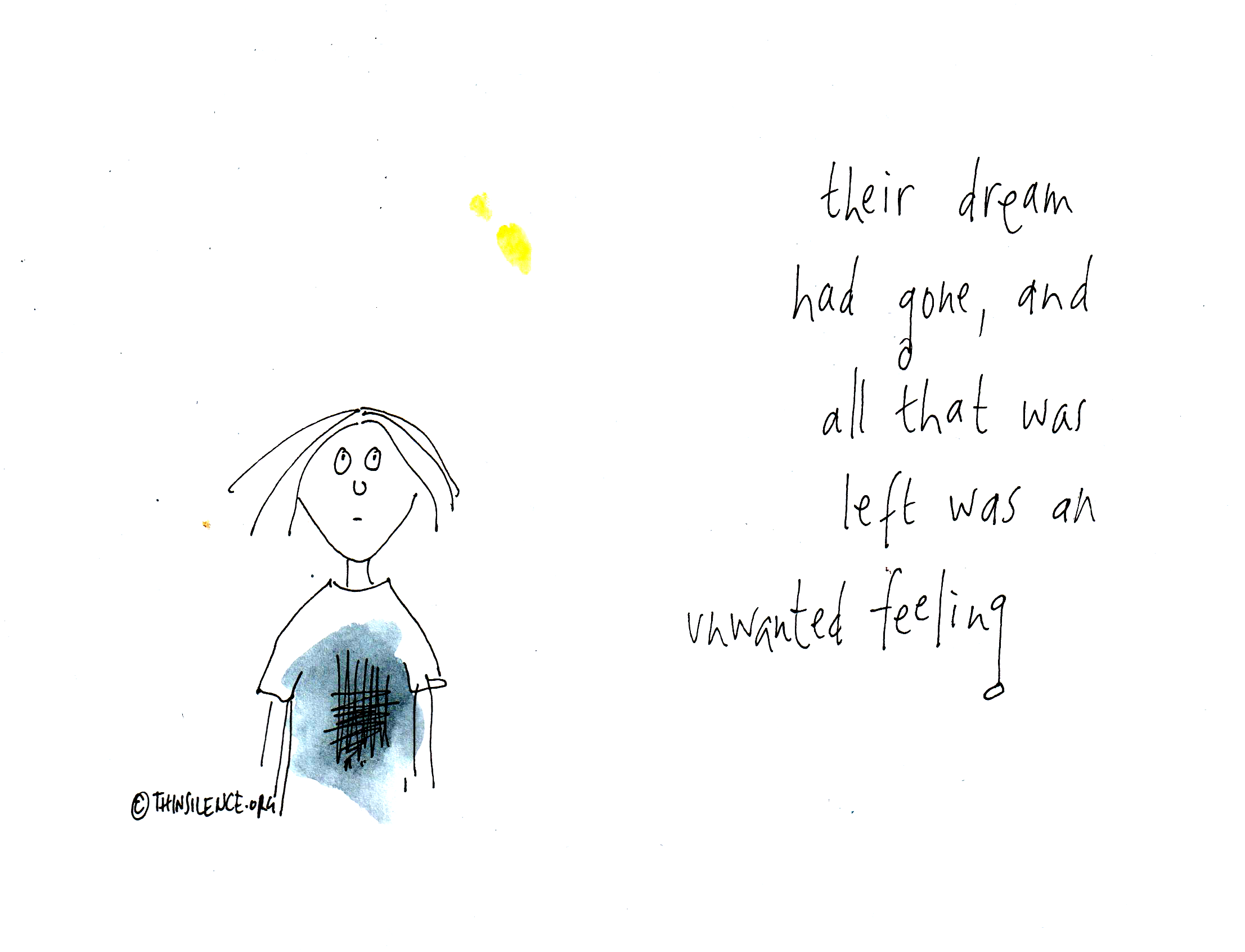
In a contest between “I Have a Dream” and “the advancement of creative dissatisfaction,” we all know which words win. The emotional ones. The ones that speak to a universal human experience: dreaming and yearning for something more.*
gapingvoid

Emotion alerts your cognitive unconscious to the events you need to remember because they contain info that might come in handy in the future and allows everything else you experience to evaporate into the ether as if it had never happened.**
Lisa Cron

Martin Luther King Jr. was about to
tell his audience to “go back to [your] communities as members of
the international association for the advancement of creative dissatisfaction,”*

But he paused, a friend on stage asked him
to tell them about his dream –
The rest is history, and more:
The dream is still alive today.

Our emotions may get us into trouble
at times, leading us down false paths,
But we need them –
Vulcans can only exist in Star Trek’s imagination,
At best they would only be a chaotic species –
We’d struggle making even
simple decisions without them.

Which brings us to the importance of dreams,
And how they play upon our lives,
The emotions they evoke,
Prompting stories we want to explore beyond
the hard facts of life;
Dare to express your dream, then
follow where it leads.^

*gapingvoid’s blog: No Emotion, No Justice;
**Lisa Cron’s Story Or Die;
^Let me know if I can help with dreamwhispering: geoffrey@thinsilence.org.

You’ve got this

If myth accomplishes only one thing, it is to expose human beings as multidimensional creatures … No one volunteers to be insignificant. No one yearns to be powerless and without purpose. The self craves one thing: to express its potential.*
Deepak Chopra

Each day holds
opportunities to do something
purposeful and significant;
These actions may be small but
we don’t know where they’ll lead –
Permission isn’t out there,
It’s within us.

*Jean Houston’s The Wizard of Us.

The bookshelf*

Humans are smart because we have evolved to connect with other brains.**
Matthew Syed

If you read books on different topics an different genres at the same time, your brain can’t help but find weird connections between them.^
Austin Kleon

I’m not claiming to be smart,
But I do hope to be smarter through being
open to others for the sake others.

Every morning, I am met
by a random group of writers and thinkers,^^ and
I never know what’s going to emerge.

*The bookshelf doesn’t have to be a physical one; it can be digital, visual, audible.
**Matthew Syed’s Rebel Ideas;
^Austin Kleon’s blog: Letting books talk to each other;
^^I have a shelf of twenty eight open books at the moment, which shuffle as I read from about four of these each day, together with around three or four blogs.
Today’s randomly included Richard Rohr, Matthew Syed, Bina Venkataraman, Adam Kohane, Seth Godin, Gabe Anderson, Deepak Chopra, and Austin Kleon. When ideas are coming together within us, we are shaping our permission to do something – we don’t have to wait (something that spills over into tomorrow’s blog).

Whoa, that’s a lot of energy

To tell great stories as fast as possible. That’s my jam.*
Hugh Macleod

Be a monomaniac on a mission to be truly great at something difficult. Pick one thing and send the rest of your life at getting deeper into it. Mastery is the best goal because the rich can’t buy it, the impatient can’t rush it, the privileged can’t inherit it, and nobody can steal it. You can only earn it through hard work. Mastery is the ultimate status. Striving makes you happy.**
Derek Sivers

Identifying the thing we want to do –
The must to work at and deliver to others – will
leave us feeling alive and
emitting power-stations of energy;
We’re thrilled to have found something
so meaningful and satisfying, but
what we do won’t be for everyone:
We must find those it is good for.

You’re either the person who creates energy. Or you’re the one that destroys it.^

*From a Hugh Macleod tweet;
**Derek Sivers’ How To Live;

^Ryder Carroll’s The Bullet Journal Method.

The beginning

It takes an initial tender vulnerability (“wounding”) to defeat our ego and to open us to full consciousness – which must include the scary unconscious.*
Richard Rohr

Rather than ignoring the negative emotion of regret – or worse, wallowing in it – we can remember that feeling is for thinking and that thinking is for doing.**
Daniel Pink

You don’t have to turn away from the pain.^

Notice where it places itself.^^

Does it have a shape, a colour, a texture?

Listen carefully: What is it trying to tell you?

What do you want to ask it?

Now you’re thinking; soon you’ll be doing.

*Richard Rohr’s The Tears Of Things;
**Daniel Pink’s The Power of Regret;

^The Ego does not want to give up its pain; Eckhart Tolle names this “the Painbody”;
^^Noticing helps us to move from being the victim to being an agent.

To see is life*

Drawing isn’t such hard work but seeing is.**
Tom Vanderbilt

You can’t see what your group can’t see.^
Richard Rohr

Seeing is for life,^^
It is an infinite game skill –
Seeing what is
rather than
what we think there is:
Everything we are
is a potential filter for seeing
the world –
It will take
the whole of our lives
and a lot of effort
to see things clearly;
For this I need your help

*This is always more than visually seeing;
**Tom Vanderbilt’s Beginners;
^Richard Rohr’s The Tears of Things;

^^Art is primarily about seeing, providing a metaphor for life: the better our seeing, the better our living – not in comparison with others but for the sake of others.

The birth of a conversation

laconic: /ləˈkɒnɪk/ Laconic is an adjective that describes a style of speaking or writing that uses only a few words, often to express complex thoughts and ideas

Let them wish you talked more. Let them wonder what you’re thinking. Let the words you speak carry extra weight precisely because they are more.*
Ryan Holiday

The willingness to
speak necessary words and make haste
towards silence is
an invitation to conversation.

*Ryan Holiday’s Discipline is Destiny.