Energy levels

What counts is not so much whether a person actually achieves what they set out to do; rather it matters whether effort has been expended to reach the goal, instead of being diffused or wasted.*
Mihaly Csikszentmihalyi

You can’t save today’s energy for
the next day – tomorrow
comes with its own vivacity;
And if we need a guarantee of
success before we begin then we’ll
never embark on much of anything.

Here are some playful ways in which to
engage our energy:
Curiosity, turning into
observation, but then
moving on to notice more, before turning to
thoughtfulness, resulting in making something
skilfully* –
Which may or may not be just
what you had in mind,
And you may also find that you’ve increased
your energy for tomorrow.

*Mihaly Ciskszentmihalyi’s Flow;
**Rohit Bhargava’s five steps for innovation and creativity are: Curiosity, Observation, Fickleness (not over-focusing on one thing), Thoughtfulness, and Elegance:
Non Obvious 2019).
The homeward journey

When one is at home in oneself, one is integrated and enjoys a sense of balance and poise. In a sense that is exactly what spirituality is: the art of homecoming.*
John O’Donohue

Living in accordance with our values is never finished; it is a lifelong journey.**
Steven Hayes

I love the energy and thrill of balance and poise,
Of knowing just where I am in
myself and in the work I do,
But I also love learning new things, and
trying to bring these into
me and bring them before others –
And then I am clumsy and unbalanced again;
But this is all a part of the homeward journey
towards new balance and poise,
Before I journey outwards once more.

*John O’Donohue’s Benedictus;
**Steven Hayes’ A Liberated Mind.

The other script

The thing that gets us stuck isn’t us. It’s the script that we’ve decided is our only option. Call it out. Realise that it’s not the only option … Rewrite the script, rewrite the outcome.*
Seth Godin

We have already heard that the fulfilment of meaning is possible in three main directions: humans are able to give meaning by doing something, by acting, by creating – by bringing a work into being; secondly, by experiencing something – nature, art – or loving people; and thirdly, human being are able to find meaning even where finding value in life is not possible for them in either the first or the second way – namely, precisely when they take a stance toward the unalterable, fated, inevitable and unavoidable: how they adapt to this limitation, react towards it, how they accept their fate.**
Viktor Frankl

Every life comes with a script –
Where we are born and to whom, for starters –
But it is incomplete, and if there’s
one thing that we’re adept at, it’s bringing some
imagination and creativity to bear, rendering
the original narrative unrecognisable;
Where we take our stories is up to us.

*Seth Godin’s blog: “Here we go again”;
**Viktor Frankl’s Yes To Life.

Just a doodle 118

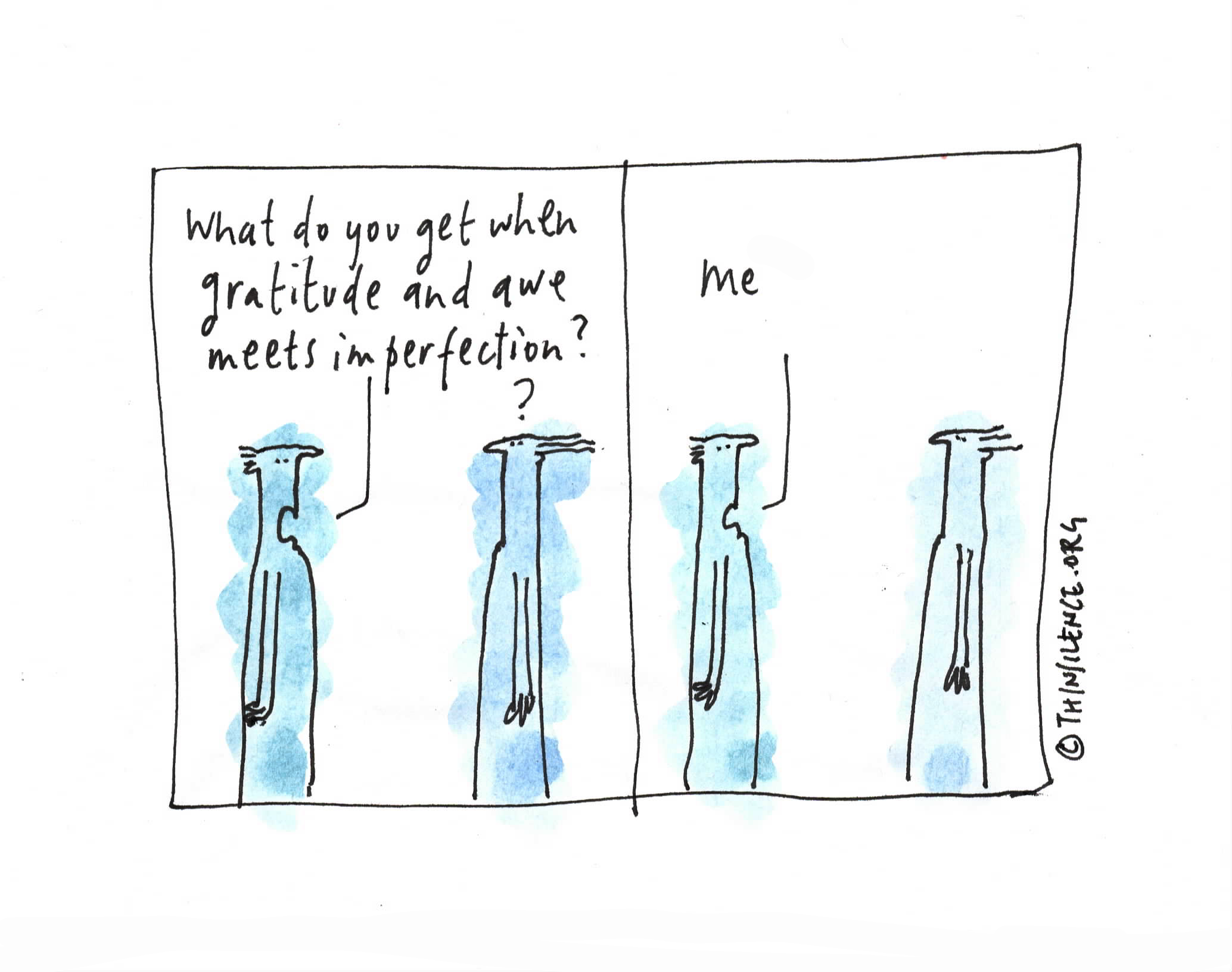
In terms of character traits, other studies have found that awe is correlated to traits like gratefulness, a love of learning, creativity, and appreciation for beauty.*
Jonah Paquette

And now to the question of the meaning of our imbalances: let us not forget that each person is imperfect, but each is imperfect in a different way, each “in his own way.” And as imperfect as he is, he is uniquely imperfect. So, expressed in a positive way, he becomes somehow irreplaceable, unable to be represented by anyone else, unexchangeable.**
Viktor Frankl

*Jonah Paquette’s Awestruck;
**Viktor Frankl’s Yes To Life.

The myth of increase

Water is H₂0, hydrogen two parts, oxygen one,
But there is also a third thing, that makes it water
And nobody knows what it is.*

D. H. Lawrence

Ultimately the goal is to become the best in the world at being you. To bring useful idiosyncrisity to the people you seek to change, and to earn a reputation for what you do and how you do it. The peculiar version of you, your assertions, your art.**
Seth Godin

Whilst the Enlightenment sounded the death knell for
traditional myths, in reality it substituted its own:
What the Enlightenment did was to
develop its own set of myths,
striking pictures whose attraction
usually centres on the lure of Reduction –
the pleasure of claiming that things are much simpler than they seem.^

I understand this to be a highlighting of how
humans need myths or stories to live by –
We cannot imagine a world,
Or our existence within it, without our stories;
The good myth retains the mystery, though
a helpful definition of a myth reminds us in timely fashion:
a partial truth based on an imaginative vision
fired by a particular set of ideals,
a dream that can help us to shape our enterprises,
but will mislead us if we
trust it on its own.^

To be our fullest self, though,
We shall require our myths that
allow for more than the ordinary, connecting us to
the mystery we encounter
within.

*From D. H. Lawrence’s poem ‘The Third Thing’; Roger Deakin’s Waterlog;
**Seth Godin’s The Practice;

^Mary Midgley’s The Myths We Live By.

In the details

We are all sculptors and artists, and out material is our own flesh and blood and bones.*
Henry David Thoreau

The challenge then is to have one super power. All out of balance to the rest of your being. If, over time, you develop a few more, that’s fine. Begin with one.**
Seth Godin

Through life, we learn skills,
Developing these into patterns of skills, or
talents and abilities;
When we notice what these are and how they
are made, we can grow them into strengths, that is,
Superpowers –
The more talent-details we notice, the more we can
propagate.

*Ryan Holiday’s Stillness Is the Key;
**Seth Godin’s The Practice.

I’m lost without my story

The stories of gods or heroes descending into the underworld, threading through labyrinths and fighting with monsters, brought to light the mysterious workings of the psyche, showing people how to cope with their own interior crises.
Karen Armstrong

Mythological images are the images by which consciousness is put in touch with the unconscious. That’s what they are. When you don’t have your mythological images, or when your consciousness rejects them for some reason or other, you are out of touch with your own deepest part.**
Joseph Campbell

Joseph Campbell’s contention is that
we need myths to connect us with ourselves and
with others,
The problem is that although the old myths no longer serve us, and so
we have discarded them,
We struggle to find their substantial replacements;
As story-making animals, we are not without our narratives to
make sense of our everyday worlds –
Worlds of finance, of work and occupation, of relationships –
But these struggle to recognise and understand the deeper and
more mystical parts of our being,
Not daring to speak of your great abilities and powers of creativity and forging
warm values in a cold universe.

*Karen Armstrong’s A Short History Of Myth;
**Joseph Campbell’s Pathways to Bliss.