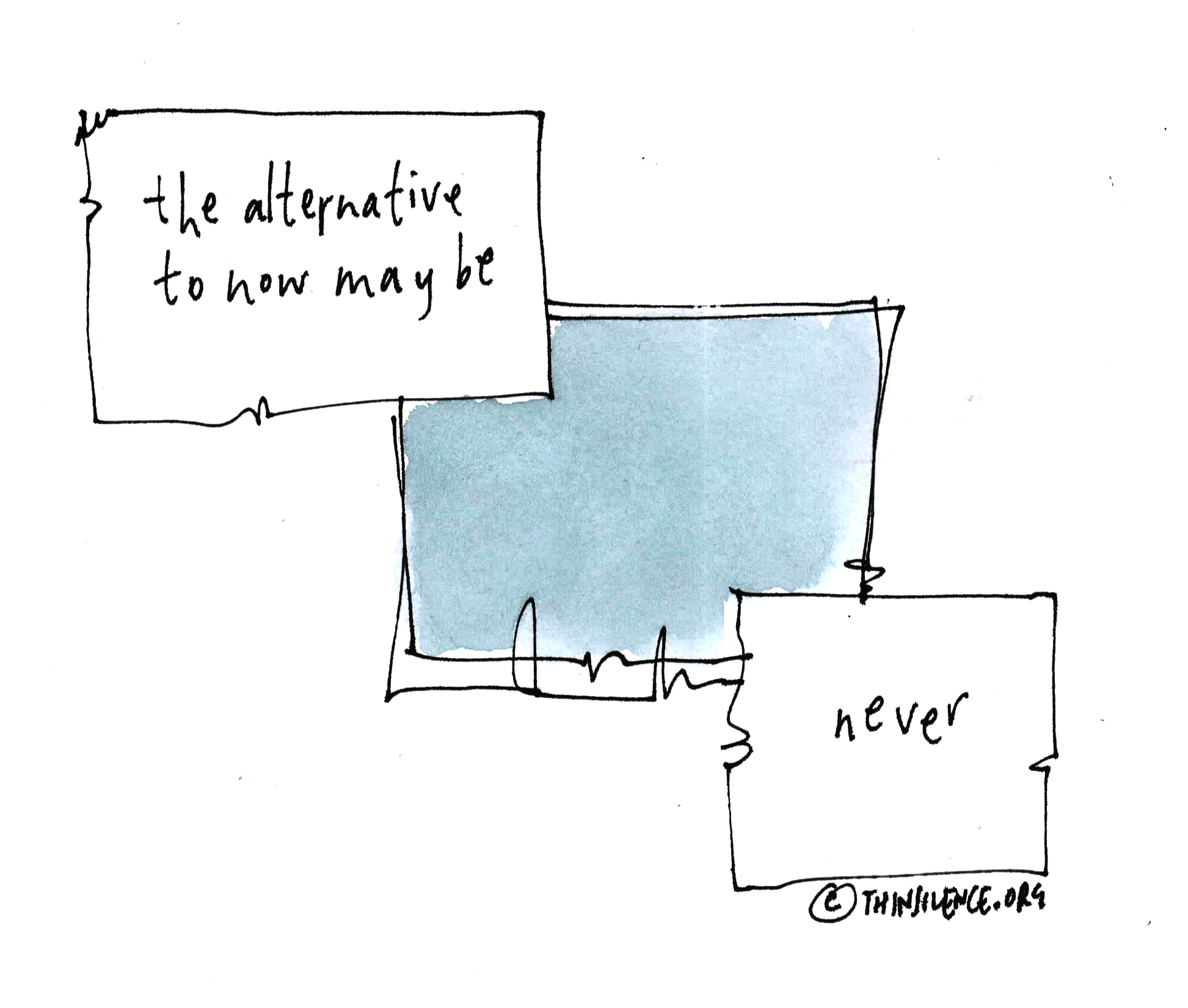
The task of tasks

This doodle is a one-liner

Society wants us to live a planned existence, following paths that have been travelled by others.  Tried and true.  The known, the expected, the controlled, the safe.  The path of the wanderer is not this.  The path of the wanderer is an experiment with the unknown.  To idle.  To daydream.*
Keri Smith

Life had gotten too busy. It seemed as if my existence had become just one long to-do list. I had forgotten about my dreams, my goals, my what-ifs, my what-if-I-coulds.**
Amy Haines

Humans are at their best when
living within a larger story,
Becoming lost or diminished or both
in the ordinary and everyday;
A myth provides wellbeing, provides
the nurture we need to keep developing
throughout our lives as we are capable of;
Joseph Campbell likens this to a joey growing in
their mother’s pouch:
Now, in order to aid personal development,
mythology does not have to be reasonable,
it doesn’t have to be rational,
it doesn’t have to be true;
it has to be comfortable,
like a pouch.^

The psalmist reflects this in declaring:
I have calmed and quieted my soul,
… my soul is like the weaned child that is with me.
O Israel, hope in the Lord from this time on and for evermore.^^

Joseph Campbell outlines how a myth
must function on four levels:
Providing consciousness with a sense of meaning;
Presenting an image of the Cosmos to maintain mystical awe;
Validating and maintaining a certain sociological system;
Psychologically and pedagogically carrying a person through life.

He argues that the
second and third of these have been taken over
by secular orders and so our traditional myths
no longer serve us as we need them to;
We need new myths or to rethink the old,
or a combination of the two if we are to
move into stories of wellbeing,
To a calm and quiet soul:
In contrast to the Western reliance on drugs
and verbal therapies, other traditions around the world
rely on mindfulness, movement, rhythms and action.*^

The psychiatrist Carl Jung decided that he needed to find and
enact his own myth,
Discovering it in building,
Describing it as his “task of tasks,” it led to him
creating his retreat home in Ascona,
A place where many more thoughts and ideas were
to emerge and grow his work.

Jung had returned to his childhood for
the symbols that most spoke to him,
And he found memories of building with small stones
that led him to build with big stones;
Campbell proffers:
The way to find your own myth
is to determine those traditional symbols
that speak to you and use them,
you might say,
as bases for meditation.
Let the work for you.^

In dreamwhispering,
This is what we are about.

*Keri Smith’s The Wander Society;
**Ryder Carroll’s The Bullet Journal Method;
^Joseph Campbell’s Pathways to Bliss;
^^Psalm 131:2-3;
*^Bessel van der Kolk’s The Body Keeps the Score.

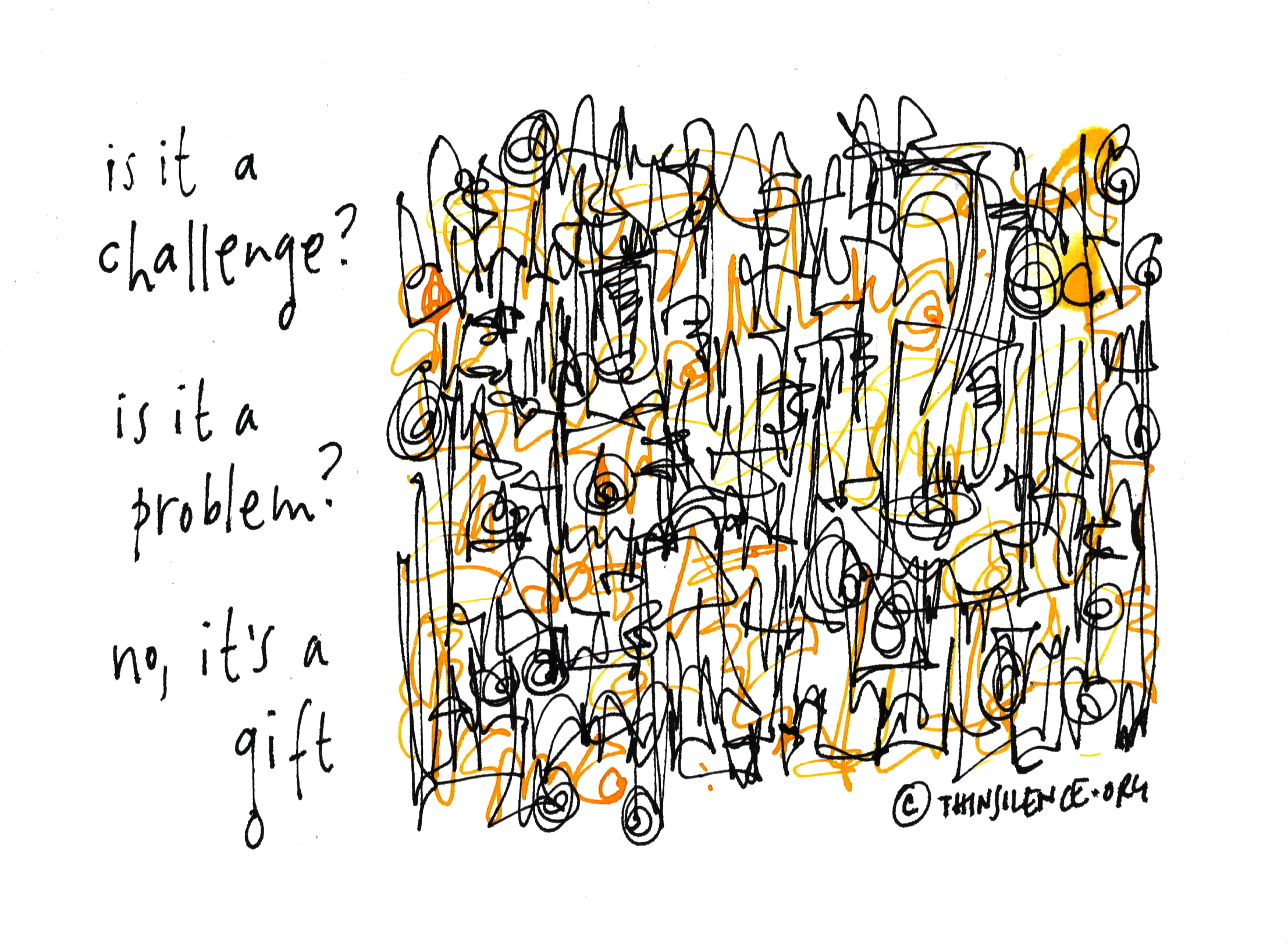
Bountiful

Allow events to change you. You have to be willing to grow. Growth is different from something that happens to you. You produce it. You live it. The prerequisite for growth?: the openness to experience events, and willingness to be changed by them.*
Warren Berger

Clues that you might not be trying hard enough.
You usually succeed.
You rarely feel like an imposter.
You already know what you need to know.
You’re confident it’s going to work.**

Seth Godin

All of this focus on the Self –
Isn’t it unhealthy?

The thing is,
When we focus on who we are then
we notice what we can do,
And that means what we can do for others:
The more we explore who we are,
the more we become invisible.
“When we study the self
it disappears.”^

A true personal myth will lead us to a
truly social myth:
And it is the myth we live for others that satisfies
most of all.

May I live this day
Compassionate of heart,
Clear in word,
Gracious in awareness,
Courageous in thought,
Generous in love.^^

*Warren Berger’s Glimmer;
**Seth Godin’s blog: Clues that you might not be trying hard enough;
^Lewis Hyde’s A Primer for Forgetting;
^^John O’Donohue’s Benedictus: Matins.

Beyond easy

What is the new horizon in you that wants to be seen?
John O’Donohue

Most innovative projects … tend to begin with someone venturing out into the world, looking around, and noticing a problem.
Warren Berger

It’s likely that you and I will need a problem in order to unwrap or break
open
More of who we are:
This is what Jung calls individuation,
to see people and yourself in terms of what you indeed are,
not in terms of all those archetypes that your are projecting around
and that have been projected on you.^

There’s always more, and
easy just won’t do it.

Eventually everyone learns his or her own best way. The real mystery to crack is you.^^

*John O’Donohue’s Benedictus;
**Warren Berger’s Glimmer;

^Joseph Campbell’s Pathways to Bliss;
^Bernard Malamud, from Mason Currey’s Daily Rituals.

4% more

Scientists have … found that to achieve a state of flow, a task must be roughly 4 percent beyond our current ability.*
James Clear

Whether it’s splitting the [bill], getting a project done or making an impact on the culture or a cause, if you want things to get better, the only way is to be prepared to do more than your fair share.**
Seth Godin

We don’t need the conference speaker to ask us
to raise our hands as high as we can
in an experiment,
Only to ask us then to raise them
higher –
We all know that we hold back.

What if, instead of working out ways of holding back,
We experimented with ways of bringing 4% more effort
in a smarter way –
Just 4% out of our comfort zones?

We’d be zooming.^

Let us begin to learn how to bless each other. Whenever you give a blessing, a blessing returns to enfold you.^^

*James Clear’s Atomic Habits;
**Seth Godin’s blog: More than your share;
^‘According to Godin, success requires companies to stifle the “anti-change reflex” and start “zooming” – a term he uses for embracing change and mining “memes,” or ideas operating as the business equivalent of genes.’
^John O’Donohue’s Benedictus.

Play is good for us

I believe a KID WHO IS PLAYING IS NOT ALONE. THERE IS SOMETHING BROUGHT ALIVE DURING PLAY AND THIS SOMETHING, WHEN PLAYED WITH, SEEMS TO PLAY BACK.*
Lynda Barry

So the psychological problem, the way to keep from becoming blocked, is to make yourself – and here is the phrase – transparent to the transcendent.**
Joseph Campbell

We need to play more;
It’s good for us –
We must beware the urgent life that
leaves us alone with seriousness.

Play is transcendent,
And there are as many ways to play as there are people –
That’s the fascinating and exhilarating thing.

*Lynda Barry’s What It Is;
**Joseph Campbell’s Pathways to Bliss.

Now is the future

Now, it’s a basic mythological principle, I would say, that what is referred to in mythology as “the other world” is really (in psychological terms) “the inner world.” And what is spoken of as “future” is “now.”*
Joseph Campbell

We are not made wise by the recollection of our past, but by the responsibility for our future.**
George Bernard Shaw

What many think of as the present
is the past, whilst
others know that what is too quickly dismissed
as the future
is now;
The latter form a space or ritual to
slow down their thinking, their
speaking, their
actioning, to be able to hear
what-can-be before filling
the moment
to overflowing:
In their intense meditation the hidden
sound of things approaching
reaches them and they listen reverently
while in the street outside the
people hear nothing at all.^

*Joseph Campbell’s Pathways to Bliss;
**Seth Godin’s The Carbon Almanac;
^Constantin Cavafy from Nassim Taleb’s Fooled by Randomness.

Special rather than ordinary

Today we don’t have the stasis that is required for the formation of a mythic tradition. The rolling stone gathers no moss. Myth is moss. So now you’ve got to do it yourself, ad lib. … We’re all without dependable guides.*
Joseph Campbell

We are all haunted by something deep inside of us, and often a lot of our best work is the result of us trying to come to terms with that.**

Our existence lies within two worlds:
The ordinary world of everyday things,
And the special world of meaning and significance.

This is far too simple a way of
describing our worlds, for which
I apologise,
It is a starting place only.

Who am I?
is an ordinary world question that has an inkling
there is more to life than meets the everyday eye;
When asked in the special world, this question becomes
Who is my True Self?

What can I do with my life?
is another ordinary world question that is altered
when asked in the special world, becoming
What is my Contribution?

These questions arrive with us from Theory U, but
I have connected them for some time with
Joseph Campbell’s diagnosis that we each are in need
of two myths:
One that is personal and the other social.

The problem is that we struggle to shape
our necessary stories in our fast-moving, noisy busy
ordinary worlds,
And we are constantly frustrated that this is so
(How many of us have wanted to find the answer by the
close of the podcast we have been listening to,
Or the final pages of the self-help book?);
We must enter our special worlds that
very much feel to be interruptions.

Peter Senge wrote of systems-thinking that many problems
do not lie in the obvious or reinforcing loop of the system,
But rather in the hidden or background balancing loop;
Attending to this takes more time and attention,
And so it is often put off or ignored.

What Senge’s systems-thinking highlights is that
our most important questions cannot be properly dealt with
in our ordinary worlds, rather
we must find and journey into our special worlds;
I mention their plurality because
these are different for each of us, though
they contain similar questions and challenges.

What we feed with our time and focus will grow.^


*Joseph Campbell’s Pathways to Bliss;
**gapingvoid’s blog: Spiritual Redemption;
^Beth Pickens’ Make Your Art No Matter What.

Perspective

Our lifetimes are specks in the universe, but they are the longest and only spans of time we will ever know.*
Beth Pickens

As Rilke says: Hier zu sein ist so viel – to be here is immense**
John O’Donohue

Hello again.

My wife and I have just returned
from three weeks of visiting
our daughter and husband
in Australia. so I wanted to leave
three weeks of doodles and quotes
to mix with your daily activities;
The author of Atomic Habits
James Clear writes
The point is to master
the habits of
showing up.^

In the middle of my sixties,
I find myself increasing thinking about
the importance of this daily practising
of turning up;
In two months or so,
I retire from my university work,
And so turning up in this way every day
helps me gain perspective for
what I have, what I can do, how soon life is over, and so,
What matters most of all.

But it’s not only about showing up;
It’s about how we show up –
These moments must contain
transcendence,
And I will be increasingly
exploring and sharing
the importance of myth and story
over these weeks;
As Joseph Campbell reflects:
myth is the transcendent
in relation to the present …
A mythic figure is like the compass that
you used to draw circles and arcs in school,
with one leg in the field of time
and the other in the eternal.^^

I invite you to join me in this journey.

*Beth Pickens’ Make Your Art No Matter What;
**John O’Donohue’s To Bless the Space Between Us;
^James Clear’s Atomic Habits;
Joseph Campbell’s Pathways to Bliss.