The nature of possibility

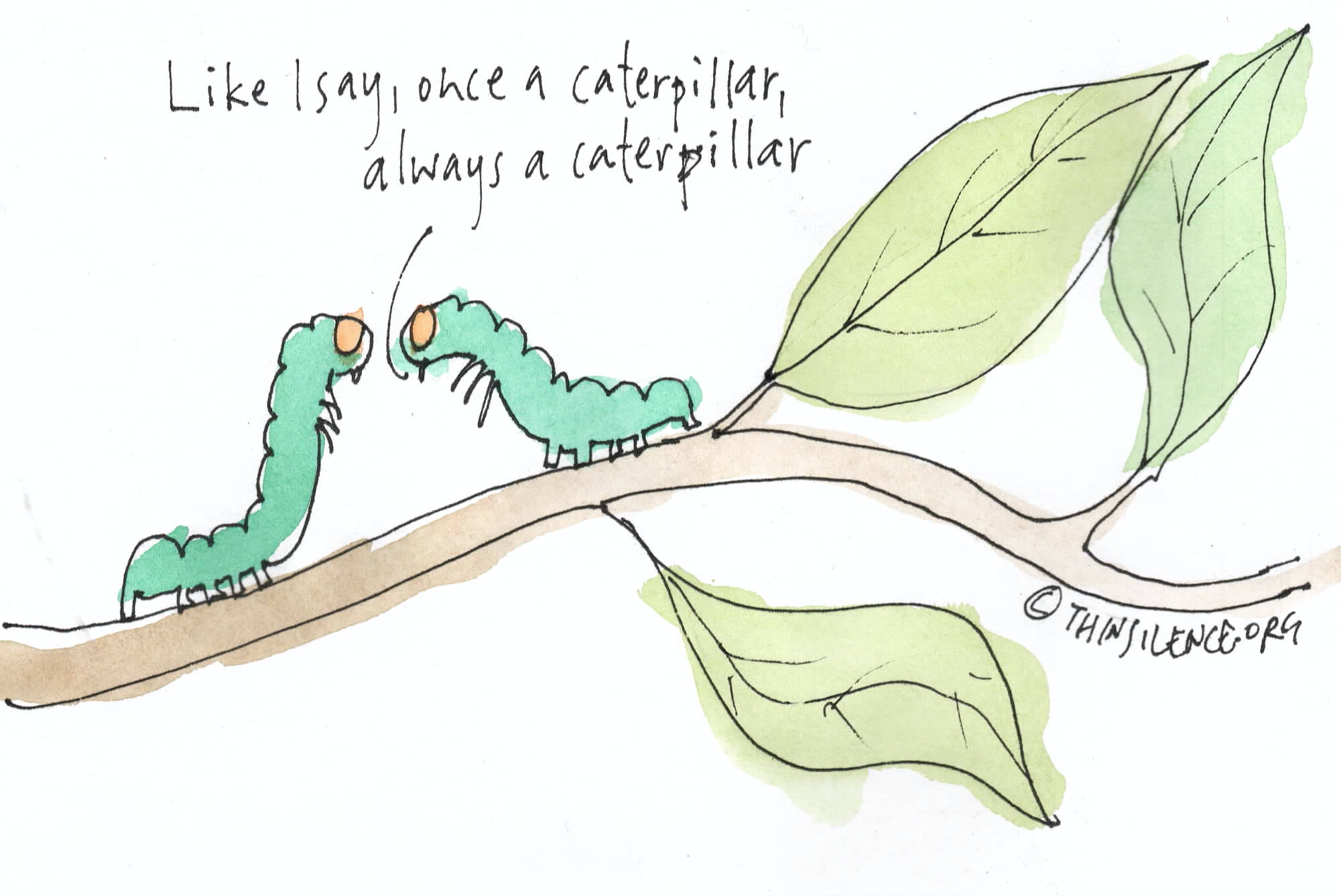
What a caterpillar is doing, in its self–imposed quarantine, is basically digesting itself. It is using enzymes to reduce its body to goo, turning itself into a soup of ex-caterpillar — a nearly formless sludge oozing around a couple of leftover essential organs (tracheal tubes, gut).*
Sam Anderson

They want the things that are truly worth wanting. They elevate their desires. The world tells them to be a good consumer but they want to be the one consumed.**
David Brooks

We resist change.
As Arthur Brooks writes,

Even more powerful than our urge for more is our resistance to less. We try even harder to avoid losses than we do to achieve gains.

He explains how this hard-wiring would make a lot of sense
in the days of our ancestors
when losing some of the little they had was more
life-threatening than obtaining some extra.

David Brooks describes those amongst us who are
willing to take a risk,
Letting go of the life they have
which they admit to be dissatisfying –
Achievement, power, popularity, wealth
(he calls these extrinsic goals the first mountain) –
For something I imagine as
life-in-all-its-fullness
What I often find myself reflecting on as
honour and nobility and enlightenment.

You’ll have spotted why I put the opening quotes
together.
The caterpillar is totally consumed and yet experiences transformation;
This is the nature of possibility
the metamorphosising caterpillar teaches us:

What you experience in the universe outside you also exists in the universe within you. The universe literally flows though you. … The universe has one intention: to create life.^^

This may not be easy,
Or even pleasant,
But it is your nature of possibility.

*Austin Kleon’s blog: Advice from a caterpillar;
**David Brooks’ The Second Mountain;
^Arthur Brooks’ From Strength to Strength:
^^Erwin McManus’ The Way of the Warrior.
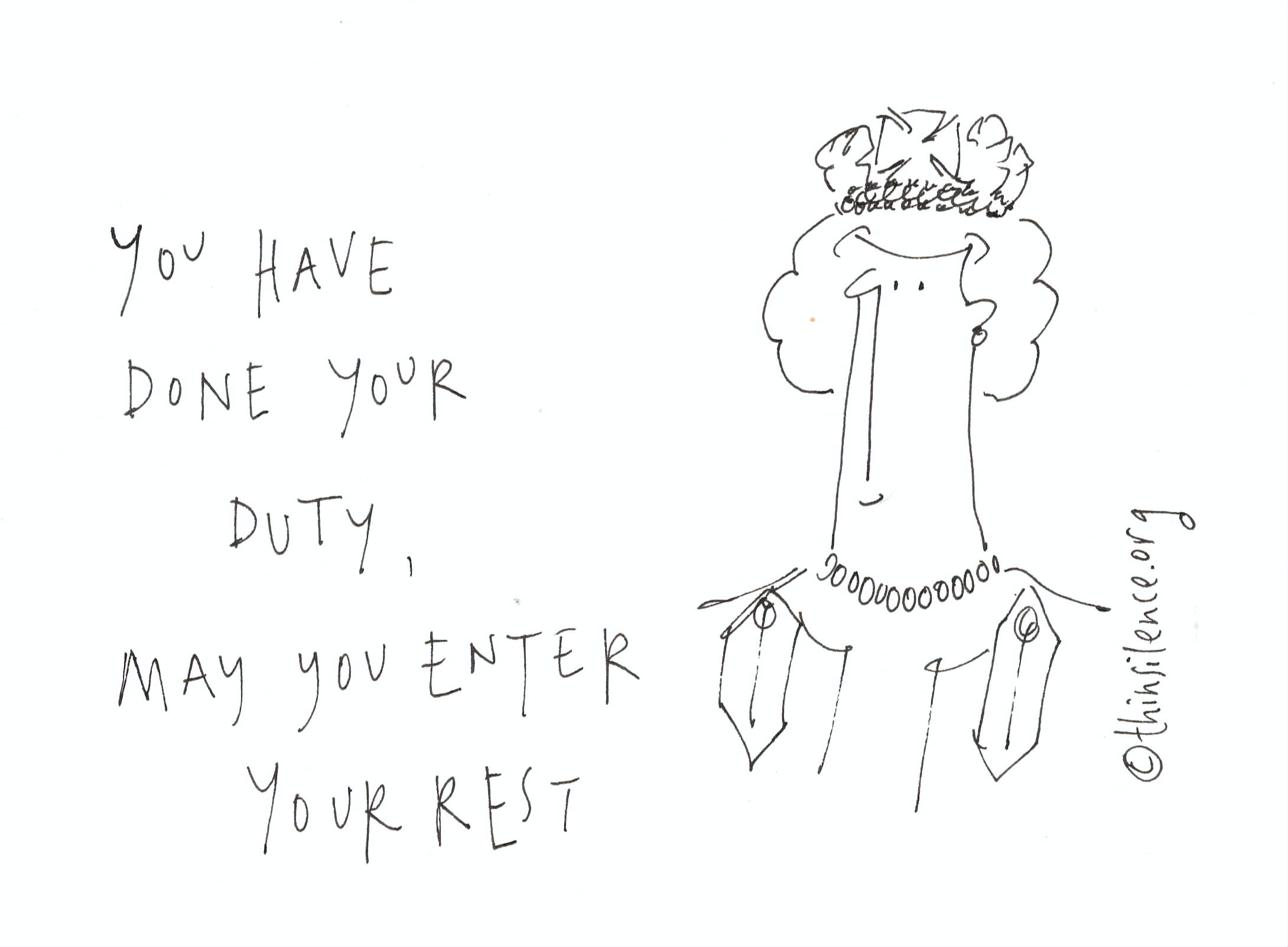
Duty, tick

As in the case of lines, you are likely to stop when you are no longer sure you should go further – at the rear edge of the region of uncertainty.*
Daniel Kahneman

I have fought the good fight, I have finished the race, I have kept the faith.**
The Apostle Paul

You know you will always remember
this moment,
When the news arrives
Where you were,
What you were doing.

Yesterday was such a moment for me:
The news of the passing of Queen Elizabeth II –
Though I am not a monarchist
I’m probably and Elizabethist.

Only two days earlier,
She had been carrying out her constitutional
duties,
Receiving the resignation of one prime minister,
Appointing their successor.

We each have duties,
Shaped by who we are
and the constraints of where we are.

Erich Fromm reflects
in his 20th century way:

When man is born, the human race as well as individual, he is throw out of a situation which was definite, as definite as the instincts, into a situation which is indefinite, uncertain and open.^

Through the abdication of her uncle,
Elizabeth would one day become Queen.
Who imagined in
1936
that she would still be reigning in
2022;
We might conclude, constraints and skill can lead to something
significant.

I cannot imagine myself making
96,
But each day,
I want to do my duty.

I like to think Queen Elizabeth had some fun along the way:

Here in 2012,
And again in 2022

Rest in peace, Ma’am.

*Daniel Kahneman’s Thinking, fast and Slow;
**2 Timothy 4:7
^Erich Fromm’s The Art of Loving.

The aide memoire

A gift is something for nothing except that certain obligations are attached.*
Robin Wall Kimmerer

In the most elegant complexity possible, everything in creation exists not for itself but for everything connected to it.**
Erwin McManus

Arthur Brooks has been helping me to move on
from fixating on a desire to be remembered
after I am gone,
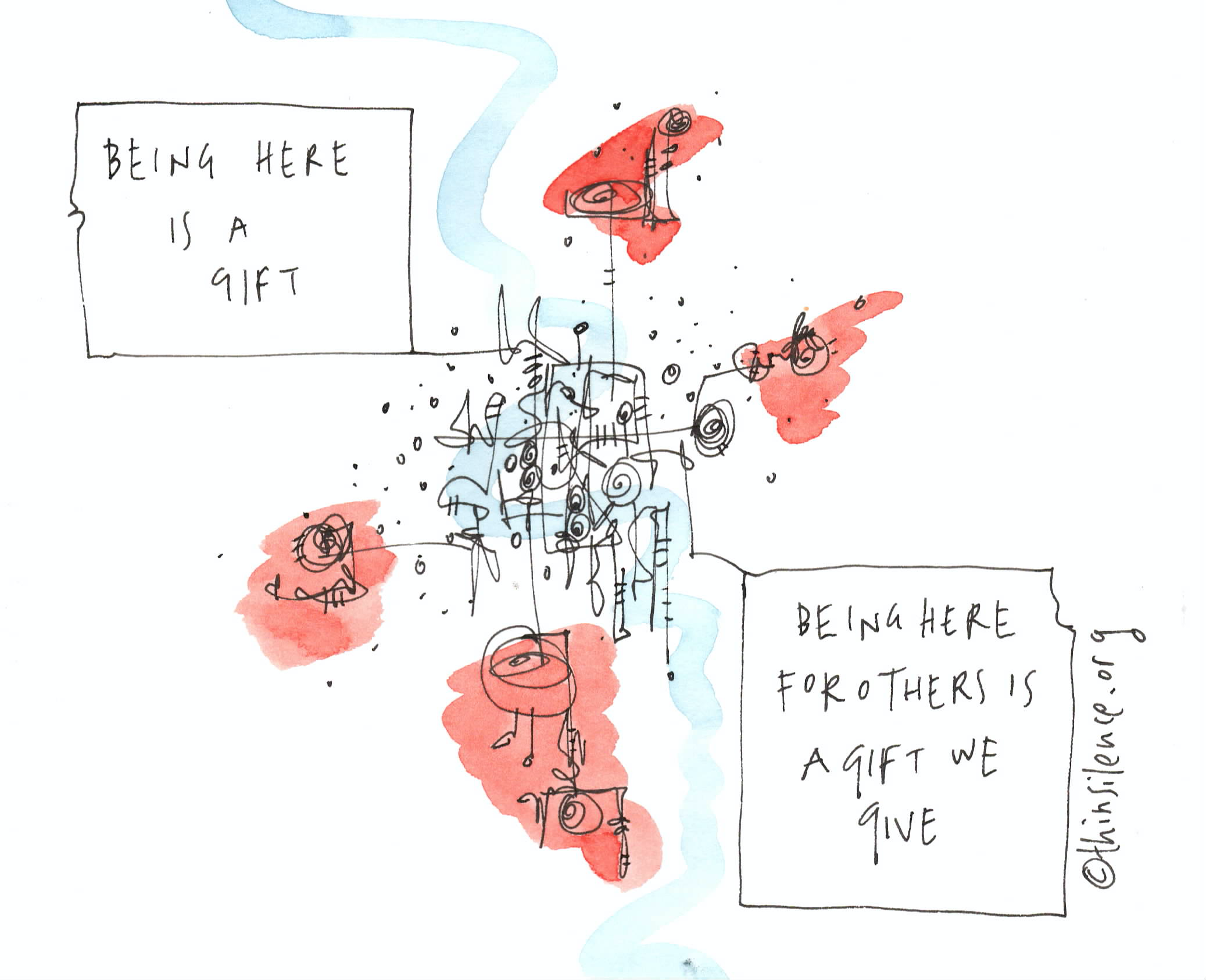
To being a gift to others whilst I am here:

The true master, when his or her prestige is threatened by age or circumstance, can say, “Don’t you see that I am a person who could be utterly forgotten without batting an eye?”^

This sense of being a gift is captured by John O’Donohue’s blessing:

Awaken to the mystery of being here and enter the quiet
immensity of your own presence. …
Respond to the call of your gift and the courage to follow its
path.^^

Whilst this may sound a solitary occupation,
it is anything but.
Even the introvert is part of a community,
A vast interconnectedness;
It’s just a different kind to the
extrovert’s.

Whilst I’ve been journaling this morning,
I have been accompanied the people in the footnotes, plus
Some Biblical writers,
Seth Godin,
Nick Cave,
Tom Vanderbilt,
Trishna Singh,
Lynda Barry,
James Clear, and
Angela Duckworth.

Lewis Hyde reminds me,
To be the gift to others
is more than simply the thing we offer,
It is also spirit and community.*^

And the aide memoire?
That’s me,
Helping you remember what a
gift you are.

*Robin Wall Kimmerer’s Braiding Sweetgrass;
**Erwin McManus’ The Way of the Warrior;
^Arthur Brooks’ From Strength to Strength;
^^John O’Donohue’s Benedictus: For Presence;
*^Lewis Hyde’s The Gift.

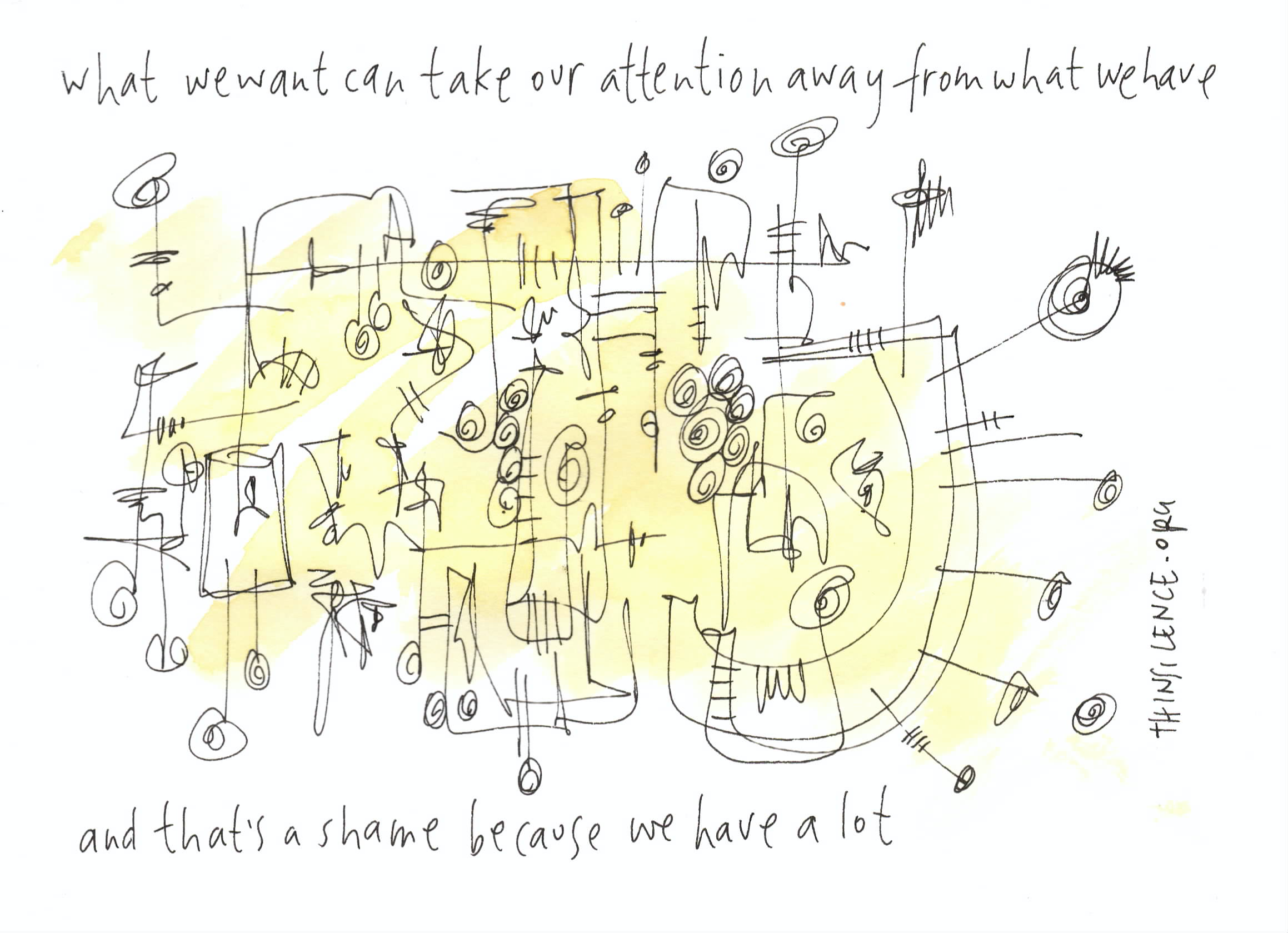
Haves and wants

The way we store energy is through our desires, values, passions, hopes, dreams, aspirations, and ultimately our greatest capacity is through what we love. … I have come to realise that people do not bring the same level of energy with them.*
Erwin McManus

Satisfaction = What you have ÷ what you want**
Arthur Brooks

Arthur Brooks holds that
if our satisfaction depends on
money
power
pleasure
and honour
then we’re in trouble.

Perhaps take a moment to reflect on his formula for satisfaction:
I certainly feel its wisdom.
How true has this been in your own experience?

Anna Katharina Schaffner,
In reflecting on more than two thousand years of self improvement,
Notices a change:

In the self-improvement literature of the past, the emphasis was placed on the virtues. Yet reflections on goodness have all but disappeared from modern self-help. Our focus tends to be on personality rather than character and our effectiveness in achieving successful careers.^

You may have spotted the transition in this sentence,
How self improvement has become self-help,
How focus on the inward is replaced by a greater concentration
on the outward.
Brooks reflects on the negative impact for us, how

Self objectification lowers self-worth and life satisfaction.**

Erwin McManus offers us plenty of starting places
for noticing just how much we already have.
Even grabbing two minutes to ponder these today
will begin to make a difference:

May the Angel of Encouragement confirm you
In worth and self-respect,
That you may live with the dignity
That presides in your soul.^^

*Erwin McManus’ The Way of the Warrior;
**Arthur Brooks’ From Strength to Strength;
^Anna Katharina Schaffner’s The Art of Self Improvement;
^^John O’Donohue’s Benedictus: A Blessing of Angels.

A certain person

What do Drawing Singing Dancing Music MAKING Handwriting Playing Storywriting Acting Remembering and even Dreaming all have in common? THEY COME ABOUT WHEN A CERTAIN PERSON IN A CERTAIN PLACE in a CERTAIN TIME arranges CERTAIN UNCERTAINTIES INTO A CERTAIN FORM*
Lynda Barry

May you have the wisdom to enter generously into your own unease.
To discover the new direction your longing wants to take.**

John O’Donohue

There are many things you do not know,
But what you do know that you are the person
who MUST do this …
And this is the time,
And this is the place.

*Lynda Barry’s What It Is;
**John O’Donohue’s Benedictus: For Longing.

Never too late

I wish I could draw.
I wish I could write.
I wish I could dance.
I wish I could sing.
I wish I could act.
I wish I cold play music.
I wish I could be funny.
By the 5th Grade most of us knew it was already too late.*

Lynda Barry

May the Angel of Wildness disturb the places
Where your life is domesticated and safe,
Take you to the territories of true otherness
Where all that is awkward in you
Can fall into its own rhythm.**

John O’Donohue

Your head may be saying that
it’s too late,
But your heart is still hoping
to a different beat.

Just take a moment to listen.

*Lynda Barry’s What It Is;
**John O’Donohue’s Benedictus: A Blessing of Angels.

Reinventions

Devote the back half of your life to serving others with your wisdom. Get old sharing the things you believe are most important.*
Arthur Brooks

May the Angel of Awakening stir your heart
To come alive to the eternal within you,
To all the invitations that quietly surround you.**

John O’Donohue

Yesterday
I noted two intelligences at work in our lives:
The fluid KIND that wanes as we grow older,
And the crystallising sort that we are able to harness
fruitfully
Into the larger numbers of our years.

It could perhaps be said
that fluid intelligence leads to inventions
but crystallising intelligence leads to reinventions
beginning with ourselves.

The world is richer for it.

Brooks aligns fluid intelligence with a first curve of creativity
and the crystallising kind with a second,
But I’d even go as far as to suggest –
For those of us who strongly suspect we missed out on the first curve –
Here is another opportunity of a different kind.

*Arthur Brooks’ From Strength to Strength;
**John O’Donohue’s Benedictus: A Blessing of Angels.

Late developers

I invented ideas early on; I synthesise ideas – mine and others – now.*
Arthur Brooks

God looks down from heaven on humankind to see if there are any who are wise … .**

After reading yesterday that I went
into decline a long time ago,
Arthur Brooks now informs me that
the reason for this is a decline in my fluid intelligence.
He continues with some good news;
There is also crystallising intelligence –
By which I use the knowledge I learned in the past.

This straightaway piques my interest for two reasons:
This sounds a lot like wisdom –
Living what we know into
life-in-all-its-fullness;
It also echoes Theory U’s^ discovering of our
crystallising intent –
What it is we ultimately want to bring into the world
through our lives.

I read on a little further
and there it is:

When you are young, you have raw smarts; when you are old, you have wisdom. When you are young, you can generate lots of facts; when you are old, you know what they mean and how to use them.*

And this kind of intelligence
need not decline.

*Arthur Brooks’ From Strength to Strength;
**Psalm 53:2;
^Otto Scharmer’s Theory U.

Beyond 10,000 hours

I’ve heard people say it takes 10,000 hours to master your style or your line or something, but to be honest I think it takes 10,000 hours to become boring and mediocre. The moment you master something is the moment you stop being creative.*
Gareth Brookes

When did you first notice you were bad at something? And then what happened?**
Lynda Barry

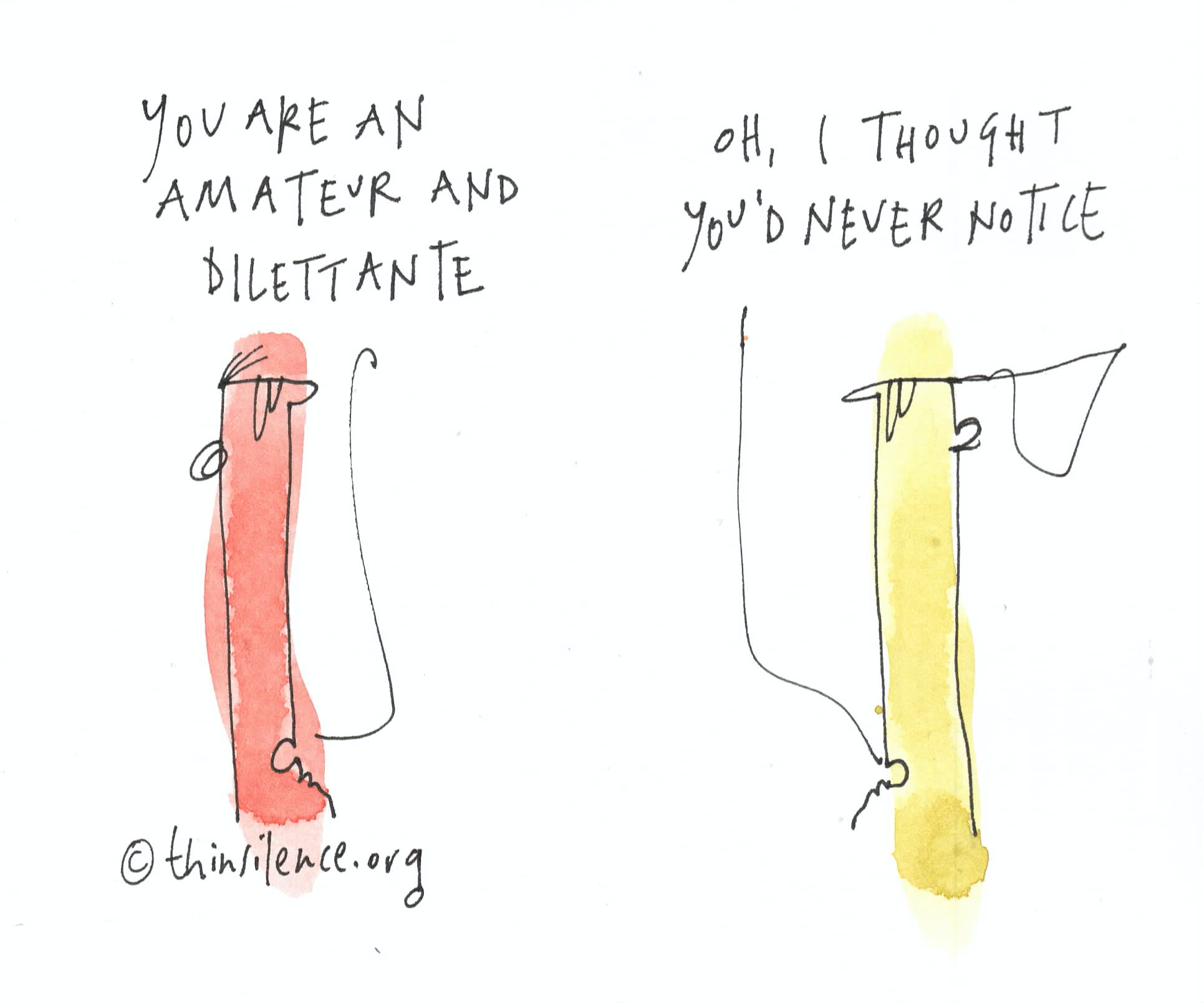
Dilettante, from the Italian dilettare, meaning “to delight.”

Amateur from the French aimer, meaning “to love.”

Arthur Brooks suggests our decline comes sooner than we think:^
For athletes it comes the soonest,
But even for scientists and musicians
it arrives in the mid-forties
or a little later at best.

This is not good news for me,
Tracing, as I do,
My starting point to forty five.

If you’ve read Malcolm Gladwell’s Outliers
you’ll be well-versed in how ten thousand hours works,
But it has never made sense to me as a destination;
Passion and competency and grit have brought us here for
WHAT NEXT?

To answer Lynda Barry’s question,
There were things I always thought I was bad at,
But it was only in my late forties to early fifties that I came to
admit
I wasn’t very good at the things my work included,
Or at least it felt like that.
Whatever the reality, it became a starting point
for what really matters to me
and is open-ended,
The things I love and delight in.

You were made and set here to give voice to this, your own astonishment.^^

*From The Comics Journal: If the Marks are Perfect How Can You Relate to Them?;
**Lynda Barry’s What It Is;
^Arthur Brooks’ From Strength to Strength;
^^Annie Dillard, quoted in Rob Walker’s The Art of Noticing blog; Olfactory work
.

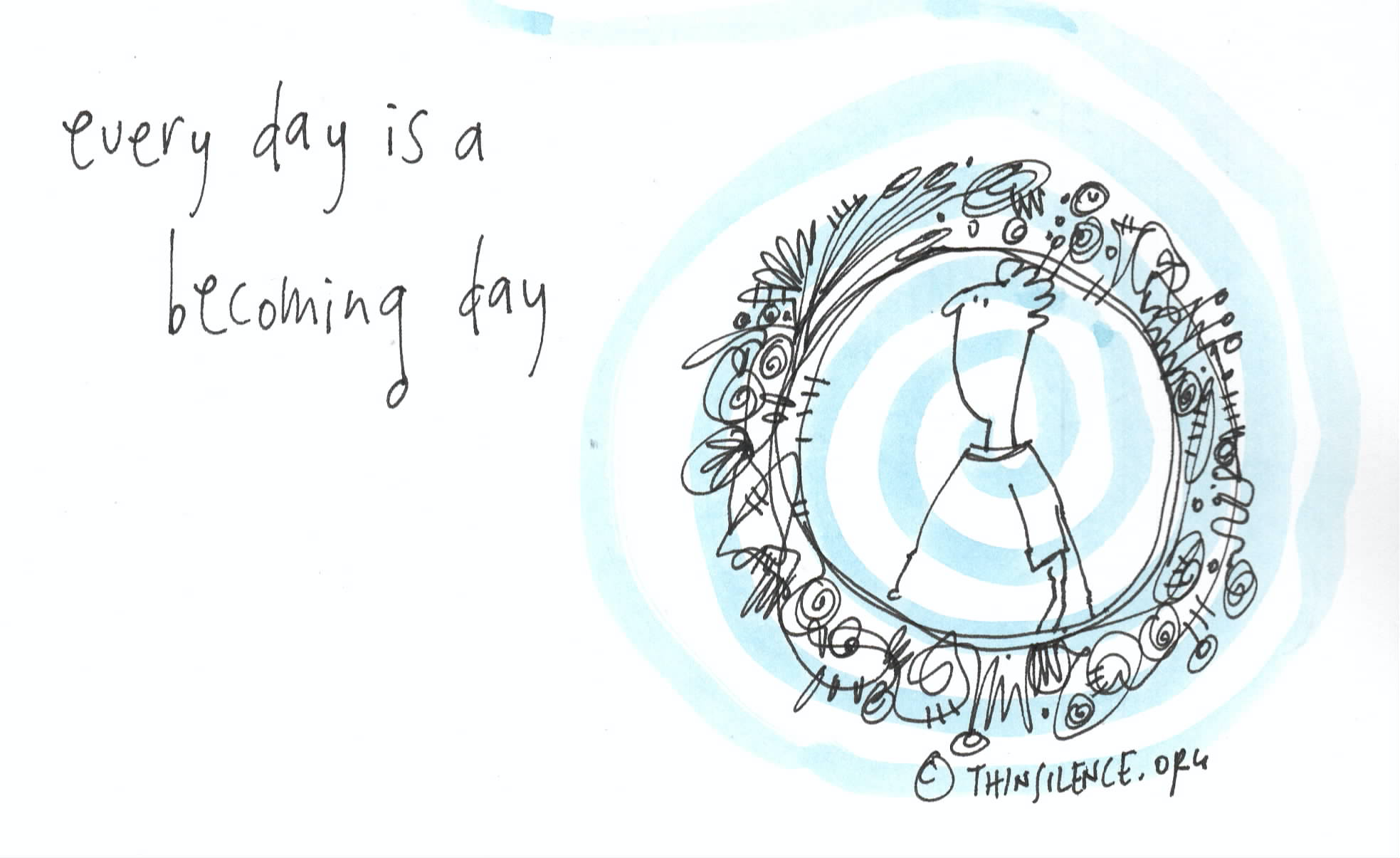
It’s becoming day

Being of any reasonable sort appears to require limitation. Perhaps this is because Being requires Becoming, as ell as mere static existence – and to become is to become something more, or at least something different.*
Jordan Peterson

True humility can be experienced only when we have come to know our power and use it for the good of others, and not for ourselves.**
Erwin McManus

We don’t get to feel better about ourselves by putting
down others.
The way of becoming is a better way,
And we can include helping others to become
and see what happens.

*Jordan Peterson’s 12 Rules for Life;
**Erwin McManus’ The Way of the Warrior.