Decisions decisions

What lies behind us and what lies before us are tiny matters to what lies within us.*
Henry Stanley Haskins

By heart I mean the place where emotions meet reason, mobilise the will, and shape identity.**
Alex McManus

There are tens of thousands of decisions to be made every day. Some are very small, whilst others have a size about them that will take us towards or away from the person we ca be and the things we are capable of doing.

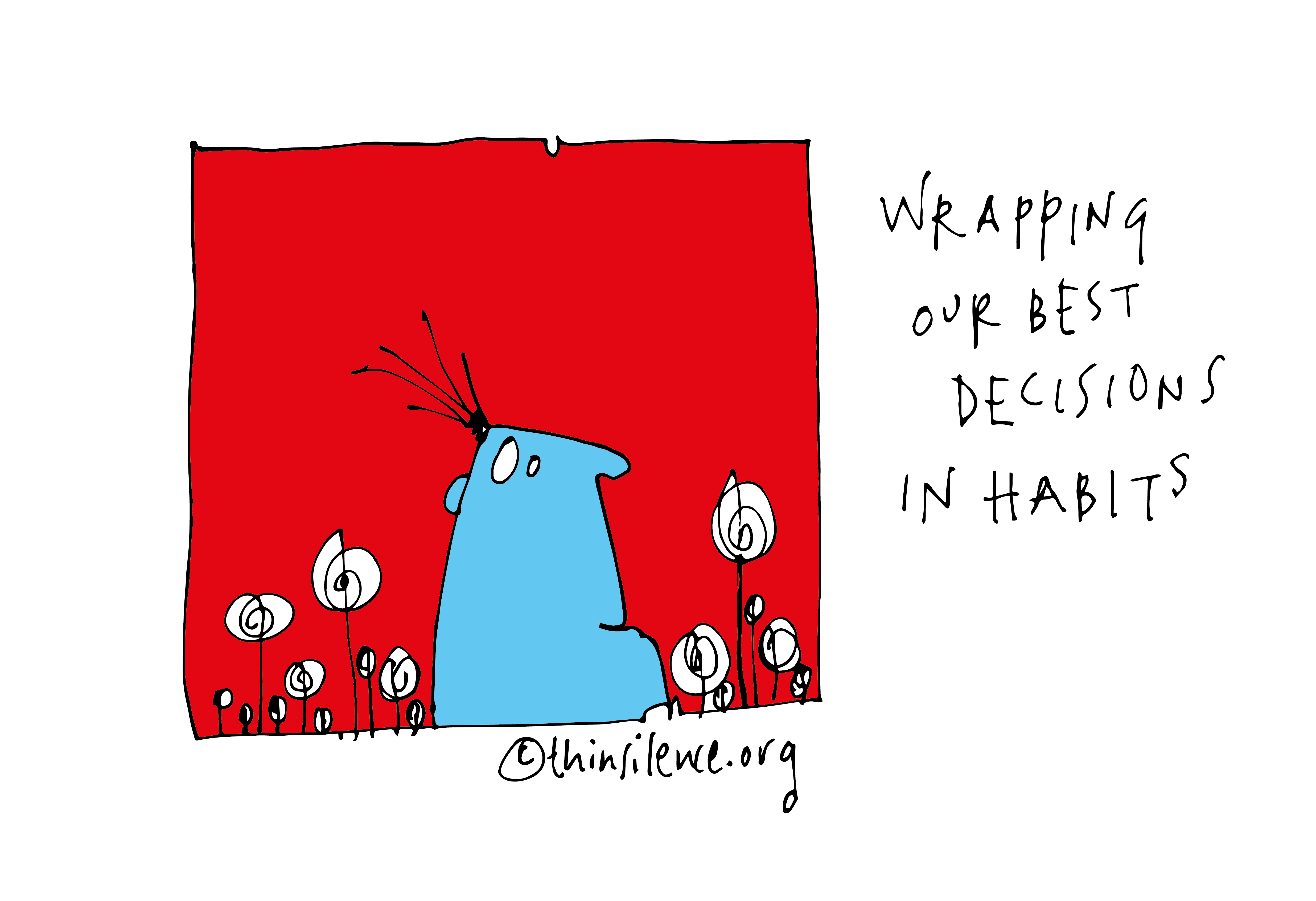
Perhaps the most critical are those we make at the very beginning of a day, the ones we have wrapped in habits that align us to our most important hopes and dreams.

These also form a space in which we are able to find recovery from our bad decisions.

*Henry Stanley Haskins, quoted in Sunil Raheja’s Dancing with Wisdom;
**From Alex McManus’ Makers of Fire.

The tune-up

A counter-offensive on our social emphasis on feeling good and looking good at the expense of living good.*
Kirk Strosahl

Or perhaps it’s not the software or the hardware that needs tuning. Perhaps it’s our attitude, our approach to work, the way we deal with possibility…**
Seth Godin

I’m a spring and summer person.

I am suspicious of autumn, knowing that it’s trying to hide winter from me.

It’s not that I hate winter, but I am nevertheless arrested by Katherine May’s words:

Once we stop wishing it were summer, winter can be a glorious season when the world takes on a sparse beauty, and even the pavements sparkle. It’s time for reflection and recuperation, for slow replenishment, for putting your house in order.^

I can’t change or avoid winter but I am able to change rather than avoid my attitude: I have the capacity to make a space for it in my life.

Who knows what might happen.

Maybe I’ll even start on that second book I have a mind to write and doodle.

When we make space through compassion and understanding for the more difficult things in life as well as those we welcome, life can open up in the ways we want it to.

Kirk Strosahl adds:

If we are pursuing what we want to in life we’re not going to be experiencing mental health problems.*

It’s a bold statement, but it aligns with the truth that trauma separates us from the things we really want to do, and we must reconnect with what is most important to us – so that we regain our integrity or oneness, our singleness.

As I’ve suggested on many occasions, journaling can be a way for us to retune ourselves to what matters most:

Julia Cameron’s morning pages help unlock something inside. Not the muse or a magical mystical power, but simply the truth of your chosen identity. If you can do something creative each day, you’re now a creative person. Not a blocked person, not a striving person, not an untalented person. A creative person.^^

*Kirk Strosahl, from Psychwire’s course: ACT as Brief Intervention;
**From Seth Godin’s blog: Do you have a tuner;
^From Katherine May’s Wintering;
^^From Seth Godin’s The Practice.

Homeward

An individual who has become a person has staged a rebellion. She rebels against the individualistic ethos and all the systems of impersonalism.*
David Brooks

Martha Beck writes about the way of integrity we need to find our way back to: that is, our intactness.

Cynthia Bourgeault writes about “singleness,” becoming one with our imaginal self: the fullness of the person we can be.

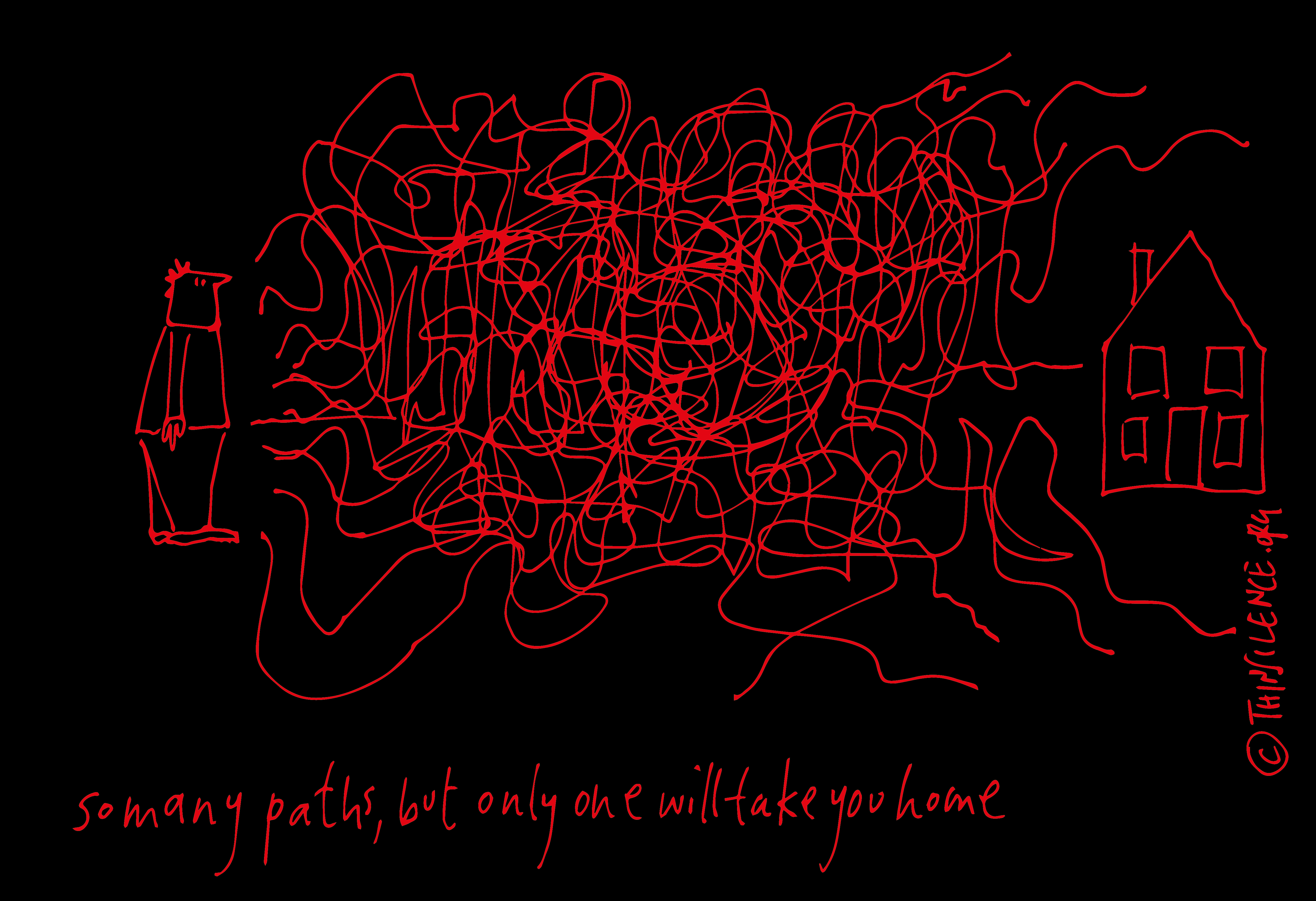
Integrity and singleness are about finding our way home.

They are not alone in bearing witness to the existence of a path that leads us from our present to a different future, a path that contemporary society doesn’t feel it needs to inform us about (not least because it cannot place a value on it), a way that is not continuation or extension, but is transformative, and this over and over.

When we find our own path – we cannot walk another’s – we will also find our guides and become guides to others who will find us.

This is possible because, whilst each path is unique, they contain elements that are found in all.

We are the product of a highly individualistic society and may baulk at the idea of being guided, David Brooks warns and exhorts when he writes:

A hyper individualist sees the individual as a self-sufficient unit; the relationist says, a person is a node in a network, a personality in a movement toward others.*

The true guide understands that the person who will know your way best of all is you, and they will aim to help you to trust what emerges from your heart; they also know that you will have things to share with them that will help them on their own path: it’s two-way.

The human soul is hungry for beauty; we seek it everywhere – in landscape, music, art, clothes, furniture gardening, companionship, love, religion and in ourselves. No one would desire not to be beautiful. When we experience the Beautiful, there is a sense of homecoming.**

*From David Brooks’ The Second Mountain;
**From John O’Donohue’s Divine Beauty.

Heart treasure

“Connais-toi pour t’ameliorer” (“Know yourself to improve yourself”).*
Alain de Botton

When you get past making labels for things, it is possible to combine and transform elements into new things. Look at things until their import, identity, name, use, and description have dissolved.**
Corita Kent

We give up on our potential long before it gives up on us.

Let us fill our hearts with good and hopeful and generous words from many places and many people every day.

May we wrap these in a daily practice of our own invention and be open to see what emerges in thousands of new actions and words.

What if we made this our exploration for the upcoming new year?

*From Alain de Botton’s Religion for Atheists;
**From Corita Kent and Jan Steward’s Learning by Heart.

But I want a lightening bolt

good art is the sensuous presentation of those ideas which matter most to the proper functioning of our souls – and yet which we are most inclined to forget, event though they are the basis for our capacity for contentment and virtue*
Alain de Botton

Though so much else is in motion in the mind and the senses the hidden heart never loses sight of us. If we can ever feel lost or overwhelmed, all we have to do is become still and listen ins to our heart and we will soon find exactly where we are.**
John O’Donohue

There’s a story about the Older Testament prophet Elijah, who, having lost direction and forgetting what he had to do, wanders his way to the mountain of God and hides in a cave.

God finds Elijah there and promises to be present to the struggling messenger.

There ensues an earthquake, storm-wind, and fire, but he doesn’t recognise God in any of these.

Then follows a sheer, or thin, silence and when the prophet exits the cave there’s God waiting to recommission him.

We all lose our way, but when we’re tempted to want something dramatic to find our bearings and what it is we must do, the best way is to remember to fall into silence so that we might hear the beating of our own heart.

It is about discovering and living all that we are intended to be, with awe and wonder.^

*From Alain de Botton’s Religion for Atheists;
**From John O’Donohue’s Benedictus;


^From Sunil Raheja’s Dancing with Wisdom.

Finding faith

When you lead without compensation, sacrifice without guarantees, when you take risks because you believe, then you are demonstrating your faith in the tribe and its mission.*
Seth Godin

All you have is what you are and what you give.**
“Shevek”

You are enough.

Attach this to faith and you will begin.

I’m saying this to myself, but you’re welcome to borrow it.

*From Seth Godin’s Tribes;
**Ursula Le Guin’s character Shevek, quoted in Maria Popova’s The Marginalian: Ursula K. Le Guin on Suffering and Getting to the Other Side of Pain.

Open for wonder

Awe is the feeling we have when we encounter the monumental or immeasurable. We experience a sudden shrinking of the self, yet a rapid expansion of the soul.*
Nick Cave

When we shift our mindset and open ourselves to the awe of daily life, we may find that opportunities to be wowed are all around us.**
Jonah Paquette

More often than not to be in awe is a choice I make.

Yes, I can wait for something incredible and breathtaking to happen: some natural occurrence or  human encounter, but wonder is all around me, hidden when I rush, get busy  or consume.

Jonah Paquette suggests learning awe-inspiring facts as a place to begin returning to awe: how we live in a galaxy potentially containing 500 million “Goldilocks” planets like our own (plenty of scope for Star Trek’s scriptwriters), and how there are some 170 billion galaxies in the observable universe.

But it’s not only about looking outwards.

I’m fascinated by the wonder to be found in people’s lives and how it is possible to grow ourselves through wonder and awe: the things we are curious about that grow into interests and pursuits, firing our imaginations and leading us into creativity.

I have rewritten the next lines a few times, trying to find the words that connect wonder, art and work together in a way that doesn’t make me sound naïve. 

Rainer Maria Rilke connects art and work, confessing:

I long so impatiently to get to work, to begin my workday, because life can become art only once it has become work.^

Corita Kent understood how we all get to be artists:

The root meaning of the word art is to fit together and we do this every day.^^

That we do not easily see ourselves to be artists with the the possibility of joining wonder and art and work together should not surprise us.  We must first enter into the wonder of just who we are:

One of the most important parts of growing up is to see ourselves as we really are instead of assuming we are what our parents and teachers told us we were.^^

Elsewhere, Mihaly Csikszentmihalyi touches upon the way we see and understand ourselves as being critical to how we come to the work we perform:

Whether a job has variety or not ultimately depends on a person’s approach to it than on actual working conditions.*^

There are terrible jobs out there, for sure, but a little like the flight instruction to put your oxygen mask on first, we must open ourselves to the journey that leads us from wonder to creativity.

In leading into the remark, above, Csikszentmihalyi had written:

But originally “amateur,” from the Latine amare, “to love,” referred to a person who loved what he was doing. Similarly, “dilettante,” from the Latin delectare, “to find delight in,” was someone who enjoyed a given activity.*^

Love and delight are the fruit of wonder and awe, capable as we are of turning what we pay attention to into something different with artistry and joy, this beyond job roles, as we define ourselves as alchemistic creatures.  Sunil Raheja says it well when he proffers:

It is about discovering and living all that we are intended to be, with awe and wonder.^*

Austin Kleon offers a place before wonder that we may want to use as a place to begin – awe is a choice we make:

Try sitting in the same place at the same time for the same length of time every day for a month and see if anything happens.⁺

What might we fill this time with: silently gazing, reading, journaling, drawing, walking a familiar path slowly, or some combination of these?

*From Nick Cave’s newsletter: The Red Hand Files: Issue 157;
**Jonah Paquette’s article for the Wise Brain Bulletin:
Mind Bending Awe;
^From Rainer Maria Rilke’s
Letters on Life:
^^From Corita Kent and Jan Steward’s
Learning by Heart;
*^From Mihaly Csikszentmihalyi’s
Flow;
^*From Sunil Raheja’s Dancing with Wisdom;
⁺From Austin Kleon’s blog:
On praying, whether you believe or not.

There are no ordinary people*

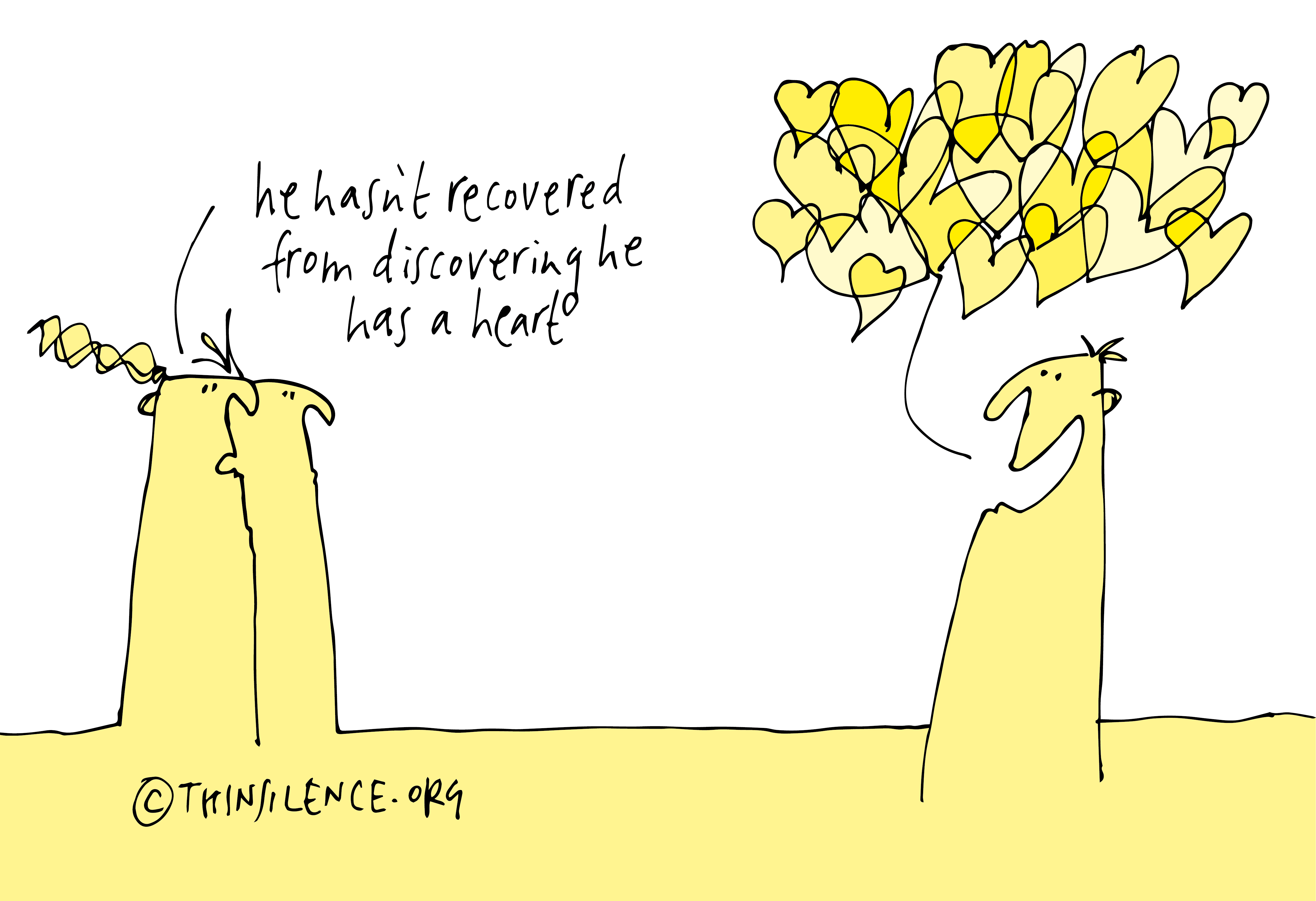
With the senses, we see, hear, taste, smell and touch the world, drawing its mystery inside us. With the mind, we probe the eternal structures of things. With the face, we present ourselves to the world and we recognise each other. But it is the heart that makes us human. The heart is where the beauty of the human spirit comes alive. Without the heart, the human would be sinister.**
John O’Donohue

Every day we have opportunities for becoming more human.

Our day are filled with the many challenges and encounters that make it possible to explore living with heart. To repeat yesterday is to be in danger of cliché:

Clichés grow in the barren mind of the lazy writer. … Create a story that only you could write.^

Such a personal story takes a lifetime to write and, even then, is unlikely to be unfinished.

Perhaps Cynthia Bourgeault provides us with three practices towards such a tale when she writes:

The “letting go” of kenosis [emptying] is actually closer to “letting be” than it is to any of its “non-” equivalents (nonclinging, nonattachment, nonidentification and so forth); its flow is positive and fundamentally creative. … Abundance surrounds us and sustains us like the air we breathe; it is only or habitual self-protectiveness that prevents us from perceiving it. … To experience abundance is essentially to see from oneness^^

Emptying, abundance and oneness: not holding tightly to the person we were up until yesterday; being open to the pleroma or abundance experienced through all people and things which may bring invitations to live in new directions; and, bringing our mind and heart and will together as one so that we may move in the direction of fullness.

*C. S. Lewis, quoted in Sunil Raheja’s Dancing With Wisdom;
**From John O’Donohue’s Benedictus;
^From Robert McKee‘s newsletter: Why Story Needs Your Unique Vision;
^^From Cynthia Bourgeault’s The Meaning of Mary Magdalene.