The untrue inside the true

The goal could be to become useful, remarkable and worth seeking out. To do something that’s hard to replace, groundbreaking or thrilling. Generous work that makes things better.*
(Seth Godin)

Blessed are the meek, for they will inherit the earth.**
(Jesus of Nazareth)

Humility is most accurately about knowing ourselves and what it is we can do, including how we can continue to grow and what we are able to imagine and aspire to.

Rainer Maria Rilke writes about not waiting for circumstances to be right but to become people the people who begin whatever these may be:

Not to wait (which has been happening until now) for powerful things and good days to turn you into something but to preempt them and to be it yourself already: this is what you ought to be capable of at some point.^

Some time ago, I was having problems in my work and I felt like giving up, but I made the decision not to blame the circumstances or the people who made these but to take responsibility. Many years later I would read:

The real block is inside the true one. The real problem is the untrue limiting assumption smirking in there […].^^

Nancy Kline’s words point to the untrue assumption that lies behind the true, and helps me to make more sense of how I was right not to assume everything was okay in me, even though my reading of my situation was pretty accurate. This allowed me to start out on a path of necessary personal development and creating the work I love to do, a path I still find myself on twenty two years later.

Your reading of circumstances may be accurate and true, but that won’t help you. Look within and find the untrue assumption about who you are and what you can do that is preventing you from being the only you and bringing your art into the world.

Replace the untruth with the truth.

(*From Seth Godin’s blog: It turns out that “beiger” isn’t a word.)
(**Matthew 5:5)
(^From Rainer Maria Rilke’s Letter on Life.)
(^^From Nancy Kline’s More Time to Think.)
Scale and scalability

Once you realise that you can improve, amplify and refine the things that other people call attitudes, you may realise that they are skills.*
(Seth Godin)

Scale was a term initially used solely to indicate differences in size: It was felt that the scale of a cathedral had to be different from that of a village church […]. Only when the notion of scale was applied to production technologies was an increase in scale perceived as an increase in effectiveness […].**
(Ursula Franklin)

Some people want to be a person of scale; they want to be big.

Which mean other people have to be small.

Other people want to awaken their scalability, improving, amplifying and refining who they are.

They are only happy when those around them are pursuing the same.

The former are a hangover from when kings and queens ruled the world. They are yesterday’s people.

The latter are a picture of our future and the challenge we have to extend this to more and more in our world.

It seems Rainer Maria Rilke was ahead of his time when he perceived a future where we would value the person:

The more human we become, the more different we become. It is as if suddenly human beings would multiply a thousandfold. A collective name that used to be sufficient for thousands will soon be too narrow for ten human beings, and we will be forced to consider each human being entirely on his own.^

Here are some scalable skills to try out:

Playfulness
listening deeply
seeing more
wandering
doodling.

(*From Seth Godin’s blog: Attitudes are skills.)
(**From Ursula Franklin’s The Real World of Technology.)
(^From Rainer Maria Rilke’s Letters on Life.)

Reach

To be close to another person who holds opposing views while being a deep, committed friend can be a wonderful, shaping influence*
(Rainer Maria Rilke)

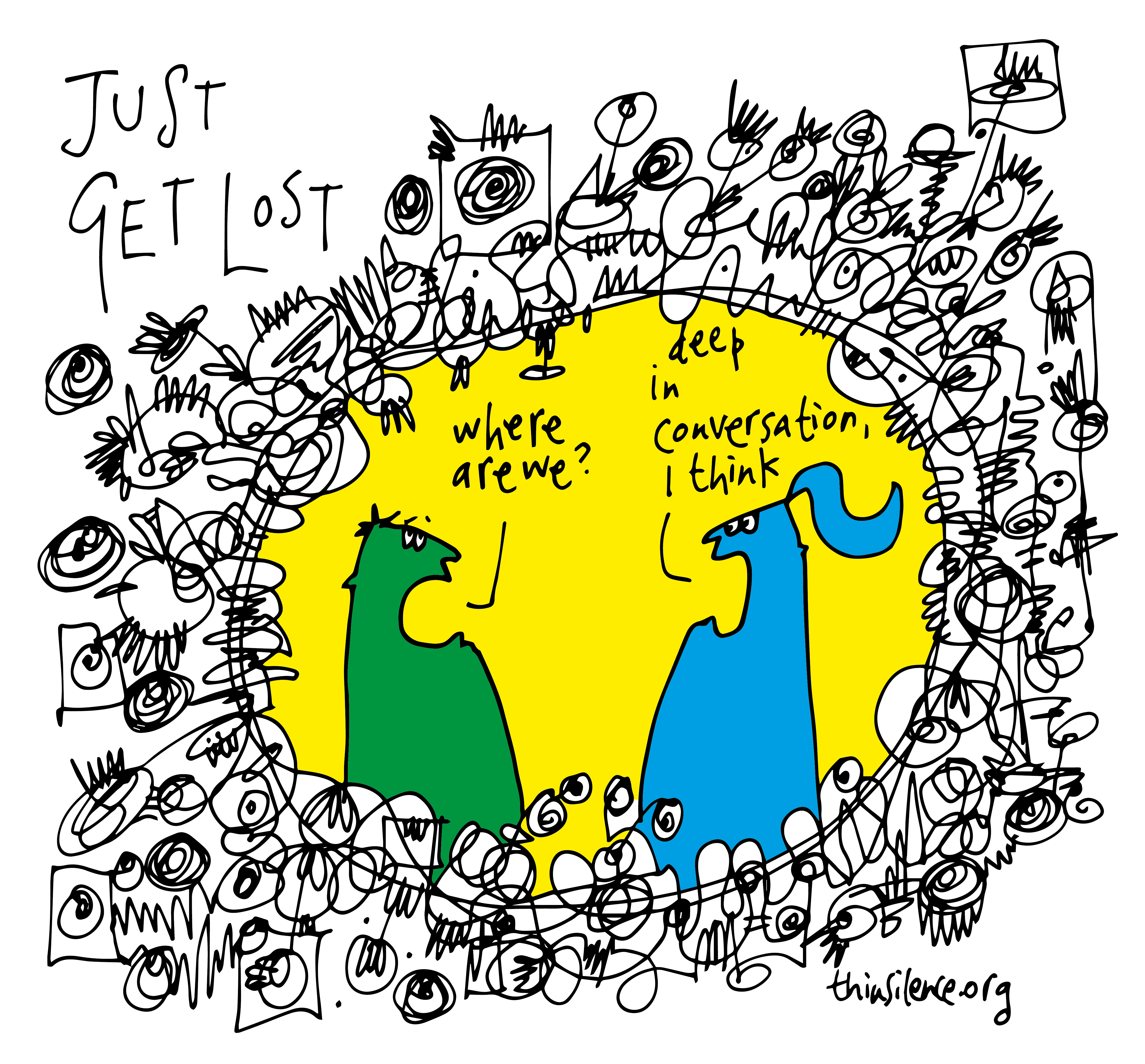
The question then is how to get lost. Never to get lost is not to live, not to know how to get lost brings you to destruction, and somewhere in the terra incognito in between lies a life of discovery.**
(Rebecca Solnit)

On the other side of the coronavirus, we will need a great effort to reach out to one another in person. We have found it possible to Zoom (other video call providers are available) one another for so many tasks and reasons, and we’ll likely carry on in this vein for many of these into the future.

While such ways and means for staying connected have been quite marvellous in lockdown, the big picture is likely to be one of relational contraction. While I believe the future is connection, this needs to be increasingly conversational connection.

Sherry Turkle shares from her research on the use and effects of social technology:

A twenty-four yearly woman who works at a start-up tells me she is no longer able to focus on one thing or one person at a time. And that’s the problem with conversation; it asks for skill she can no longer summon.^

Conversation makes it possible to enter each other’s world and become lost in what can be quite alien to us. Part of this, according to Rainer Maria Rilke involves admitting that these other worlds exist – this world isn’t just as I see it but it includes:

I and the one who is most different from me. And only when such a complete world is admitted to and considered possible will one succeed in arranging one’s own interiority with its internal contrasts and contradictions generously, spaciously, and with sufficient air to breathe.*

Interestingly, Rilke connects this allowing for different world’s outside of our own being necessary for the ordering of different worlds inside our life. The person who is at war with others is at war within themselves.

There are many ways for getting lost in order to discover worlds unknown to us, but the simplest and most available to us is conversation. Here are three things to try next time the possibility of a conversation is available between you and a stranger:

Seek to discover what they know, to understand what they feel about these things, and then imagine something that it may be possible for you to collaborate on together.

(*From Rainer Maria Rilke’s Letters on Life.)
(**From Rebecca Solnit’s A Field Guide to Getting Lost.)
(^From Sherry Turkle’s Reclaiming Conversation.)

Better than easy

“A life of ease is not the pathway to growth and happiness. On the contrary, a life of ease is how you get stuck and confused in life.” […] But if you look closely at joyful people, you notice that very often the people who have the most incandescent souls have taken on the heaviest burdens.**
(Ben Hardy and David Brooks)

Every weekday morning I have my constitutional walk. It gets me out of the house when I would otherwise be working inside all day. Because it’s the same walk each time, it makes things easier for getting out for exercise and fresh air – no umming and ahing. The changing scenery is a delight, no two days are alike, but I wouldn’t want this to be the only path I ever walk.

I have found that the more I understand about what I must do with my life, the more difficult the path becomes.

You would think it would be the other way around, but finding my way brings me to many crossroads and forks. A pathway equivalent of the Ship of Theseus, through the choices I have made it is now quite a different path than the one I first set out on, although it looks like one.

When I look more closely, I see these crossroads and forks are really possibilities into richness, of creativity, community and commission – as in, purpose.

There has always been the easier option, which may be to continue on the way I have been travelling awhile, or even to select something easier than this, but there are often multiple better ways, too.

A more difficult path tends to do that, multiplying possibility, reflecting the complexity life is.

(*Ben Hardy and David Brooks from Brooks’ The Second Mountain.)

When the young are old and the old are young

I believe in old age: to work and to grow old: this is what life expects of us. And then one day to be old and still be quite far from understanding everything – no, but to begin, but to love, but to suspect, but to be connected to what is remote and inexpressible, all the way up into the stars.*
(Rainer Maria Rilke)

At the age of twenty four, I found myself with hundreds of people to care for, many fifty or more years older than me. I am grateful for this experience. In their presence, I believe I determined many things about how I wanted to be when older and how I did not want to be.

One of the problems, though, was to try and still be young; I would be described as “a breath of fresh air,” but many didn’t want to leave the windows open for too long.

The wonder of life I hope I was discovering is that, in each other’s company, the young can be old and the old can be young – we learn from those who are ahead of us and we never forget to be explorers.

(*From Rainer Maria Rilke’s Letters on Life.)

The shortcut

In a word: one ought to turn the most extreme possibility inside oneself into the measure for one’s life, for our life is vast and can accommodate as much future as we are able to carry.*
(Rainer Maria Rilke)

Designing story tests the maturity and insight of the writer, his knowledge of society, nature, and the human heart. It demands both vivid imagination and powerful analytical thought.  But above all, it requires a mastery of craft.**
(Robert McKee)

It seemed like a good idea to the small group of us who didn’t enjoy the idea of a cross-country. We saw the opportunity to take a shortcut down a slope, cutting of a loop of the circuit.

Out of the bushes at the bottom of the hill appeared our P.E. teacher. My recollection is that that he was smiling as he told us that we would be running cross country again the following week when everyone was playing football.

We had cheated but the only ones cheated were ourselves.

A shortcut to our goals or to get ahead may seem like a good idea at the time, but in the end we may only be cheating ourselves out of who we can be and what we can do.

Anyway, in the exploring of the fullness of things the goal we’ve been so intent on gaining may change completely.

(*From Rainer Maria Rilke’s Letters on Life.)
(**From Robert McKee‘s newsletter: Why Writers Study.)

A different perspective

We lead our lives so poorly because we arrive in the present always unprepared, incapable, and too distracted for everything.*
(Rainer Maria Rilke)

It is […] an unavoidable challenge: how to contain the serious within the truly playful; that is, how to keep all our finite games in infinite play.**
(James Carse)

What are you doing when you turn up to life most capable, prepared and focused?

Does this seem to be in any way hard work, or does it feel more like play?

Rainer Maria Rilke pens this interesting thought:

We have to mix our work with ourselves at such a deep level that workdays turn into holidays all by themselves, into our actual holidays.*

What is the work that feels like a holiday for you, that is, you are refreshed and renewed by it, and is perhaps playful, too?

Do you think such a thing is possible?

What is it that all of your life seems to have been preparing you for?

(*From Rainer Maria Rilke’s Letters on Life.)
(**From James Carse’s Finite and Infinite Games.)

ROMO

I need to be here
for a while;
there is no
other place I need
to be.

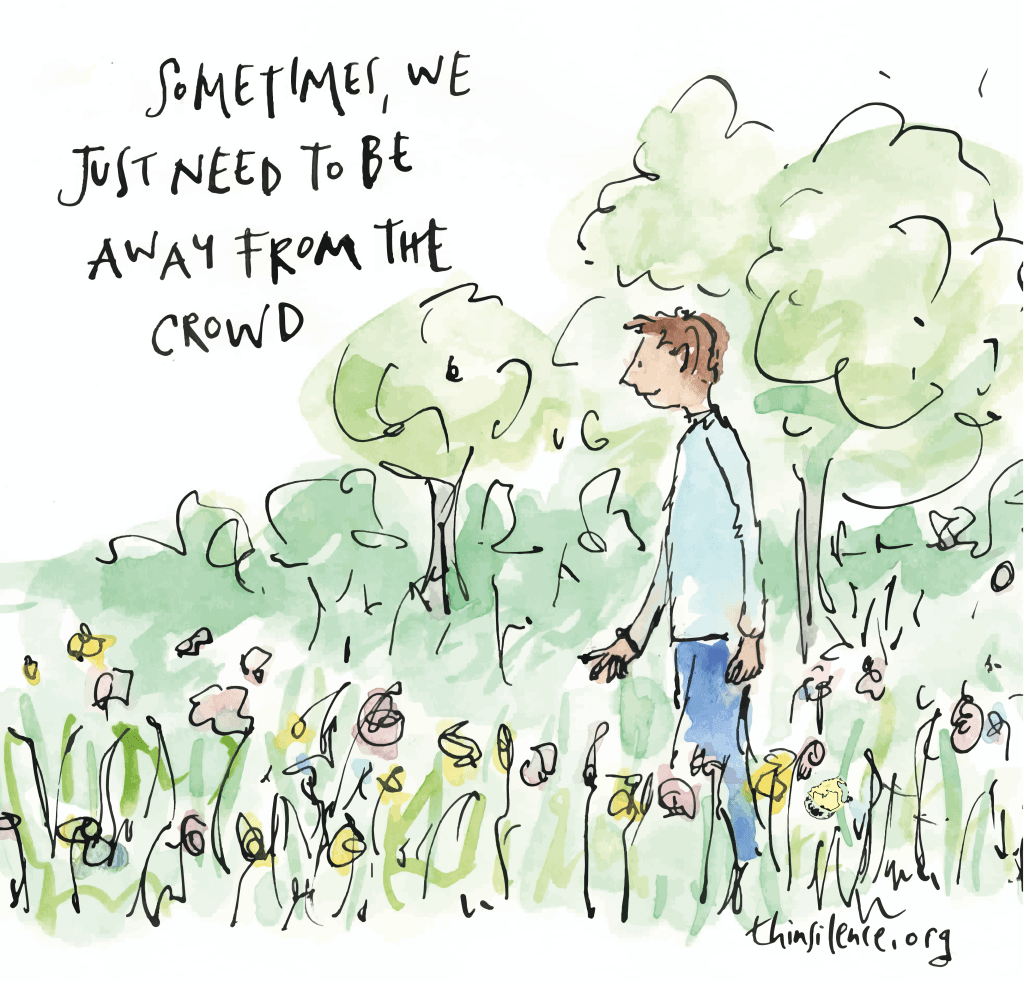
I’m not wanting to add to the growing levels of FOMO in our world, but just maybe, the fear of missing out will mean we’ll miss what will only come to us when we are away from the crowd and on our own.

ROMO = the rewards of missing out.

Endangered conversations

How will you go about finding that thing the nature of which is totally unknown to you?*
(Meno)

Most endangered [conversation]: the kind in which you listen intently to another person and expect that he or she is listening to you; where a discussion can go off on an tangent and circle back; where something unexpected can be discovered about a person or an idea.**
(Sherry Turkle)

I love the conversations in which someone see something new. The only thing better is when there are surprises for everyone.

The world deserves risky and adventurous conversations.

(*Meno, quoted in Rebecca Solnit’s A Field Guide to Getting Lost.)
(**From Sherry Turkle’s Reclaiming Conversation.)

Some assembly required

Grant yourself the superpower of making “art” wherever you go and see how that changes what you perceive. Art is everywhere if you say so.*
(Rob Walker)

In a word: one ought to turn the most extreme possibility inside oneself into the measure for one’s life, for our life is vast and can accommodate as much future as we are able to carry.**
(Rainer Maria Rilke)

Each day comes to us requiring effort on our part to make it complete.

I don’t mean as far as the universe is concerned, but from our perspective, as conscious beings creating meaning.

The day can be what we want it to be.

I found myself wondering whether joy is another word for what Mihaly Csikszentmihalyi identified as flow, when we lose awareness of self and are one with what it is we are doing, with the thing that brings our talents, values and energies together in the gift we want to bring into the world.

I think what this day needs is some of your joy.

(*From Rob Walker’s The Art of Noticing.)
(**From Rainer Maria Rilke’s Letters on Life.)