It’s, like, this, or, it’s like this

Put simply, epigenetics is showing that who a person becomes is based far more heavily on which genes are present.  And gene expression is based in large part on environmental signals and choices.  Thus, a person’s biology is not fixed, but highly fluid and malleable.  It’s an exciting and empowering message.*
(Ben Hardy)

Never stop looking for what is not there.**
(“Monte Wildhorn”)

I like the the word “like,” but it’s increasingly used to replace “er” or a pause or silence (   ) in speech.

Like has a much more interesting use, though.

When we delve into the unsure, unknown, unfamiliar, discovering something new or different, we have to liken it to something.  It’s the only way we can understand and communicate it.  I found myself doing this yesterday when someone asked me about dreamwhispering: “Well, it’s a little like coaching and mentoring but it’s different, too …”.

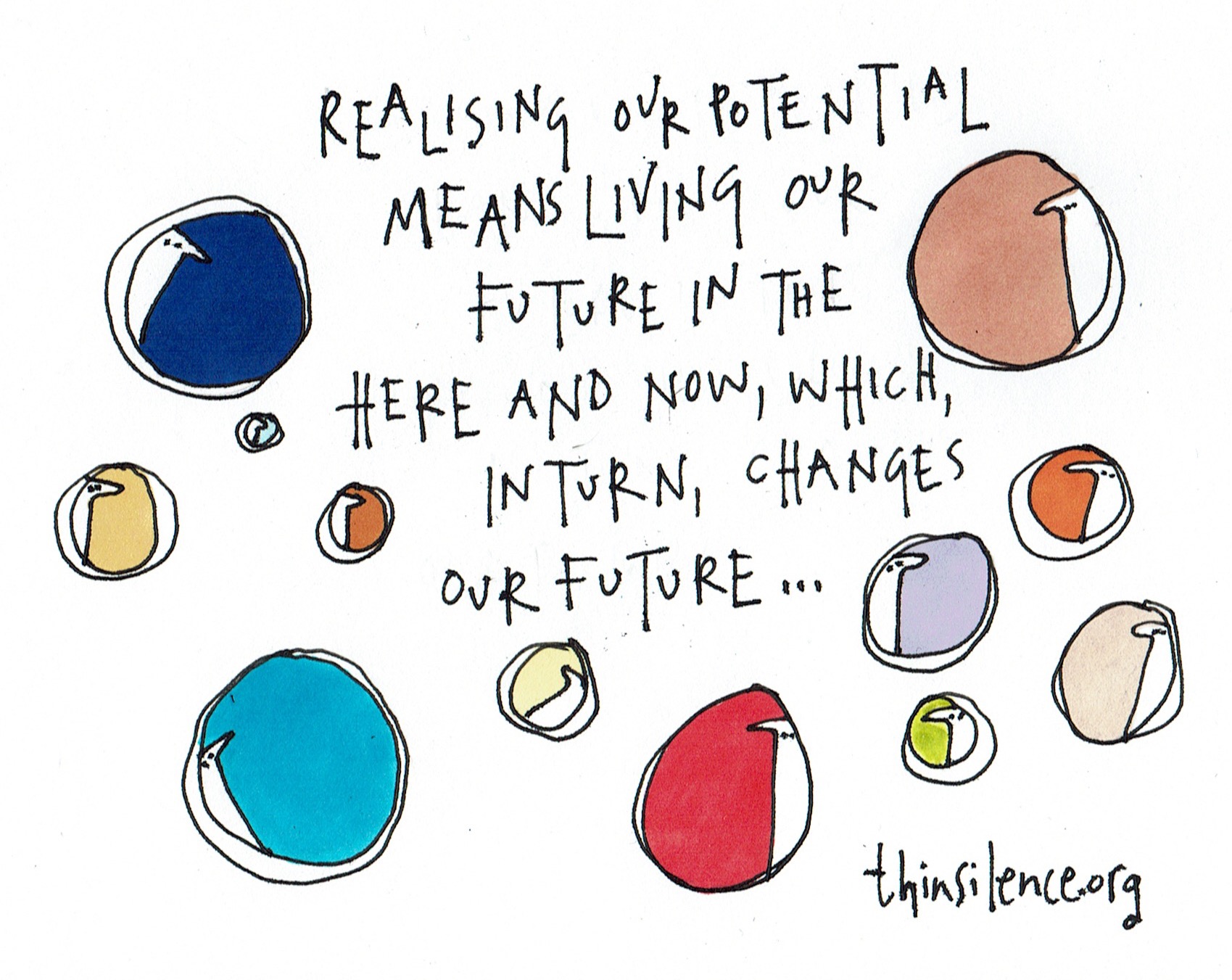
I think it also comes into play when someone is talking about their potential.  Ben Hardy’s opening words tell us that potential is quite a tricky thing to know.  Our potential looks different in different environments.  He shares how he began discovering things about himself he never knew when he moved into a more challenging environment:

‘I didn’t know what I didn’t know.  And thus, I was unaware of the latent potential within me.  Moreover, I was unaware of what true productivity could look like.’*

If you can describe your potential to me then you probably don’t know your potential.  You only know what it looks like where you are now.  It’s more than this, I know, because everyone has way more potential than they know.  We need to move into more challenging environments to discover how much more, the kind of more that leaves us floundering for ways of describing it: “Well it’s a little like this …” we say.

Graham Leicester and Bill Sharpe describe well the uncertainty, and so, the possibilities of the future when they write:

‘a landscape of uncertainty, in which we too are actors’.^

Those who adapt and learn to play in such an uncertainty will become transformative innovators, those who will bring the future into view, those willing to explore the uncertainty of “er” and (   ):

“I and this mystery, here I stand.”^^

It doesn’t have to be big but there’s definitely something beyond this now.  Something that we’ll only be able to describe in the first place as “like this.”

Here’s a blessing for your exploring:

‘May you have the courage to listen to the voice of desire
That disturbs you when you have settled for something safe.

[…]

May you come to accept your longing as divine urgency.’*^

(*From Benjamin Hardy’s Willpower Doesn’t Work.)
(**Morgan Freeman’s Character in the movie The Magic of Belle Isle.)
(^From Graham Leicester’s and Bill Sharpe’s Transforming Higher Education.)
(^^Walt Whitman, quoted in Jonah Lehrer’s Proust was a Neuroscientist.)
(*^From John O’Donohue’s To Bless the Space Between Us.)

Paying attention

The problem with thinking is that it causes you to develop illusions.  And thinking may be such a waste of energy!  Who needs it?*
(Nassim Taleb)

In his book The Last Word and the Word After That, Brian McLaren identifies the community of knowing.  It’s really a community of unknowing because each member encourages and is encouraged to explore and attempt more.  When the group ceases to do this, either they must be challenged to step up or members must leave and find or form another community.

I recently came across how difficult it is to be openly listened to in a possibility of exploring way in a group just like this.  One person offers input, the others listen openly and reflect back but do not give advice.   This felt unnerving, a different kind of experience for the one inputting.

When we are being deeply listened to, our thinking is taken to new places, places we have not had to go to before when others have produced the answers for us.

Those listening were equally honest, confessing how hard it was not to deeply listen, not to make their ideas the centre of the conversation or follow distracting thoughts out of the room.

These words from Richard Rohr, identifying the kind of disorientation likely to be personally experienced when moving from the past to the future, provide a description for moving into deeper listening:

‘You normally have to let go of the old and go through a stage of unknowing and confusion, before you can move to a new level of awareness or new capacity.’**

This being with others in an increasingly open way is unsettling, as Nassim Taleb points out what’s normally going on:

‘We unwittingly amplify commonalities with friends, dissimilarities with strangers, and contrasts with enemies.’^

These commonalities, dissimilarities and contrasts probably have little basis, “heuristics and biases”* we tell ourselves and they must be broken through with deeper listening.  Rainer Maria Rilke knew how hard this is:

“for one human being to love another … is perhaps the most difficult of all our tasks … the work for which all other works is but preparation”.^^

Rilke is positing the closest of all human relationships but the work of relationships are true for all.

To listen deeply, with all our heart, soul, mind and strength – because it will take all – creates the new environments we need to move into futures we cannot imagine on our own.

We have to go to the difficult places, counsels entrepreneur Jim Rohn:

“Don’t join an easy crowd; you won’t grow.  Go where the expectations and demands are high.”*^

Uncanny are surprising things that can change and grow us:

“The uncanny is always crouching, ready to spring.”^*

(*From Nassim Taleb’s Fooled by Randomness.)
(**From Richard Rohr’s The Naked Now.)
(^From Nassim Taleb’s The Bed of Procrustes.)
(^^Rainer Maria Rilke, quoted in Maria Popova’s Brain Pickings: How to Break Up with Integrity.)
(*^Jim Rohn, quoted in Benjamin Hardy’s Willpower Doesn’t Work.)
(^*Tom Cunning, Quoted in Charlotte Bosseaux’s Dubbing: Film and Performance.)