
“If I chose to hide you away, it is for a reason.
I have brought you to this place.
Drink in the silence. Seek solitude.
Listen to the silence.
It will teach you. It will build strength
Let others share it with you.
It is little to be found elsewhere.
Silence will speak more to you in a day than the world of voices can teach you in a lifetime.
Find silence. Find solitude – and having discovered her riches, bind her to your heart.”*
Courage is found in an unexpected place. It begins with our awareness, the breaking open of our pride, greed, and foolishness by our mindful use of humility, gratitude, and faithfulness.
The courage to be ourselves is the courage to be ourselves for others.
This has serious implications for our planet, as I will come to. Seth Godin describes the difference between pleasure and happiness from his perspective as a marketer with a heart, in which he sees the marketplace wanting us to buy from it for our personal pleasure:
‘Pleasure is short-term, addictive and selfish. It’s taken, not given. It works on dopamine.
Happiness is long-term, additive and generous. It’s giving, not taking. It works on serotonin.
This is not merely simple semantics. It’s a fundamental difference in our brain wiring. Pleasure and happiness feel like they are substitutes for each other, different ways of getting the same thing. But they’re not.’**
Pleasure is becoming an increasingly powerful force in a world of more choice, twisting how we think of happiness; Godin continues:
‘More than ever before, we control our brains by controlling what we put into them. Choosing the media, the interactions, the stories and the substances we ingest changes what we experience. These inputs lead us to have a narrative, one that’s supported by our craving for dopamine and the stories we tell ourselves. How could it be any other way?
Scratching an itch is a route to pleasure. Learning to productively live with an itch is part of happiness.
Perhaps we can do some hard work and choose happiness.’**
Pleasure is often short-lived, we need the next fix. Happiness tends to be self-growing because it reaches a part of us that is regenerative. Ed Catmull offers a metaphor from his experience within Pixar:
‘But the differences between directing a five-minute short and directing an 85-mibute feature are many.’^
Life isn’t a short. And we can’t find the happiness we’re wanting in life the way we can provide ourselves with pleasure.
The harder work Godin alludes to is enabled by our humility, gratitude, and faithfulness, because these lead to integrity, wholeness, and perseverance – the generative self I mentioned earlier and the second part of being our courageous self – I discover I have more than enough and can be about ‘giving not taking’ (Godin).
Within this there’s a sense of less is more, that we do not need to go after everything because what we have allows us to be far more imaginative and creative than we know. It’s the equivalent of shopping at Aldi over Sainsbury’s:
‘Less is more contradicts two core beliefs held in our culture:
More information is always better.
More choice is always better.’^^
We’re connecting to our gut feelings, our essential Self.
The reason this has planetary implications is that moving from pleasure to happiness is a movement from making more faster, to making what we need: at the moment we’re consuming 1.5 Earths and one day that will catch us up.
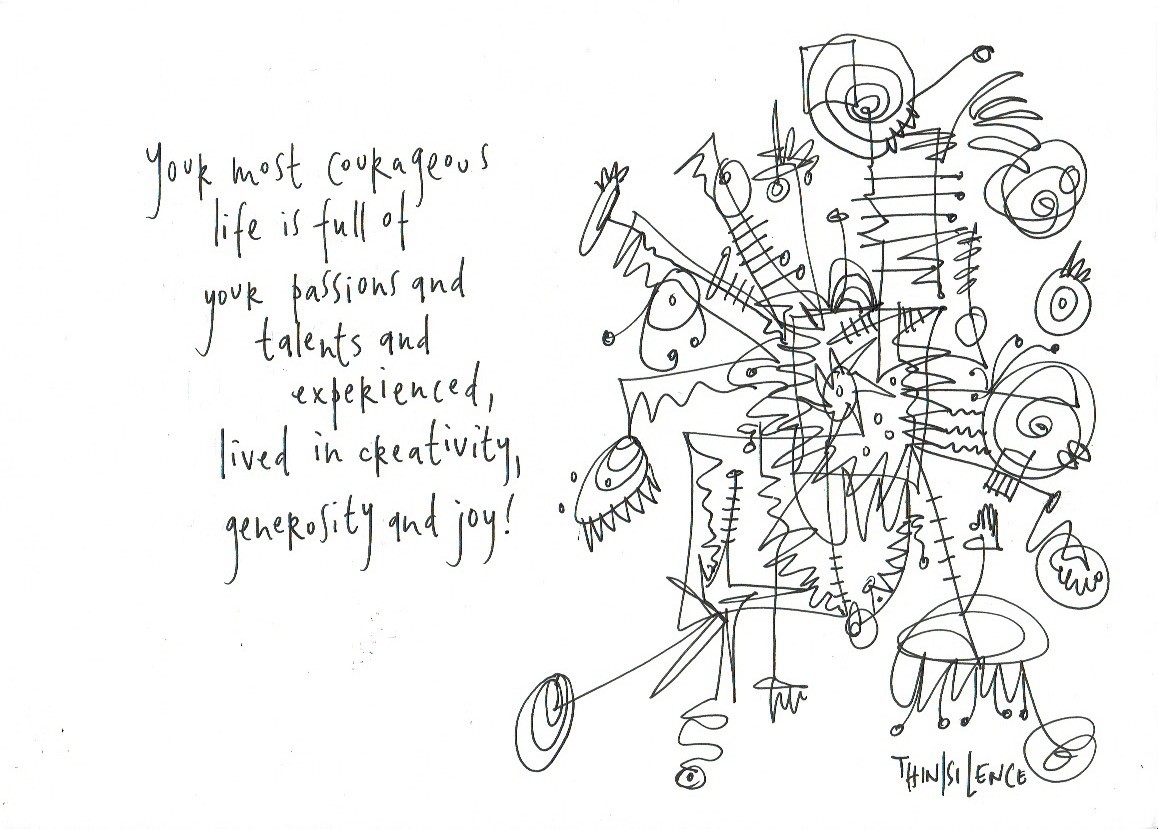
The third part of this moment to being our courageous self, then is a movement towards sharing ourselves – from integrity comes personal courage, from wholeness comes generosity, and from perseverance comes living-wisdom.
It all begins in the silence, the emptiness we so often try to flee is not empty at all. Ken Mogi writes about why in Japanese culture there’s a sense that the morning is the most productive time of the day:
‘In the morning, assuming you have had a sufficient amount of sleep, the brain has finished its important night job. It is in a refreshed state, ready to absorb new information as you start a day’s activities.’*^
And maybe we don’t simply need more of what we had yesterday. Perhaps at the beginning of the day, for a few moments or more, we can wait in the silence and imagine something new out of the deep source of our lives:
‘They just see more because they’ve learned how to turn off their minds’ tendencies to jump to conclusions.’^
(*Frances Roberts, quoted in the Northumbria Community‘s Morning prayer.)
(**From Seth Godin’s blog, The pleasure/happiness gap.)
(^From Ed Catmull’s Creativity, Inc..)
(^^From Gerd Gigerenzer’s Gut Feelings.)
(*^From Ken Mogi’s The Little Book of Ikigai.)
 THIN|SILENCE
You must be logged in to post a comment.