the we story

11 let us imagine

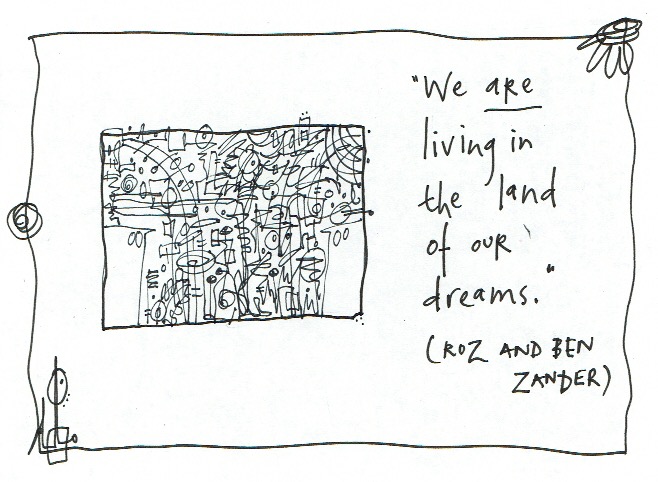
‘The WE appears when, for the moment, we set aside the story of fear, competition, and struggle, and tell its story.’*

‘Live the questions now.’**

The best stories make it possible for us to journey into the future.  Whilst they tell of the past, they are full of humility, gratitude, and expressions of beautiful faithfulness which open up life for as many as possible.

The most ancient of human stories tell of how we have all come from one beginning.

The WE story is the great human story we are all part of, it is a tale of relationships – how we relate to one another and how we relate to the world in which we find ourselves – all fauna and flora.

At different times in history, we have seen the power of this story to overcome stories of them and us.  We see it in different times and places, only to disappear, reappearing somewhere else.  It appears where we are prepared to ask a powerfully disturbing question: “Will we journey together to somewhere neither you nor I have been to?”

The WE story is far more creative because it hopes for what cannot be seen:

‘What happens after that is not in your control, but springs spontaneously from the WE itself.’*

My personal sense of being deepens as my relationship with others and the world develops, and I know, I have hardly begun.

Whilst our ancient stories appear to preserve the past, they actually allow us to invent the future, moving us towards something rather than away from something, an infinite game of possibilities.^

(*From Rosamund and Benjamin Zander’s The Art of Possibility.)
(**Rainer Maria Rilke, quoted in the Northumbria Community’s Morning Prayer.)
(^An infinite game is marked by the aim of including as many as possible for as long as possible and changes the rules when these things are threatened, whilst a finite game seeks to include some towards a goal and always plays by the rules.)

see slowly

10 proceed slowly

“If you want your dream to be
Take your time, go slowly”*

“Always keep Ithaca on your mind.
To arrive there is your ultimate goal.
But do not hurry the voyage at all.
It is better to let it last for many years;
and to anchor at the island when you are old,
rich with all you have gained on the way,
not expecting that Ithaca will offer you riches.”**

To see hope where others do not requires that we see slowly

Then new treasures appear along the slow road, to those who are prepared to live a slow presence – to dawdle.  I have often thought of my life as a slow journey in the same direction, yet have found myself busy with many things.

Last year, we moved into a new home.   We have waited for the Spring before working on the garden.  Gardens are another metaphor for life, for what life can produce – gardens cannot be grown quickly, natural laws attending to be attended to.

‘The person who rigorously maintains the clarity to stand confidently in the abundant universe of possibility creates an environment around him generative of certain kinds of conversations … inviting us to play in the meadows of the cooperative universe.’^

This journey explores more deeply than we had thought possible, this garden is rich in growing new possibilities, especially for others.  There are too many given up on by those who are in a hurry to move through life, to arrive at their Ithaca, unable to see many of the definitions and assumptions they are living by.

What we find for ourselves in these slow possibilities are the things which contribute to our own generativeness – specifically, I think, our integrity, wholeness, and perseverance.

Go slowly, noticing the things in which you are successful, act intuitively, grow as a result of, and, which meet your needs.  What you will find, then, is you’re creating possibilities for others.

(*Donovan Leith, quoted in the Northumbria Community’s Morning Prayer.)
(**Constantine Covafy’s Ithaca, quoted in Chris Guillebeau’s The Happiness of Pursuit.)
(^From Rosamund and Benjamin Zander’s The Art of Possibility.)

sight for sore eyes

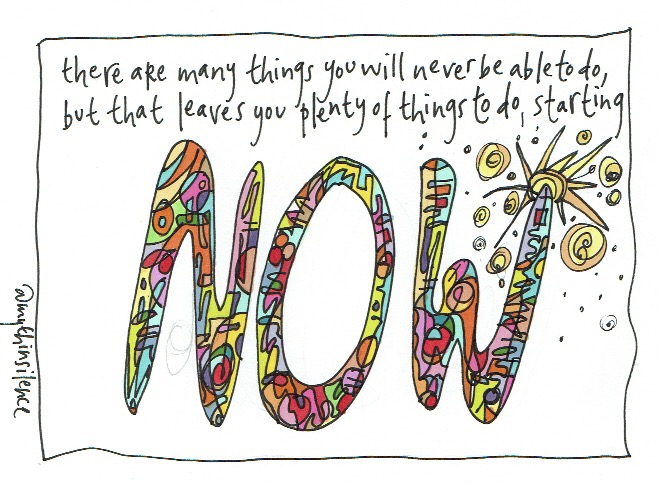
9 there are many things (colour)

Vision is our antidote for prematurely judging.

We open our eyes and our minds towards an alternative possibility becoming reality, rather than closing down possibilities, for both ourselves and for others.  Vision is for everyone, without prejudice.

“Too many people, guilt-stricken, wounded,
Walk in regret, feel bad about failing,
apologise even for breathing.”*

It is also about now, carrying within it the reality it promises, opening a game of possibilities that can be entered into and played now.

‘When “the possibility of ideas making a difference” is spoken, at that moment ideas do make a difference.’**

A disturbingly exciting thought is that our lives can offer vision to others because of how we live out what it is we must do.

(*Andy Raine, quoted in the Northumbria Community’s Morning Prayer.)
(**From Rosamund and Benjamin Zander’s The Art of Possibility.)

verdancy

8 verdancy

Multiplication and abundance.

“You start by sketching, then you do a drawing, then you make a model, and then you go to reality – you go to the site – and then you go back to drawing.  You build a kind of circularity between drawing and then making and back again.”*

‘Then I pushed the sheets of paper all over my office, rearranging them into piles, and then a stack, the order of which I coped back onto the computer.  That’s how the book was made – hands first, then computer, then hands, then computer.  A kind of analogue to digital loop.’**

There is a to and fro-ness being lost in our digital age, a loop of skill-building is lost when a computer programme can design a building, or put together a book, or design a course, or create an advert, cleanly and in quick-time.  The digital age is made up of bits and bytes – everything being able to be broken down into small components and reassembled into an endless number of possibilities – lego-like.

In the last two days I’ve mentioned spaces of possibility and cities that listen, in which people are able to learn how to be seekers again, makers and creators joining head and heart to become crafts-people once more.  The team co-creating these spaces are very capable of putting something together quickly and efficiently, delivering a generative environment for others, but they have seen the possibility for more and are taking it slowly.  There’s no substitute for what happens in people and between people who come together with an idea, as they both encounter it as individuals and together.

Richard Sennett’s counsels, ‘simulation can be a poor substitute for tactile experience,’ ‘CAD [computer aided design] can be used to repress difficulty,’ and provides overdetermined design ruling out the messiness of life which needs to ‘abort, swerve, and evolve.’^  Sennett is encouraging us not to abdicate responsibility to the computer, but to be craft-people, using the digital tool as part of a larger creativity.  Austin Kleon offers an example of how he works between a digital space and analogue space – he doesn’t allow one to stray into the other.

We exist within randomness.  Success is far more about chance and luck than it is about predictability.  Dealing with randomness is where we find humans at the top of their game; we’re so good at dealing with it that we don’t even notice we’re doing it.  But we’re seeing more and more how our success depends on meeting people at the right time, saying yes instead of no, or no instead of yes, trying something on a flight of fancy, and so it goes on.

‘[W]e must treat unexpected problems with unexpected responses. … If we allow more people to solve problems without permission, and if we tolerate (and don’t vilify) their mistakes, then we enable much larger set of problems to be addressed.’^^

A creative loop of digital and analogue, shared with creative others, provides us with one of the most verdant fields.

(*Architect Renzo Piano, quoted in Richard Sennett’s The Craftsman.) 
(**From Austin Kleon’s Steal Like an Artist.)
(^From Richard Sennett’s The Craftsman.)
(^^From Ed Catmull’s Creativity, Inc.)

cities that listen

7 what is your question

What if, when you move into a new city or town, it inclined itself towards you, making all you require to thrive?

This really would be a city that listens.

It isn’t the bricks and concrete of the city, of course, but the people of a city that make themselves available as deep listeners and co-conspirators for creating the future.

‘Group membership makes people feel closer and brings a significant boost in personal confidence and happiness.’*

‘Robotic companionship may seem a sweet deal, but it consigns us to a closed world – the loveable as safe and made to measure.’**

When we retreat into our own worlds, when we guard our borders, we can’t fully know others and we cannot know ourselves^ – the city does not lean toward us.

Yesterday, I was reflecting on the experience of co-creating a space of possibility, a city that listens, in which everyone who enters is able to flourish.  When we know our Self and we meet with others, things get interesting.^^

‘That, right there, is a beautiful question for the ages: what do you want to say?  Why does it need to be said?  What if you could say it in a way that has never before been done?  How might you do that?’*^

(*From Gretchen Rubin’s The Happiness Project.`)
(**From Sherry Turkle’s Alone Together.  Looking ahead at the content of her book, Turkle remarks, ‘Later, we will hear teenagers talk about their dread of conversation as they explain why “texting is always better than talking.”  Some comment that “sometime, but not now,” it would be good to learn how to have a conversation.’)
(^Neither our present self or future Self.)
(^^Get in touch if you want to find out more about creating spaces of possibility.)
(*^From Warren Berger’s A More Beautiful Question.)


hide and seek, seek and find

6 could it be

“All artists are willing to suffer for their work.  But why are so few prepared to learn to draw?”*

‘Skill development depends on how repetition is organised.  As skill expands , the capacity to sustain repetition increases.’**

We are born seekers.

As we grow older, though, we tend to seek less and less.  Maybe it’s because we’ve already found what we’re seeking.  Maybe it’s because we’ve been disappointed by not finding what we seek, and we’ve settled on Plan B.  Maybe Plan A is just too demanding.

It’s really important to remember that every human is capable of loving some creativity as though its the best thing in the world – this is our art.  Yet after the exciting idea, there’s all the learning and routine and slog to go through.

Richard Sennett points out how skill can expand exponentially in open-ended practices, but not if the end pint is fixed.  Then the affect is to stop people seeking.  The industrial revolution did this, by taking many hand skills away from people; the smart revolution looks set set to take over people’s mental skills – when a machine can produce something faster, the repetition of skills is taken over.

This isn’t about demonising technology, but to use it smarter.  I also read these two views today, and they’re more hopeful.

Chris Anderson reminds us we are all makers, and many will be able to step outside of the more traditional business places to invent, innovate, and make their art.

The other view comes from Roz and Ben Zander, who write about ‘restructuring meanings, creating visions, and establishing environments where possibility is spoken – where the buoyant force of possibility overcomes the pull of the downward spiral.’^

I’ve just been co-designing such a space with others this morning – somewhere for people to become seekers once again, the opportunity to reconnect their hands and minds to their work.

Seeking is never ending – seeking stimulates more seeking:

‘How do we continually find inspiration, so that we can inspire others?’^^

The future will increasingly find us “building” spaces that are living questions for those who enter them.

(*Banksy, quoted in Chris Guillebeau’s The Happiness of Pursuit.)
(**From Richard Sennett’s The Craftsman.)
(^From Rosamund and Benjamin Zander’s The Art of Possibility.)
(^^From Warren Berger’s A More Beautiful Question.)
(Check this on work from Hugh Macleod.)

where others fear to tread?

5 we are living

‘When you are being the board, you present no obstacles to others.’*

We don’t tend to pay much attention to the board the game is played on.  And who notices the foundations of a building, yet both are critical to what takes place upon them.

On the other hand, we find it hard to be in the background.

We all want to be noticed somehow, whether it be on a stage, a mention in the acknowledgements for a piece of work, or a text from someone in the family (my mum once sent me a cross-stitch picture with the words, “Phone your mother – she cares!”).

One of the dynamic pieces of personal work for anyone in our age is to figure out how to turn our passion into something that can be foundational for others.

Pioneers wanted:

‘Do the emotional labour of working on things that others fear.’**

‘People who are good at questioning are comfortable with uncertainty.’^

This is deeper human work.  It’s about living in the high energy and skills of our passion and making a difference for others.  It’s not worrying about someone else providing the board or foundations are stage because we are the foundations.

Which brings us to the moment.

The moment when we make the switch:

“[B]reaking your programming requires a single moment of strength.”^^

(*From Rosamund and Benjamin Zander’s The Art of Possibility.)
(**From Seth Godin’s Whatcha Gonna Do With That Duck?)
(^From Warren Berger’s A More Beautiful Question.)
(^^Julien Smith, quoted in Chris Guillebeau’s The Happiness of Pursuit.)

practising unpredictability

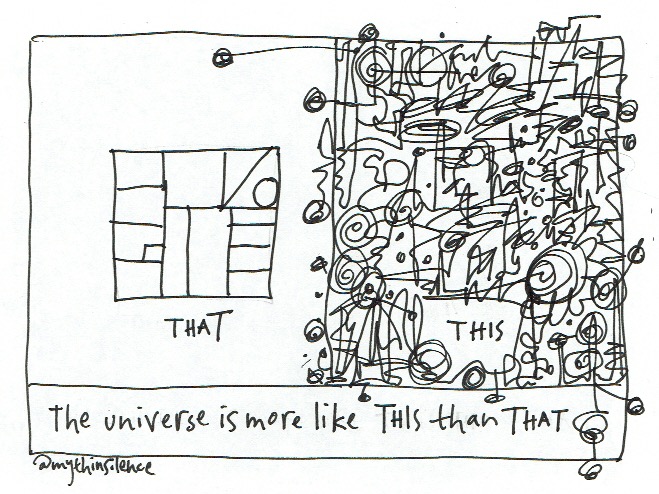
4 the universe is

I love ingenuity, how it makes adventures of possibility available to everyone.

Now, right where we are, we can identify an adventure.

It doesn’t matter that we’re not somewhere else, that our education is what it is, that we own various have limitations and responsibilities.  We can innovate for ourselves and for each other.

The adventure or quest, Chris Guillebeau suggests, has the following marks which set it apart from a project: there’s a clear goal, it’s measurable, it has a sense of calling to it, and it involves great effort.*

At the end of 2013, I had an idea to blog every day in 2014 because I was already journalling every day – a 365 day adventure.  To add more of a challenge, and being inspired by Hugh Macleod, I decided to post only if I could add a doodle – the challenge being, I’d never doodled before.  With this, a project turned into a quest.  I bought the same pen as Hugh Macleod – a 0.2 drawing pen – and began to doodle on the back of business cards, as he had done.**

What is your “right where I am” adventure?

This is the practising part I engage in everyday.

I’m so glad that I didn’t stop on the 31st December 2014, though.  When I set out, I’d no idea where it would lead to, which is the unpredictability part of this.  There’s a randomness to where doodling has taken me.  Which means there are other things that haven’t happened, but I’m oblivious too.

I’ve mentioned that Malcolm Gladwell identified how 10,000 hours of deep practice develops remarkable skills in the world of measurement.  Practising unpredictability, however, is about exploring how hours of questioning and openness can lead to remarkable skills in the universe of possibility.

I realise now, answers haven’t led me here – questions have.  Questions and openness have allowed life to become what it is, which, to connect this with my opening thoughts, is a lot more than we often think.

Questions are like a long lever to pry open what remains closed to short answers.

‘In most situations, the rules of the game change all the time.’^

Each of us has an adventure waiting to be started:

‘Obsessively specialise.  No niche is too small if it’s yours.’^^

(*See Chris Guillebeau’s The Happiness of Pursuit.)
(**Enjoy Hugh Macleod’s Ignore Everybody.)
(^From Frans Johansson’s The Click Moment.)
(^^From Seth Godin’s Whatcha Gonna Do With That Duck?)

board games

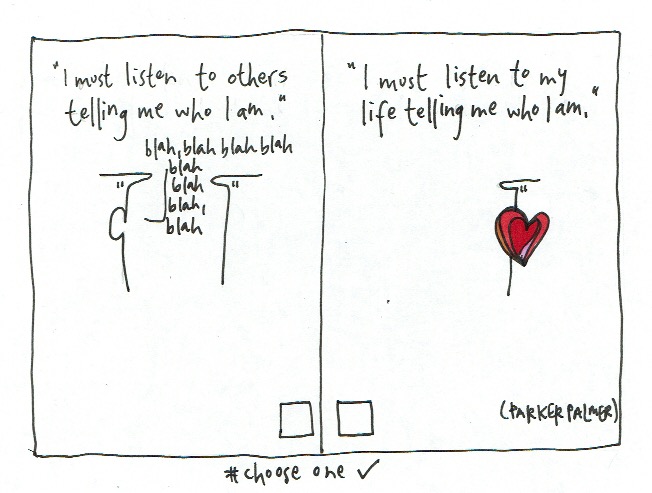
3 i must listen

‘[Y]ou define yourself not as a piece, nor as the strategist, but as the board itself, the framework for the game of life around you.’*

Beyond reacting, beyond even responding, we’re able to have a perspective on life which opens up the possibility of initiating.  This is the infinite game** – a game we play for others.

The infinite game includes as many players for as long as possible and if these dynamics are threatened then the rules are changed.  The infinite game player is content to dissolve into the background, knowing the infinite game makes it possible to do everything they love, making the game more open and inclusive.

The infinite player knows that in any game there’re multiple games being played.  Peter Senge talks about how in any system there’s more than one loop at play.  Most will see the reinforcing loop – the thing the business is about, but will fail to see the balancing loop – where the real problems are to be found, and also where the unseen or undervalued rules are found.^

Imagine these thoughts for the individual:

‘Before you can disrupt your product you have to disrupt your process.’^^

‘This is the essence of intuitive heuristics: when faced with a difficult question, we often answer an easier one instead, usually without noticing the substitution.’*^

‘Finding the time and the space to question, in a cultural landscape that doesn’t encourage it, is challenging.’^*

A synopsis of these might be: we need to look behind the scenes of our lives at our values, curiosities, talents, experiences, and passions; but we have a tendency to focus on the things we’re doing on the surface and resist going deeper; and, this is often reinforced by a culture that doesn’t value deep reflection, often being sceptical or reasoning that it’s too busy.

Malcolm Gladwell highlighted the critical element of 10,000 hours of deep practice for living a remarkable life.***  However, when we look closer what we see is how these 10,000 hours of practice are in relation to the obvious rules – Frans Johansson points out that the more rule-bound the game the more visible the benefits of the 10,000 hours are.^^^

When we’re prepared to focus on the balancing loop of our lives, we begin to see the invisible rules, that is, the interplay of deep practice around the things which make us essentially who we are – and the universe of possibility which emerges.

“I must listen to my life telling me who I am.”**^^

(*From Rosamund and Benjamin Zander’s The Art of Possibility.)
(**See James case’s Finite and Infinite Games.)
(^See Peter Senge’s The Necessary Revolution.)
(^^From James McQuivey’s Digital Disruption.)
(*^From Daniel Kahneman’s Thinking, Fast and Slow.)
(^*From Warren Berger’s A More Beautiful Question.)
(***See Malcolm Gladwell’s Outliers.)
(^^^See Frans Johansson’s The Click Moment.)
(**^^Parker Palmer, quoted in Henri Nouwen’s Discernment.)


when glory is the only word

2 what are you doing

“It’s important to think about that time and place and activity where you shine, where you feel most alive.”*

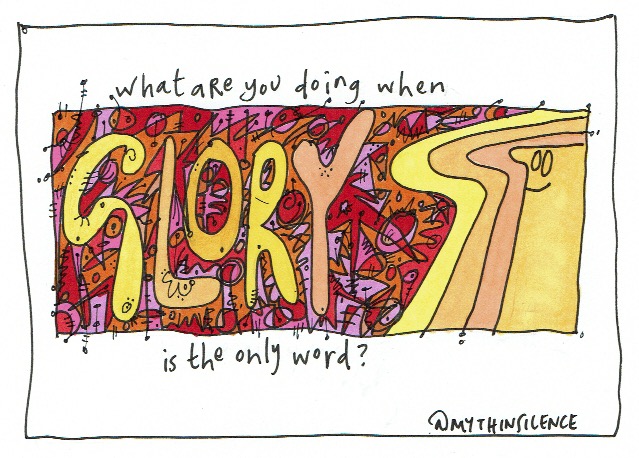
Glory is such a short word for something so full of magnificence and beauty.

It was a year ago when I first reflected on the quote, above.  It reminded me of what I love to do.  One year later, I find them to be more true one year later – the point they are making.  We must focus on the things we most love to do.

I juxtapose this idea from Roz and Ben Zander:

‘Gracing yourself responsibility that happens in your life leaves your spirit whole, and leaves you free to choose again.’**

I found myself thinking back to a moment when I decided to blame no-one and no thing for being close to burning out; instead, I took responsibility for what I had and hadn’t done.  It turned out to be the beginning of an incredible journey which continues today, which finds me journeying from the general to the specific, and sometimes the only word to describe this is glory.^

‘Obsessively socialise.  No niche is too small if it’s yours.’^^

(*Jacqueline Novogratz, quoted by Warren Berger’s A More Beautiful Question.)
(**From Rosamund and Benjamin Zander’s The Art of Possibility.)
(^Scott Peck uses the word glory when describing the fourth stage of community,I his book The Different Drum.)
(^^From Seth Godin’s Whatcha Gonna Do With That Duck?)