‘We are conditioned to search for similarities, not differences.’*
‘Our futures enter into each other. What is your future and mind becomes ours. We prepare each other for surprise.’**
As we reach out into a world and universe of randomness, we try and see patterns and similarities where there are none – maybe trying to find more people like us, comparing this experience with that, and this person with that person.
Nassim Taleb describes a black swan. First of all we don’t expect it – there was a time when Western hemisphere dwellers thought all stand were white. So we are deeply impacted by what we didn’t see coming. Thirdly, when we’ve recovered, we write a back story to explain how we ought to have seen it coming, rationalising or justifying the phenomena – we see patterns where there are none.
It’s really hard to be as open as we need to be in a random universe; our brains want to fill in the gaps of what we don’t know, enabling us to make a speedy judgement – something to do with survival from our ancient past.
In this post, I’m pulling disparate thoughts together from various authors and thinkers I happen to be reading today. Frans Johansson is writing about randomness, Ed Catmull writes about the hidden, and Chris Guillebeau mentions a book publisher called Random, and I begin to see a pattern.
But there is no pattern, there’s only coincidence.
However, if I’m aware of this, and still pull these different thoughts together into a new idea – realising this is exactly what it is – then I’m expressing something exciting about being human. We are generative beings.
We create patterns which allow us to play within the universe through the entirety of our lives – we may well be acted upon and respond much of the time, but we also act upon the universe, we initiate.
All of us do this, so it’s surprising that we don’t create an impossible chaos. But then another incredible human ability kicks in:
‘Our futures enter into each other. What is your future and mind becomes ours. We prepare each other for surprise.’**
We play together in order to create bigger patterns or stories within which we are able to live together. Yuval Noah Harari suggests that humans have created political, national, and religious myths to live in communities larger than 150 members:
‘Yet none of these things exists outside the stories that people invent and tell one another.’^
I like to think of this as the alchemy made possible by those who know they’re playing an infinite game: inviting as many as possible to play and ensuring the game remains open and running for as long as possible.
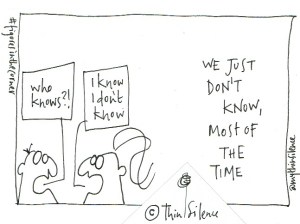
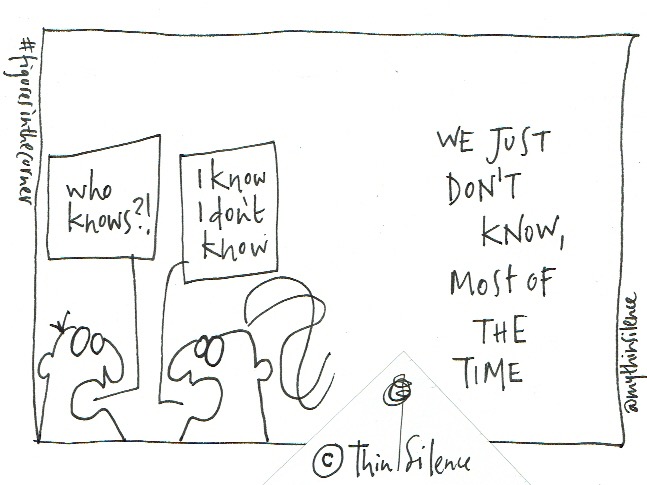
Here we are, opening our lives to one another, recognising we are all in the dark about things way more than we’re in the light, together reaching into the random:
‘Accessing your ignorance, or allowing curiosity to lead you, is often the best guide to what to ask about.’^^
(*From Frans Johansson’s The Click Moment.)
(**From James Carse’s Finite and Infinite Games.)
(^From Yuval Noah Harari’s Sapiens.)
(^^From Edgar Schien’s Humble Inquiry.)



 THIN|SILENCE
You must be logged in to post a comment.