in search of dignity

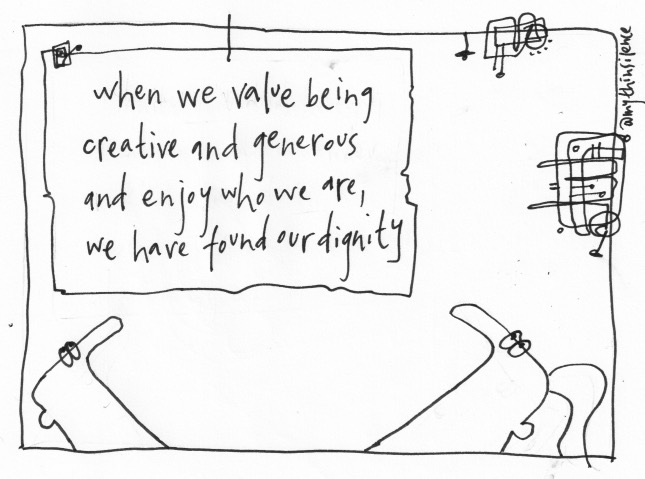
21 when we value being

“Listen to your life.
See it for the fathomless mystery it is.”*

Dignity is essentially living our our worthiness.

It emerges from humility: being exactly who we are is to find our dignity.

‘What they really want, in fact, is to be helped to do the things they want to do. … The smallest thing can feel like magic to someone who has been living with a problem they may not be able to articulate.’**

Bernadette Jiwa reminds me that the thing which brings dignity to another doesn’t have to be big or complex.  It does ask us to listen to our life, perhaps to ask, “Does this make me feel fully Human?”

I realise I’m stringing these random quotes together because it matters to me that people find out just how amazing they really are, and that they are able to share the beauty of their resulting art with others.

“Try not to become a person of success, but rather try to become a person of value.”^

Some wish for there to be an easier way, but shortcuts don’t take us to our dignity, as Robert Greene points out – mastery being a part of our dignity:

‘The very desire for shortcuts makes you eminently unsuitable for any kind of mastery.’^^

This sentiment is echoed by Seth Godin:

‘Sooner or later, it comes to this: Great work is the result of seeking out tension, not avoiding it.  Great work doesn’t require reassurance, in fact, it avoids it.’*^

This last point from Godin is important, suggesting, as it does, that our dignity doesn’t come from outside, from another; it is already within us, waiting to be uncovered.

Create, give, enjoy.

(*Frederick Buechner, quoted in The Northumbria Community‘s Morning Prayer for 21/1/16)
(**From Bernadette Jiwa’s Meaningful.)
(^Albert Einstein, quoted in Bernadette Jiwa’s Meaningful.)
(From Robert Greene’s Mastery.)
(*^FromSeth Godin’s What To Do When It’s Your Turn.)
city of dreams

20 notice dream connect do 1

“And above all, if you must:
shine!”*

So, I thought, “whatever it is you must do, give it to others.”

I’m reading through Nesta‘s Visualise Plan Test Build & Launch and it’s asking me these questions about what I feel I must do:

What does it enhance?
What does it replace or make less desirable?

What does it bring back?
What does it flip when pushed to the limits?**

So I wrote down my answers, …

How I want to enhance the lives of others, not only my own.
How I want to replace “the story so far” as the way it has to be into the future.
How I want us to be able to respond to our primal needs to be free to choose, to do something uniquely well, and to live for something bigger than ourselves.
How I long to be part of a gripping story passed from one to another.

I continued to reflect on this, knowing this is not about people being pushed from outside, but motivated from what they find within.  Edward Deci offers this thought:

‘The proper question is not, “how can people motivate others?” but rather,“how can people create the conditions within which others will motivate themselves?”^

Seth Godin dreams of as many people as possible choosing this way:

‘When it’s your turn, it’s your turn.  You own it.  Your choice.  Your freedom.  Your responsibility.’^^

I found myself imagining a city of dreams.  A place of belonging for those who would  bring out and explore their unique dreams, around who we are, not who we are not; where we’re aware of what we have, not regretting what we lack; knowing we have enough to take our turn.

Now it’s your turn, and what will you do?

(Create, give, enjoy.)

(*Kerry Hillcoat, quoted in The Northumbria Community‘s Morning Prayer for the 10th January, 2016.)
(**From Nesta’s Visualise Plan Test Build & Launch.)
(^From Edward Deci’s Why We Do What We Do.)
(^^From Seth Godin’s What To Do When It’s Your Turn.)
when the journey enters us

20 everday, we get to be explorers

Humans are journey-making creatures.

Yuval Noah Harari describes how there were once tens of thousands of “worlds” within our planet. As Humans made their journeys, these other worlds disappeared to one another.  The last major world to be integrated into our “one world” was Tasmania.

Have we become more Human as a result?

We are now on the brink of journeying into space.

Journey is a powerful metaphor we use in other ways, too.  We travel through life by growing older, changing work, meeting new and different people, facing challenges, serving.  The best journeys are transformative, help us to become, to change, to grow.

‘Struggling through the production of Toy Story 2 twisted our heads around, causing us to look inward, to be self-critical and to change the way we thought about ourselves.’*

It’s not so much about entering the journey, but the journey entering us, when it changes us.

Every day can be a transformative journey, capable of changing us – just a little.  What are the new ideas, who are the new people, where are there different sequences offering us an opportunity to stretch and become.  And tomorrow, there’ll be another day.

Create, give, enjoy.

(*From Ed Catmull’s Creativity, Inc..)

crossroads for anger

18 don't stay angry

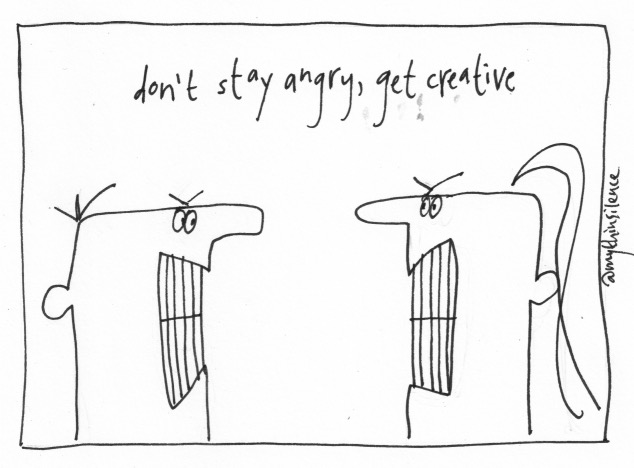
Anger tells us something is wrong.  We then have a choice: to become immersed in the anger, often leading to poor or weak decisions and worse actions, or we can do something about what’s wrong – we can get creative.

One place to begin is to ask questions about our felt anger.  Perhaps the prime question is: Which of my values has just been transgressed by this?

Our values come from the deepest places our lives, guiding us and making it possible to respond with foresight, intention, and love.

Great questions help us to open our minds, in turn allowing us to open our hearts to the whole situation, towards coming up with an imaginative response.

When we connect to our values, we know there are many responses we can select from.

Create, give, enjoy.

is this wise?

17 and the people

If wisdom is ultimately about all things thriving, here are six tests to see if this is wise:

Is there interdependence?  Is the whole being greater than the individual parts?

Is there multiplication?  Are more and more people benefitting, to the extent that everyone becomes a teacher?

Is there energy transformation? Does this wisdom welcome and incorporate the energy everyone brings?

Is there multi-usage?  Is wasted avoided or minimised, everything produced becoming energy for new things?

Is there symbiosis?  Is there a diversity of membership and expresui9sion, including collaboration over competition?

Is there function?  Does this wisdom bear fruit, rather than existing for its own sake?

Christian Schwarz named these biotic principles.*  They exist in the world around natural wisdom which we are capable of extending through Human creativity, charged with honour, nobility, and enlightenment

‘Human creativity suggests a thin fissure, a cracking a purely cause-and-effect view of the world.’**

I suggested, wisdom is about everything thriving – at least, this is our hope and intent. Everyone is a creative being and ought to be encouraged to express this.  All are worthy (honour), capable of creating and giving (noble), and, through their lives, to bring  everyone brings light into the world because of who they are (enlightening).

(*From Christian Schwarz’s Natural Church Development Handbook.  Whilst this comes from the world of religion and faith, a book from the business world which also seeks to use natural understanding to improve how we live in the marketplace is Pascale, Millemann, and Gioja’s Surfing the Edge of Chaos.)
(**From Alex McManus’s Makers of Fire.)


between this and that

16 a tough day

“Each thing we see hides something else we want to see,”*

Warren Berger warns that ‘well meaning people are always trying to solve a problem by answering the wrong question.’**

The wrong question is often an easier question.  Sometimes, we see someone in pain and, wanting to help them through this, we change the question – maybe not even seeing this is what we’ve done.

Our best work is uncovered in the places where we find ourselves wrestling with different questions, challenges, and demands, when we’re not prepared to go with the first answer, or rest on what we have done before.  Ed Catmull admits Toy Story 2 was going to be terrible: ‘The story was hollow, predictable, without tension, the humour fell flat.’^  Partners Disney were happy enough to let it go straight to video, but Pixar wanted to reach greater heights.

We all need our story to overflow with good things, to be unpredictable in the best possible ways, to have creative tension, and have plenty of laughter,

(*René Magritte, quoted in Erwin McManus’s Soul Cravings.)
(**From Warren Berger’s A More Beautiful Question.)
(^From Ed Catmull’s Creativity, Inc..)

after you jump

15 what is your story

What were you thinking?

The excitement rush is over and the reality of what you’ve done is now settling in.

There’s only cold, hard reality, and, inside, a growing panic.

Time to refocus.  You have to trust all that brought you to the point of jumping: your story, filled with all that thinking and feeling and behaving.

There’re are certainly more words now in your lexicon for describing your skills and your dreams, and those of people around you.  You’ve even made up some new words and phrases up as so many of the inherited didn’t fit comfortably.

You know why you are who you are and why this has led you down different paths to others.

‘Leave it all, and let you send just slip back into the rhythms of your intimate wildness. You will be surprised at the lost terrains, wells and mountains that you will rediscover, territories which have been buried under well-meaning but dead names.  To go beyond beyond confinement is to rediscover yourself.*

If your mind isn’t on the fear right now, it’s because you’ve just reconnected to your story – the one which caused you to jump, the one that’ll not let you down now.

(*From John O’Donohue’s Eternal Echoes.)

be blessed

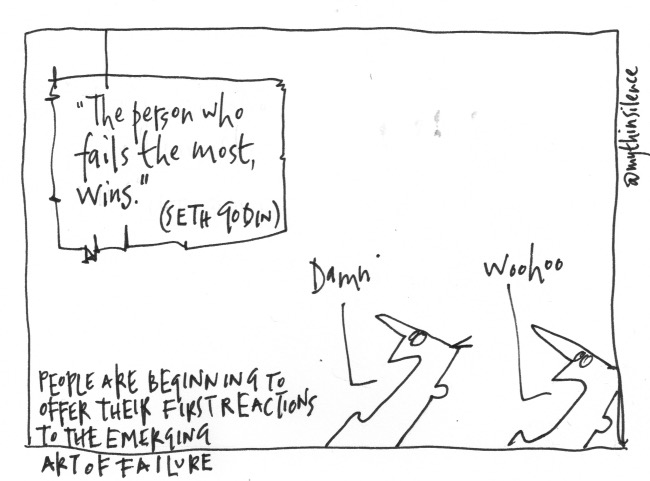
14 people are beginning to offer

“Be blessed.  And just as you are transforming your own life, may you transform the lives of those around you.  When they ask, do not forget to give.  When they knock at your door, be sure to open it.  When they lose something and come to you, do whatever you can to help them find what they have lost.  First, though, ask, knock at the door and find what is missing from your life.”*

Wisdom can be understood as what we know and who we are and the world in which we find ourselves, and our thoughts and our relationships and out behaviours all contribute to all things flourishing and thriving.

In the Genesis myth, Eve and Adam take the fruit from the tree of good and evil, or, wisdom – apparently, this was the one thing they were not supposed to do.

I find myself wondering whether this story is about how we are unable to pluck wisdom like a fruit, already formed; it has to be grown like a tree, through the kind of daily interactions described in the quote, above.

Wisdom-living is never ours in some hermetically sealed way.  Every thought, relationship, or behaviour reduces or increases the wisdom happening in our lives.

‘Whatever these forces are that make people do dumb things, they are powerful, they are often invisible, and they lurk even in the best of environments.’**

Even in the Paradise of the Genesis myth.

Wisdom – or thriving or life-in-all-its-fullness – emerges out of struggle.  It cannot be reduced to mundaneness or captured in habits and practices and self-help manuals – more attempts to pluck the fruit, more shortcuts.  By struggling to grow wisdom, we become receptive to what we do not know and cannot do, yet:

‘You were sent to the earth to become a receiver of the unknown.’^

‘The greatest quest is to make humanity human.  This will require more than knowledge, it will require wisdom.’^^

(*A Siberian shaman in Paulo Coelho’s Aleph.)
(**From Ed Catmull’s Creativity, Inc..)
(^From John O’Donohue’s Eternal Echoes.)
(^^From Alex McManus’s Makers of Fire.)

a hard rain’s a-gonna fall*

13 you don't have to

So what are we going to do?

We can moan about how hard things are – we all do it.

Or we can use these same things as means and opportunities for finding a better future – to be honed by the trial: who we are and what we do.

There are things that can destroy us – I don’t mean these things.  These are the abyss, chaos, but the edge of chaos is something else:

‘The edge of chaos is a condition, not a location.  It is a permeable, intermediate state through which order and disorder flow, not a finite line of demarcation.  Moving to the edge of chaos creates upheaval but not dissolution.  That’s why the edge of chaos is so important.  The edge is not the abyss  It’s the sweet spot for productive change.’**

Better rarely comes easily or via a shortcut.  Easy lulls us into asking the wrong questions.  Hard makes us ask deeper, better questions, and there’s always more than one to be asked.

(*Bob Dylan‘s song, which I first heard sung by Bryan Ferry.)
(**From Richard Pascale, Mark Millemann, and Londa Rioja’s Surfing the Edge of Chaos.)


alignment

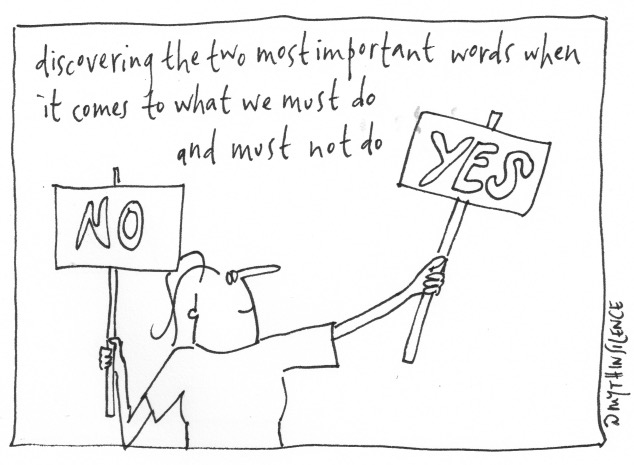
12 discovering the two most important words

‘Maybe it’s the afternoon, maybe it’s the light, but at that moment, the universe seems to be in perfect harmony.’*

There’s a moment when what are you doing, why are you doing it, who are you doing this for and with, and when you are doing it align.

Understanding what each of these elements comprises of will mean you’re better able to place yourself in a future moment of alignment, to do the thing only you can do, the reason you feel you are in the universe to contribute.

Be honest, in this moment, you’re not thinking about how much you earn or the size of the house you live in.  You know what has made this moment happen are values and hopes, some dreams, unique skills and talents, and a need beyond yourself.

What you’re realising is most the most important things of all are already within you, and, when you recognise and employ these you know a freedom of being and movement.

It’s worth taking a few moments to capture these things, to write or draw them to be able to reflect on them and imagine how to express them.  All of what you capture means you have enough to begin.

(*From Paulo Coelho’s Aleph.)