control and curiosity

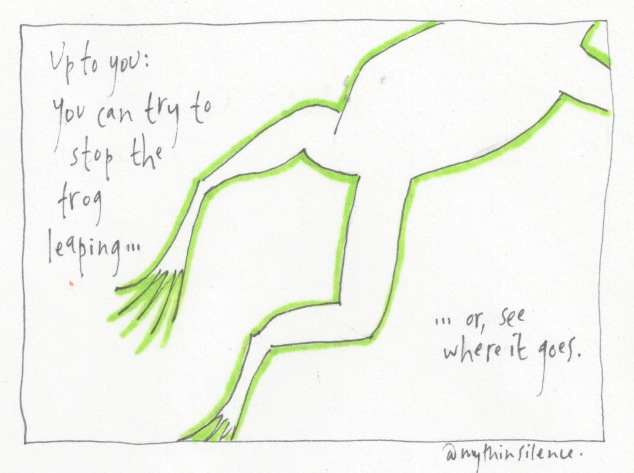
11 up to you

‘No, the jumping frogs aren’t merely an unfortunate hassle for the frog tamer.  They are, in fact, the entire point.’*

It’s hard to control and be curious at the same time.  To be curious is about letting go and to letting come.  As Pema Chödrön has pointed out to a year of graduating students:

‘No one knows what is going to happen next.’**

Back in 986CE, Bjarni Herjulffson set off from Norway to Greenland.  When blown off course, he refused to explore some land spotted by his crew.  He got back on course for Greenland.  Later in life, he told this tale to his friend Leif Erikkson who was inspired to set out on his own journey of discovery. Erikkson set foot on the land Herjulffson refused to, the first known European to step out into North America.^

The gift lies beyond.  Curiosity takes us beyond the boundaries we construct.

(*From Seth Godin’s “forward” to Pema Chödrön’s Fail Fail Again Fail Better.)(**From Pema Chödrön’s Fail Fail Again Fail Better.)
(^Told by Rohit Bhargava in Non-Obvious.)

heartedness and giftedness

10 flaneur:flaneuse

Good heartedness can turn just about anything into a gift, and bad heartedness can reduce any gift to a possession.

We expand a circle – from me to me and you, to us and others – and a gift is formed and developed and renewed.  Ego to eco.

(The gift circle is grown multi-dimensionally when we include the world and our higher hopes and values.)

When we seek to possess the gift, we reduce the circle.  Eco to ego.  The light of the gift goes out.

But we renew the gift when:

We allow curiosity to constantly renew us
We are observant, seeing what others do not
We hold lightly to pass on, rather than grasp to possess
We are reflective and thoughtful
We seek to add to (innovate), creating something beautiful to pass on.

the miser and the curator

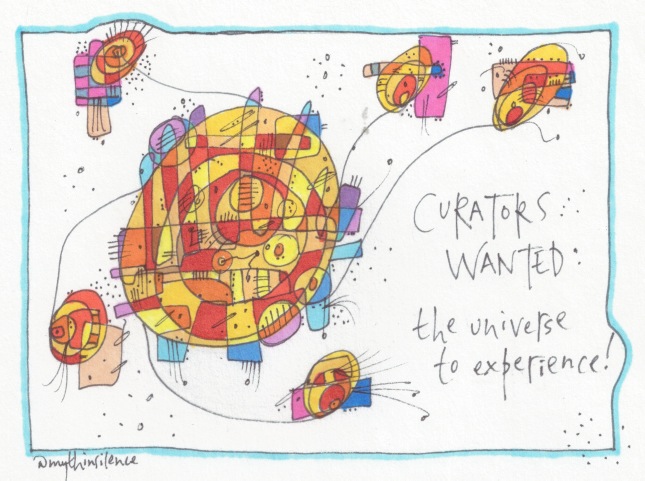
9 curators wanted

‘Exclusivity is the economic sibling of scarcity.’*

Small-town America with diners and ice-cream bars one minute, then a scoop of London the next, behind which opened up a world of witches and wizards.

My wife Christine and I thoroughly enjoyed our visit to Universal Studios in Orlando, even though it was the repackaging of the large into the small.

Life, though, seems to be set up the other way around.  Taking us from small experience to large, including from me to me and you, and from us to others and more.  From this, we know the experience of life isn’t set.  It grows through the increasing numbers of people involved in sharing gifts.

‘No one else can drink from the ego-of-two.  It has its moment in our maturation, but it is an infant form of the gift circle.’**

We are walking sensor arrays.  No wonder mindfulness is one of the phrases and experiences of the present.  People are rediscovering they’re more than their thoughts.  As I was sifting through my thoughts this morning, I was struggling with a headache but was I was still excited by what I was reading.  The excitement wasn’t registering in my head but in my chest.

Rohit Bhargava’s description of the curator caught my attention:

‘This combination of collection and contemplation is central to being able to effectively curate ideas and learn to predict the future.’^

The miser operates in a world of scarcity.  He takes something very big and makes it small so he might own it, control it.  Deep down, he’s cynical about the experiences of others who witness to there being more.

The curator selects from a world of abundance on order to shape an experience intended to open up the future.  Hers is a crucial task in the universe’s circle of the a gift, making it possible for as many as possible to receive gifts and to give gifts on.

‘When we see that we are actors in natural cycles, we understand that what nature gives to us is influenced by what we give to nature.  So the circle is the sign of an ecological insight as much as of gift exchange.’**

We all have the opportunity to be a curator for at least one other.

(*From Joseph Pine and James Gilmore’s The Experience Economy.)
(**From Lewis Hyde’s The Gift.)
(^From Rohit Bhargava’s Non-Obvious.)

the miser and the gift

8 life is a gift

‘He remains cold and indifferent to the joys and sorrows of others, even his own.  As a substitute for a live experience he substitutes the memory of past experiences.  These memories are a precise possession … .’*

The miser turns everything into a possession, even experiences.

A part of our lives will be about possessions and transactions: in the West, when we purchase something, we expect the value of the object to be commensurate with the payment we make, and vice versa – reciprocity.

But life must also be about giftedness.

The best kind of gifting may move the gift between more than two people.  If I give you something, I can keep an eye on it to see what you do with it.  But if I give you something with the hope you’ll give it to someone else, then I lose sight of it, and perhaps it will keep travelling.

This is fascinating to me because of the work I love to do – helping people to awaken to their dreams and to live more fully who they are.  So I love the idea of someone I journey with, journeying with another and this experience to be passed forward.

A century ago, ethnographer Bronislaw Malinowski lived amongst the Massim people of New Guinea.  He was witness to an elaborate form of gifting.  Armbands and necklaces would be gifted between islanders, across hundreds of miles of water, armbands travelling in one direction, necklaces in the other.  This wasn’t how they dealt with everything they had – the Massim used a bartering economy – but there was also gifting.**

The miser makes everything a reciprocal transaction.  The gift adds imbalance, something beautiful to life we create together.

Even if we’re in selling mode, we can always add a gift of some kind.

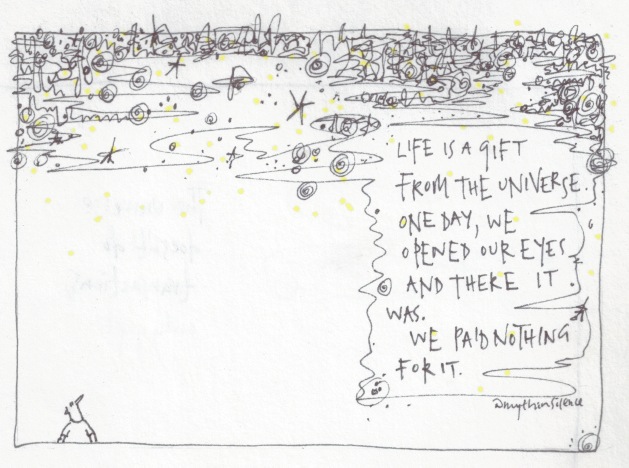
Life is a gift from the universe.  One day, we opened our eyes and there it was.  We paid nothing for it.

In this universe, gift comes first.

(*From Erich Fromm’s The Art of Being.)
(**From Lewis Hyde’s The Gift.)

potlatch universe

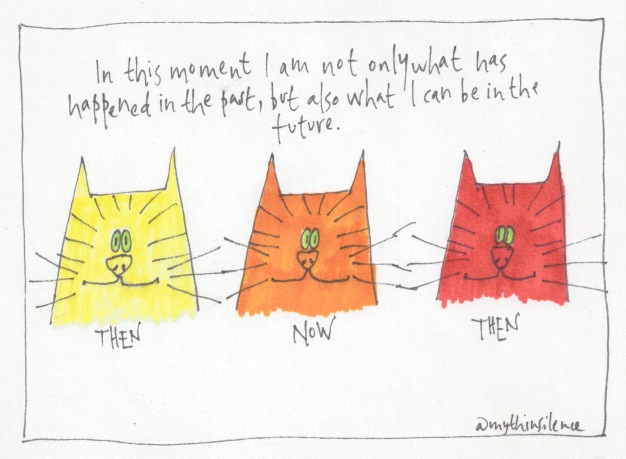
7 in this moment

We live in a moving universe – continually expanding towards we know not what.

Within such a universe, nothing remains the same and equilibrium can become a dangerous thing, such as believing this is it – especially in the stories we create to make sense of sentient life.  Even things intended for good can become harmful if they are not allowed to move forward.

Lewis Hyde tells of the origins of potluck (potlatch) ceremonies in native American culture when goods would be consumed: food would be eaten but also tents and goods would be burned – a form of eating.  The Haida people even referred to their potlatch as “killing wealth.”  When something is owned, problems follow.  In this world, a gift is meant to keep moving; when someone keeps it as their own they’ve done something wrong.*

Seth Godin writes about how a gift creates disequilibrium, creating a world of giving over one of having.  Fifty-one per cent giving to forty-nine is enough to begin.

We live in a potlatch universe, inviting us to keep moving, to keep what we have moving, to consume what we need and to see what we can do with the rest.

‘No one is born graceful.  It’s not a gift, it’s a choice.’**

Being graceful is about making our life a gift to others, whether we think they deserve it or not (the universe has graced life to us).  Seth Godin offers this thought.

(*From Lewis Hyde’s The Gift.)
(**From Seth Godin’s Graceful.)

clennon king

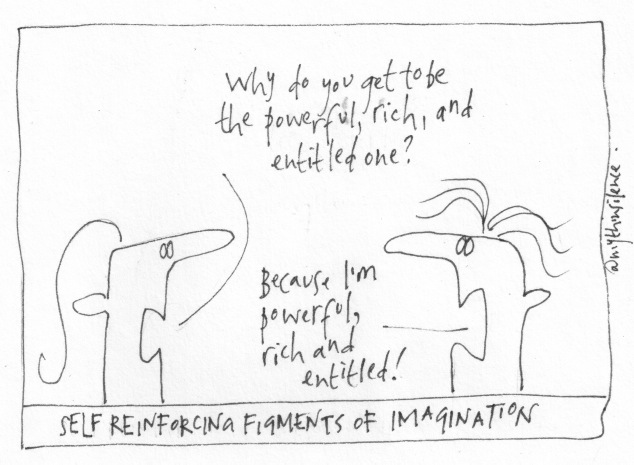
6 why do you

In 1958, Clennon King applied to be a mature student at the University of Mississippi.  A judge committed him to a mental asylum.  The reason?  He was black and had to be insane to think he could enter the university.

The frameworks which inform us this is the way it is for people because of their race, gender, sexuality, colour are, in the words of Yuval Noah Harari “figments of imagination.”*

‘Unjust discrimination often gets worse, not better, with time.  Money comes to money, and poverty to poverty.  Education comes to education, and ignorance to ignorance.  Those who are victimised by history are likely to be victimised yet again.  And those whom history has privileged are more likely to be privileged again.’*

I’d only just come across the statistics showing how a man living in east Glasgow has a life expectancy shorter than a man in Haiti.**  The stories of both these “men” are shaped by something we have made up.

Daniel Kahneman writes of a condition he names frame-bound:

Reframing is effortful and System 2 is normally lazy.  Unless there’s an obvious reason to do otherwise, most of us passively accept decision problems as they are framed and therefore rarely have an opportunity to discover the extent to which our preferences are frame-bound rather than reality-bound.’^

As highly developed cognitive beings, we need stories to live out our (sixty-two or sixty three years of existence in east Glasgow and Haiti) eighty years of existence (soon to be one hundred years?), and we know we can create better ones.

Indeed, this might be the defining characteristic of our age.

(*From Yuval Noah Harari’s Sapiens.)
(**Here is Katherine Trebeck’s TEDx Glasgow talk.)
(^From Daniel Kahneman’s Thinking Fast and Slow.  System 2 is our ability to think about what we are thinking about, but this takes energy.)

it’s a steal

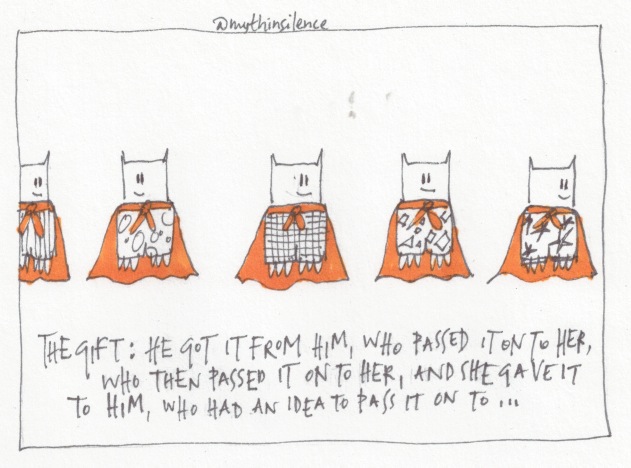
5 the gift

Not if I give it to you as a gift.

Unless we’re some kind of Robin Hood, we don’t steal to pass on to others.  We steal to gain some benefit or advantage or edge for ourselves.

Gifts, in the Native American sense, are always gifts – never become capital.  The early settlers of North America just didn’t get this.  They called those who saw a gift as always being a gift, Indian givers.  

It’s a disparaging term we can aspire to.

Each of us has a gift (knack, purpose, art, calling, vocation, element, flow) which isn’t to be kept to ourselves but to be gifted to others.  Indeed, the only way to develop this is in sharing it.  But if I give something to you, I don’t want you to keep it to yourself, I’d love it if you were to pass it on.

What’s your gift?*

(*Sometimes we can make a living from what it is we love to do, but I’m thinking about what

acknowledgments

4 some conversations

The best things we hope for ourselves, others, and our world won’t just happen.

We have to work for them.

‘And stories are all about conflict.  What lies between a person and what that person wants is work.’*

Hoping good things will happen is an event-led view of the future.

Hoping for things through hard work is a choice-led perspective.

The bad news is, we can only do it with others.

The good news is, we can only do it with others.

Like in the acknowledgements at the end of a book when the author lists all the people who have helped get them to publishing.

So many stories waiting to be written.

(*From Donald Miller’s Scary Close.)

lighten up

3 the day before

We each bring light into one another’s lives.

We can often see others better than we can see ourselves – something I was reminded of yesterday.

It can be a life-changing thing.  And just as a day is filled with many kinds of light, each with its own kind of beauty, so each person who visits with us brings a different quality of light to us.

‘[A]t times, we accidentally tear a little hole in the fabric of reality so something on the other side shines through, exposing the darkness of our routine existence.’*

The emerging future is a serendipitous thing.

It depends on our noticing and then being willing to risk becoming more what others feel they see in us – capturing these unexpected rays of light and choosing to live accordingly.

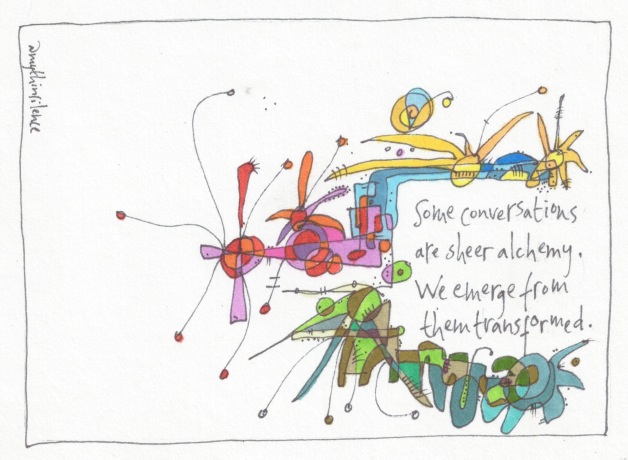
None come to us as fully formed ideas and possibilities but, when we synchronise them with our values and skills and longing, a kind of alchemy happens.

One way we can remove risk is by trying out the possibility: little experiments, prototypes, so we can learn quickly, often, and always forward.

(*From Donald Miller’s Scary Close.)

longing

2 with our values

‘I don’t mind the longing.  The longing is beautiful.  I don’t want to feel it alone anymore.’*

What is this longing?

We explore it through special others, through great endeavours, through the latest technology, and still the longing is there.  Some frame the longing in a religious way, others in a philosophical or existential way, others as a mystery.  We only know, it’s there.

‘Curation is the ultimate method of transforming noise into meaning.’**

For curation read story. Story is our way of making sense of everything within which we find the signals relating to longing.

Curation, or storyboarding, is an intense endeavour.

We need time and space for deep observation: ‘isolation stimulates risk taking, encouraging ideas weird and wild and acting as a counterforce to organisational inertia.’^

This is true for the individual and for the tribe: those we share our longing with and in whom we find the longing expressed.’

We know this is not it.  It’s the great story of Humankind which we have taken on from those before us and which we’ll pass on to those who follow.

(*From Donald Miller’s Scary Close.)
(**From Rohit Bhargava’s Non-Obvious.)
(^From Peter Diamandis and Steve Kotler’s Bold.)