permissioning (pilgrimage four)

11 pilgrimage 4

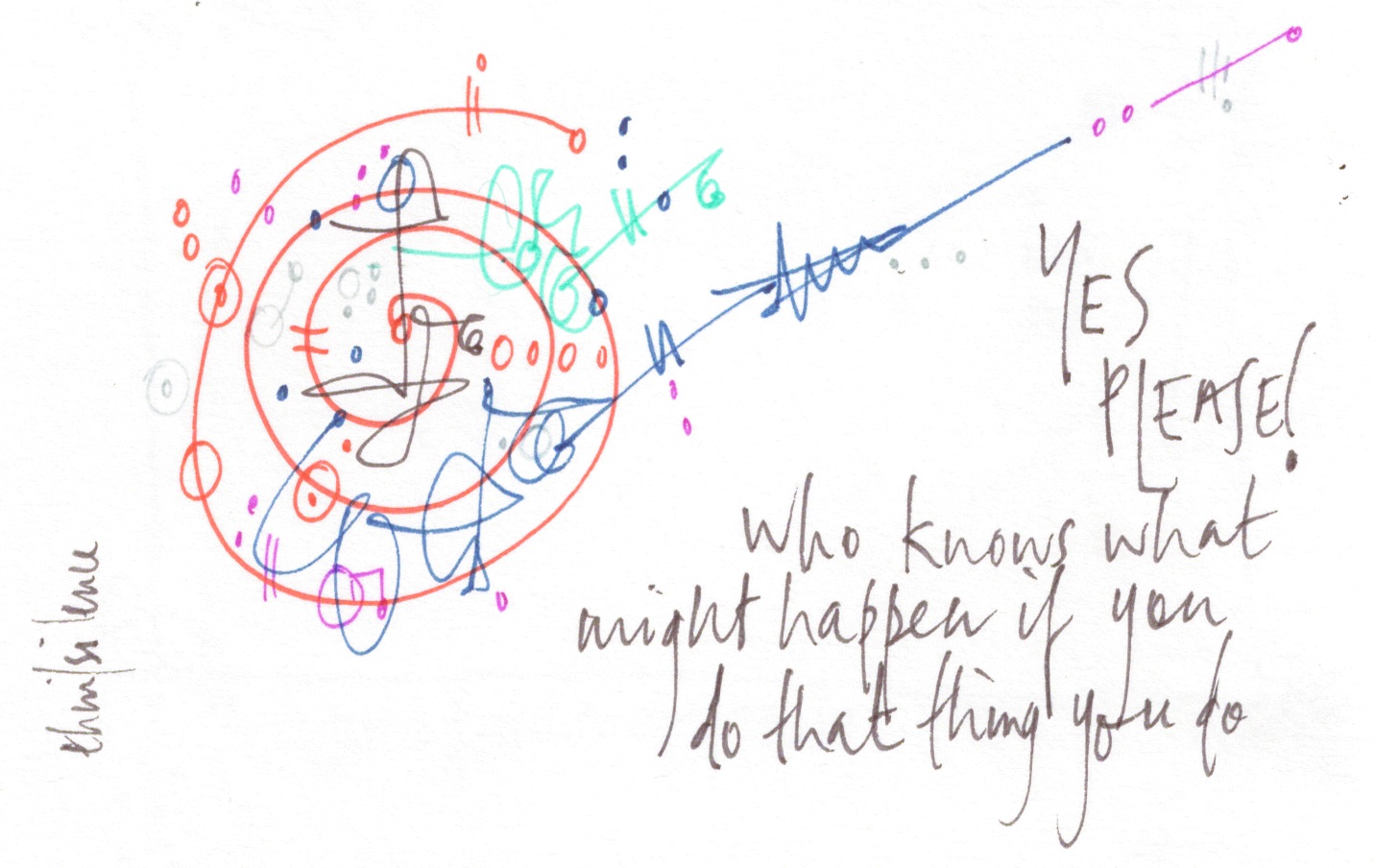
We all need someone to open up the way before us: a permissioner.

In turn, we become permissioners of others.

When we get the hang of this, we can permission ourselves too.

This not only covers what we do but how we do it.  When people live in attractive ways – the things which Erich Fromm named basic norms for human being – they give permission to others to live similarly.

Permissioners come from the future – what we can each be and what we can we be together.

movements (pilgrimage three)

10 pilgrimage 3

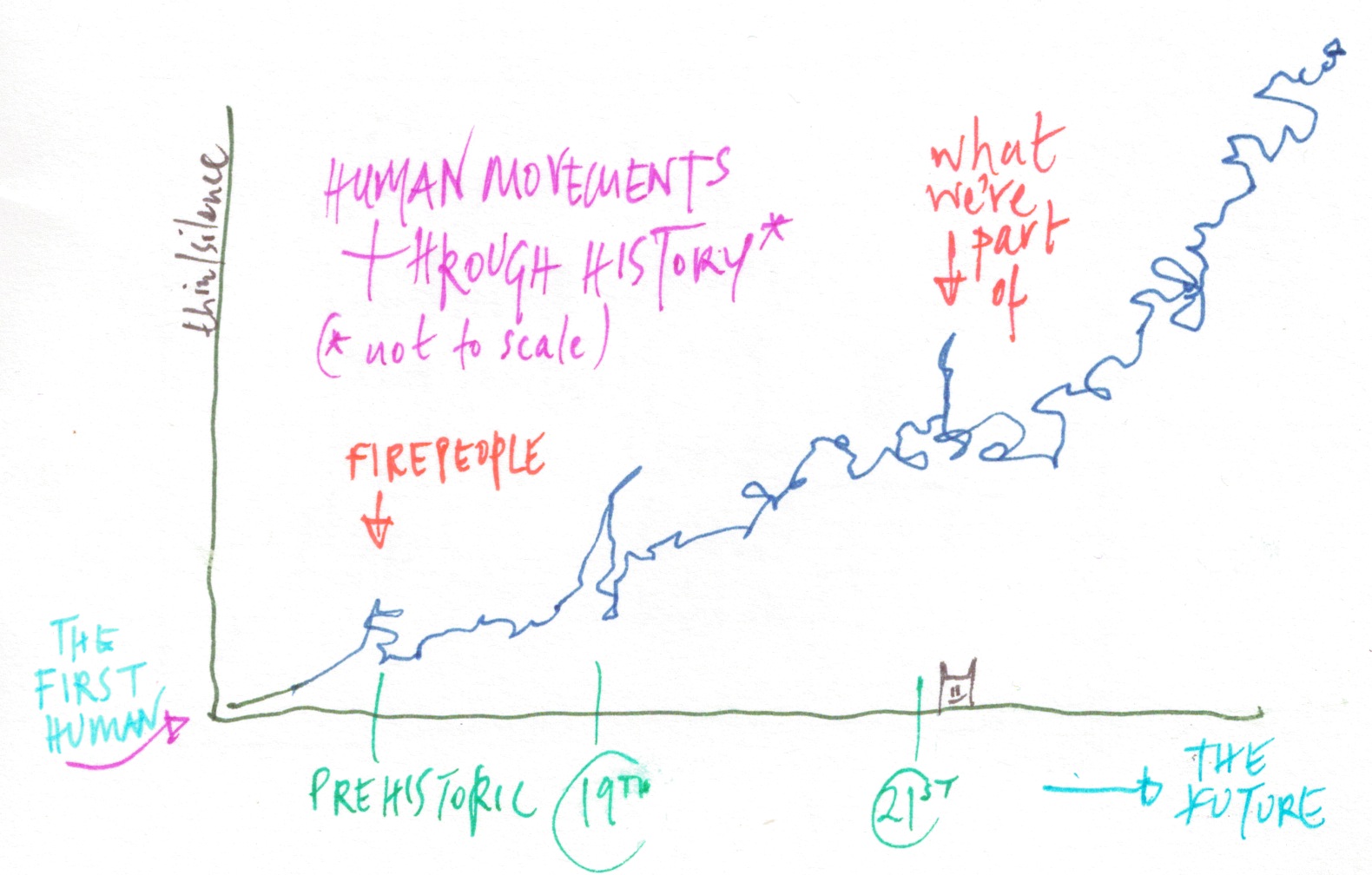
Movements are about movement.

Inner movement (our thinking, values, and motivations) being joined up to outer movements (the contribution of our “art”).

Aliveness is perceived most clearly in movement.  When we see something not moving we wonder whether it’s alive or not.  Movement people look different to non-movement people, and the world is asking that we be willing to bring our greatest aliveness to each day.

To be, Erich Fromm would say, is to be active rather than possessive.  This same thought is contained in Otto Scharmer’s Theory U: we are most present (alive) when we are producing (with others).

We do not choose to live – someone else made that decision for us.  We do quite like it, though, once we’ve tasted it.  The question is, how far will we take it?

If you are bringing your greatest aliveness to the party, you are part of a movement of people who are exploring what life can be, not for one’s self but for one another – which seems to be the thing that does it for us.

Keep moving.

paths of aliveness (pilgrimage two)

9 pilgrimage 2

How do you measure aliveness?

After agreeing the basics what would you say?  And how will you become more alive?  Because we know this is not it.  In this we are pilgrims.

Whilst this may sound like an individual thing, it’s more about engaging with others – as subject or companion.  Pilgrims help each other towards personal aliveness.  This is to be Human.

There are paths we can share with others.

There are paths we must face alone.

And oftentimes, there is no path at all.

Some are thrust into pilgrimage, others decide to embark upon it; whichever way it is for us, we look for opportunities to bring aliveness to others.

This is not the same as having.  It is about being, about an infinite game in which we seek to live our lives towards including more in the game and keeping this game going for as long as possible.

This is what occurs to me on this second day of pilgrimage.

portals for possibility (pilgrimage one)

8 pilgrimage 1

For the next few days I’m going to be on something of a pilgrimage.  Anyone can embark on a pilgrimage (an outward experience enabling an inner transformation) for any reason, in any place they wish.  The best pilgrimages enable us to mature, think, change, and grow, as Brian McLaren reminds us.

We first must pass through a portal, which may be a decision or passing through an airport departure gate as I did earlier today.

It is the beginning of something unfamiliar, something we’re not quite sure about – but also something which guarantees we will not stagnate, lose purpose, or choke.

We do not have to take a path already existing; we are developing capacity to live in new ways.

Erich Fromm would probably remind us at this point that there Is a path of having and a path of being.  This portal is about being present to more – more of our world, others, and our future Self – rather than having.

What will be your pilgrimage, investigation, expedition, odyssey?

maps and the imagined future

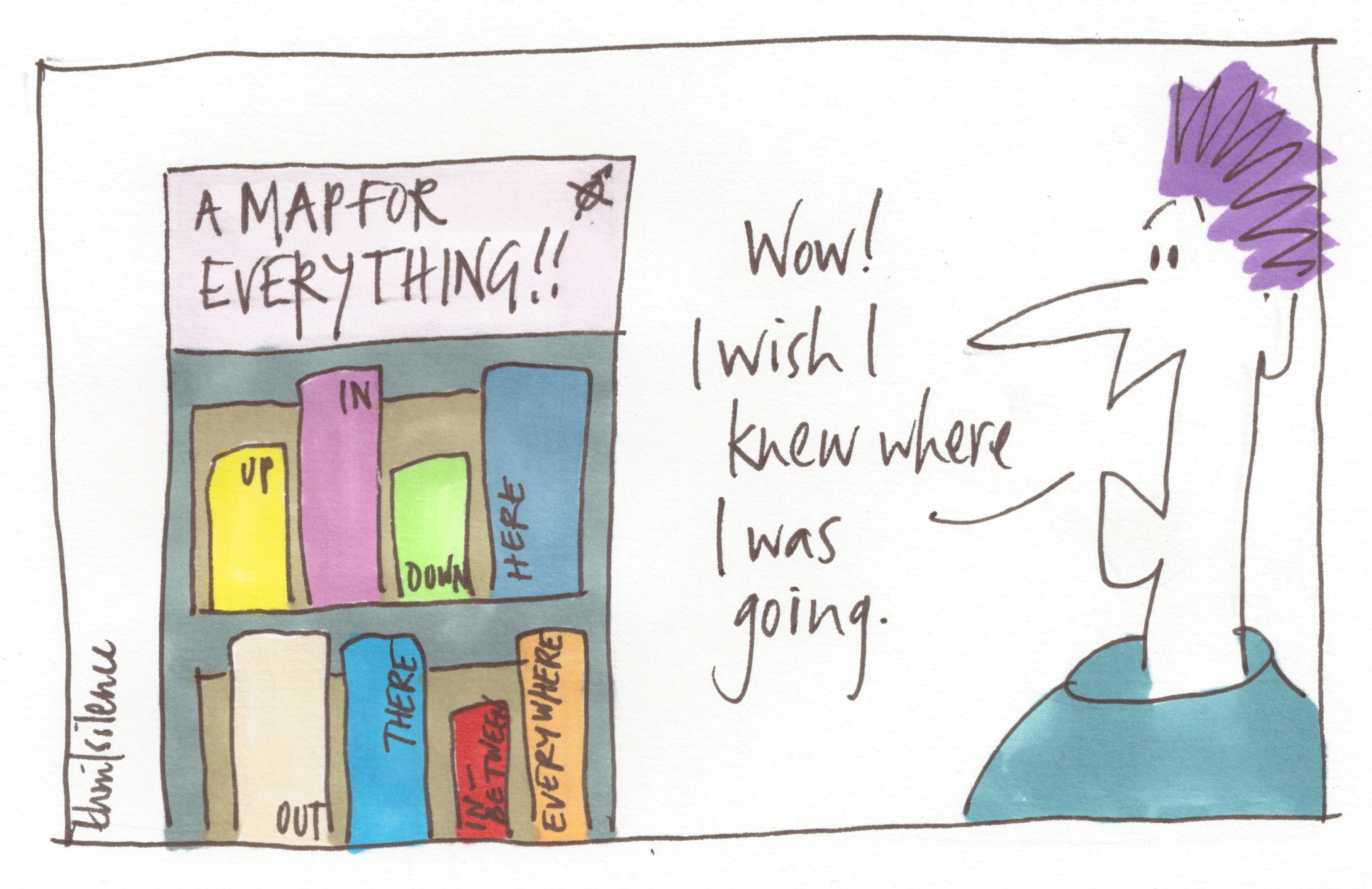
7 a map for everything 1

An Australian once told me of a trip he made to the UK.  He picked up his hire car at the airport and set out on his journey, only to find himself 200 miles past his destination before checking the map.  He hadn’t calculated in scales used for Australian and British maps were a just a little different.

Whilst maps deal in reality, they struggle with our expectations and imaginations: ‘Ultimately, the map represents us with the reality we know as differentiated from the reality we see and hear and feel.’

On the eve of a journey, I am trying to imagine what lies before me, piecing together memories and online maps with arrangements to be with people.  It’s going to be something of a pilgrimage, which I think of as an external journey which represents an inner journey. In my case, I’m exploring ideas and thoughts about my future work, my art.  My imagination is already reaching out to feel for something of what this journey might include, creating an imaginary map of the different places and people I will encounter.*  There’ll be many surprises too, things not found on any map – ‘maps are fixed in time and include only features considered relatively permanent.’

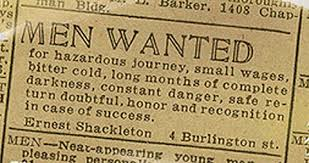
It was the possibilities not marked on an map of the Antarctic that beckoned the interest of more than five thousand men to apply for entrance to the expedition:

7 shackleton

Maps have used all kinds of materials, from lines in the sand washed away in quick time, or etched into bone to be more permanent.  Maps are also etched into Human lives.  Some of these account for journeys already completed.  Others are maps of the imagination, sketching out continents of adjacent possibility for our lives to explore.

I only want to encourage you to create some new maps.

(*Any experience or journey can be framed in such a way.)

invisible maps

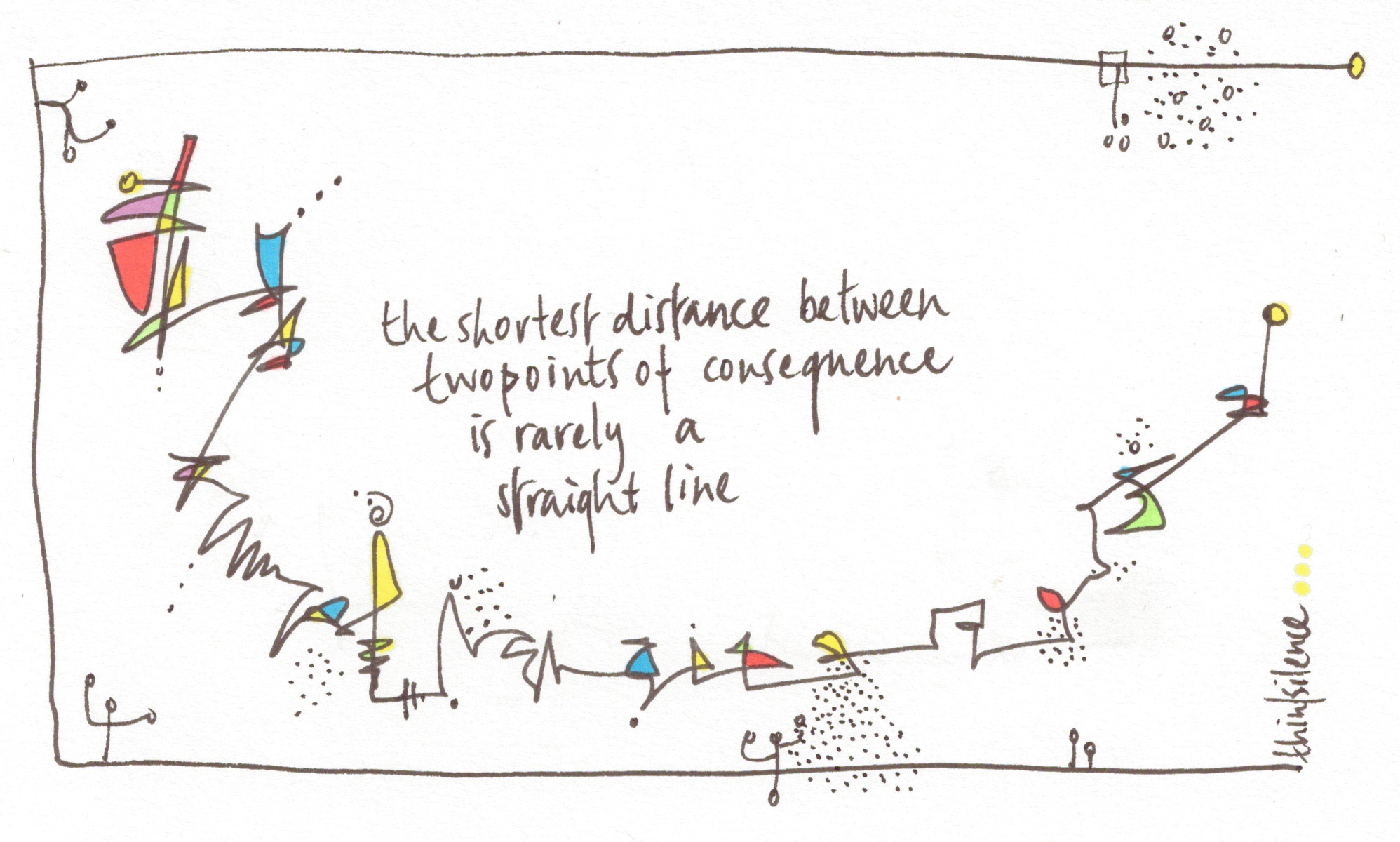
6 the shortest distance  ...

Humans are explorers.

They leave maps and follow maps and then leave new maps.

Anything can become an exploration for us: an exploration can be an inch wide and a mile deep.

Maps tell us this but not that; they tell us in this way, not that way.

The map I was following a couple of days ago didn’t tell me about the detour of more than twenty five miles!  Admittedly, it would need to be a Harry Potter’s Marauder’s Map to be able to do this.

This same trip could have been represented by many maps: maps which included contours or all the homes where someone called Angela or Friedrich lived.

We also use maps to describe our lives.  I’ve been asked to provide a description in a paragraph of what it is I do, this for an upcoming event.  I’m struggling to do this, so I’m reminding myself this has to be a map which tells this but not that.

You cannot tell me everything about yourself in one description, one map.  When you tell me “I’m only a …,” I hope you don’t believe it.  I hope you know it would take many maps to show me what your life is about.  Not only this, because maps are about what has been discovered, you’re in the process (life) of drawing new maps.

And we can share maps with each other.  Some discoveries you’ve made and recorded on your map can help me continue on a journey; maybe some of mine will help you.

wunderkammern

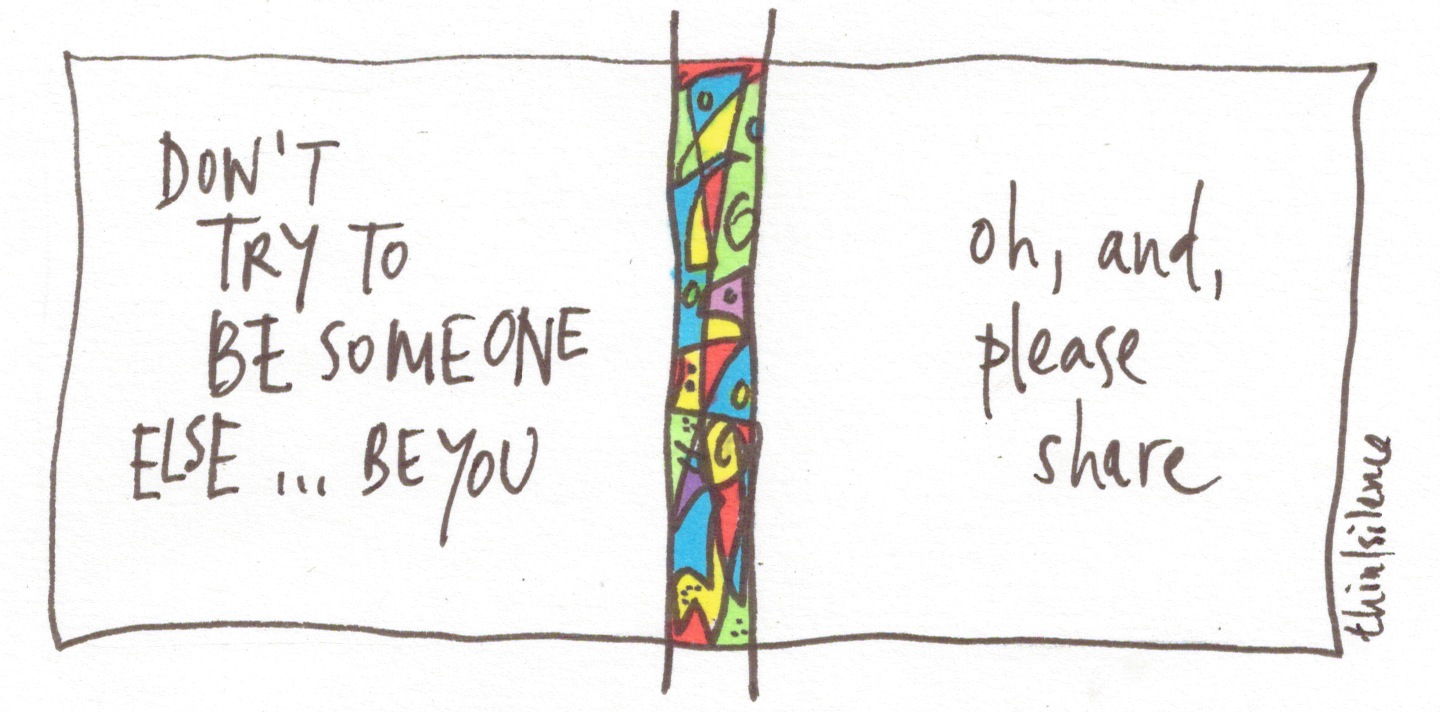
5 don't try to be somone else ...

Wonder chamber: a room or cabinet filled with the gathered objects and curiosities by the wealthy and educated 16th and 17th century European.

Every person is a wunderkammern, throughout their life capable of revealing* more of the wonder and uniqueness of who they are and what they have to contribute.  Not only a wonder to others but also to themselves – people are full of surprises and we need to keep surprising ourselves, too.

Some years ago, Christine and I were taken by some friend’s to visit collector Alex Jordan‘s eclectic House on the Rock in Wisconsin – a hideaway he built around a rock, and which grew and grew to house Tiffany glassware to carousels, ship’s propellors and gatling guns.  It is awe-inspiring and unnerving in equal measure (there was an orchestra of mannequins dressed up as celebrities, including Queen Elizabeth and Burt Reynolds!).  Jordan never intended the public to see what he was doing and collecting, and when some people began to ask how much it would cost to have a look around, he came up with an amount which was meant to turn them away.  It didn’t and he began to share his collectings.

It’s a great reminder for how we are all collectors of disparate and unusual and inspiring artefacts and thoughts, but we cannot keep them to ourselves, we must share them in new ways with others.  Austin Kleon writes:

We all love things that other people think are garbage.  
You have to have the courage to keep loving your
garbage because what makes us unique is the diversity
and breadth of our influences, the unique ways in
which we mix up parts of culture others have deemed
as high and low.

John O’Donahue asks his readers to ponder what life might have been like if they were born next door, how different our lives might be.

This brings out intriguing thoughts about how life is not as accidental as we think.  In some way, we were chosen into existence by our parents, directly and sometimes indirectly; these choices have a direct bearing on when and where and who we would be born to be and live.  With this comes a sense of destiny: ‘When you begin to decipher this, your gift and giftedness come alive.’

This is more about deciphering forward, unravelling the future, rather than saying this is what you have to do (because you were born when and where and who you are).  This is about who and what we are becoming, a revealing of our future Self (never fully known): a destiny formed of decisions from our future, not our past.

Humility, gratitude, and faithfulness then become primal attitudes or practices for us towards this destiny.  I am chosen but not because of anything I have done but for the possibility of my unlived future.  I am grateful to others that I am – I had nothing to do with this; and, I have the freedom to create and make something with all of this.

I am grateful to Austin Kleon and John O’Donahue for their thoughts, which I’ve now collected in my  wunderkammern.  By the way, this wunderkammern experience is on loan for maybe eighty years.  No pressure.

(*John O’Donahue points out that ‘the word revelation come from re-valere, literally to veil again.  ‘Behind each human face there is a hidden world which no one can see.  Interesting, we catch glimpses of more in each others lives but never see the full picture.)

mindfulness

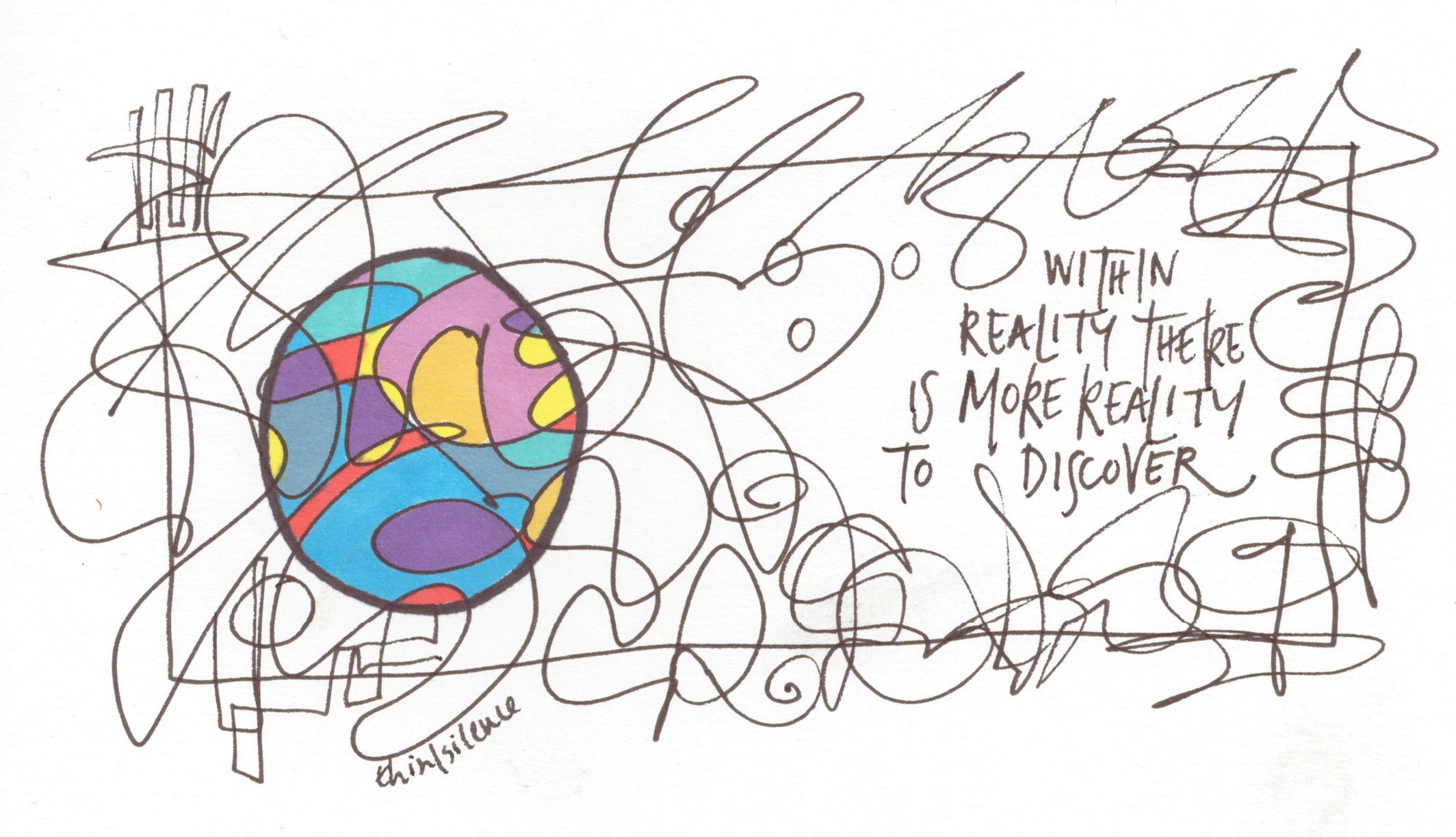
4 within reality ...

A definition of mindfulness for the purpose of this blog: to be increasingly open and connected to the Other – people, the world, our future Self – through all our senses.

There is a moment in the Star Trek movie Insurrection,* when Jean Luc Picard is arrested by the magic of a moment as seeds are lifted on the breeze by a breath as time appears to stand still.

These moments are always available to us through mindfulness, reflection, presence, meditation – whatever we may term or mnlabel it.  We forget this in the rush and necessity of daily life, but it’s always there – life’s gift to us.  Waiting to be entered into, a reality within a reality, to then be carried into the speed and demand of a day.

Perhaps we need the poet and artist and filmmaker and storyteller to capture this most sharply for us.  Activist and author Jane Jacobs didn’t see the cram of buildings in her neighbourhood, rather she saw ‘a vessel of empty spaces in which people interacted with other people.’  Jacobs saw a dance; we can all be involved in the dance, a different way of seeing the invisible city, and the invisible life.

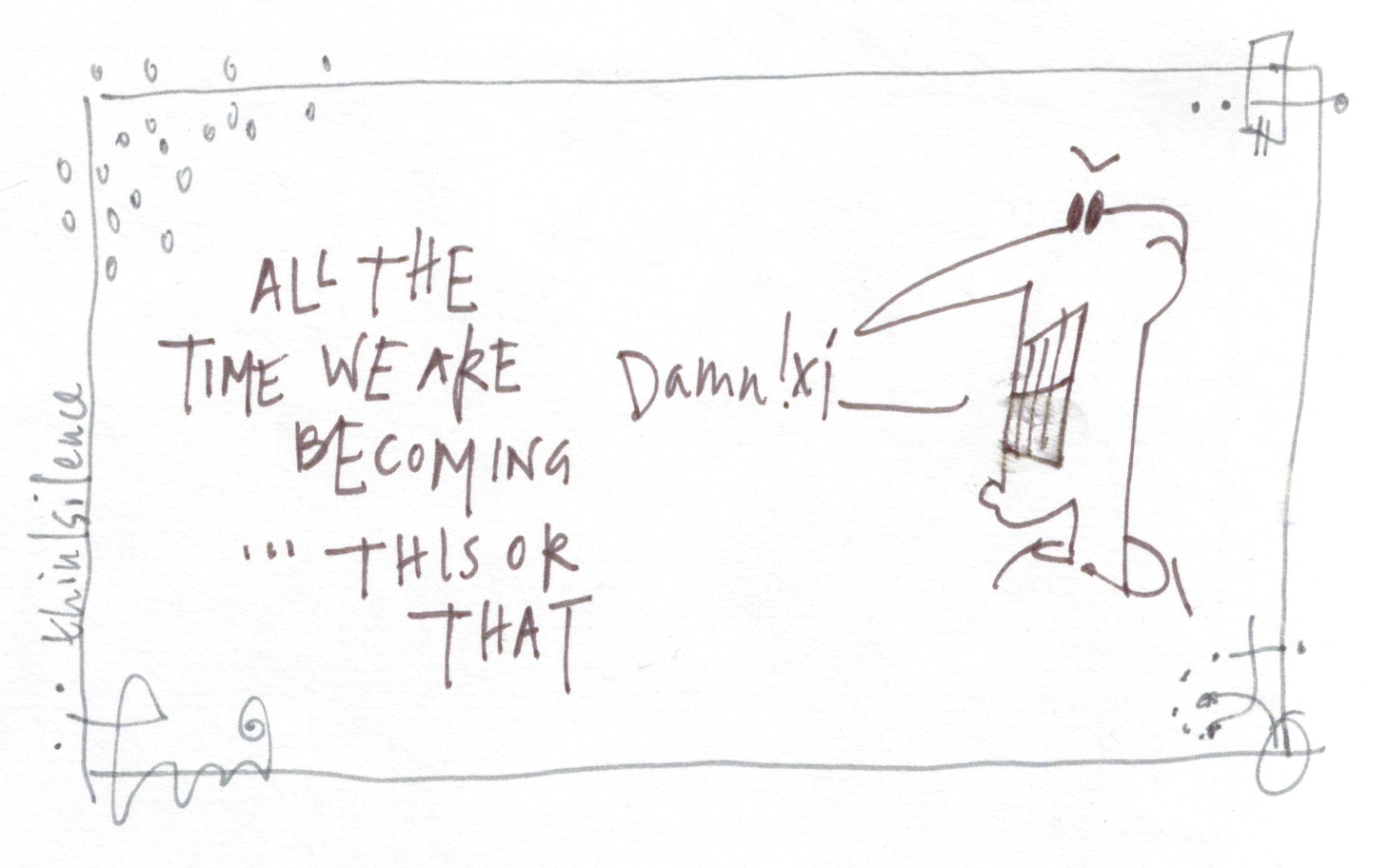
There’s a hugely valuable game for improv (theatre and comedy): “yes and”.  You cannot say “no and,” “no but,” or “yes but.”  You have to say “yes and” and see where it leads you and the one proposing.  This recognises life is best played as an infinite game.

When have you been arrested by something which has caused you to wonder for a moment – an image, a story, a film, an action, take it as an impro moment: “yes and.”  You can’t say “no and,” “no but,” or “yes but.”  You have to say “yes and” and see where it leads you and the one proposing.  

(*Check out moment “3” in this youtube video.  As with many sci-fi movies, we are exploring what is available to us right now through the lens of the future.)


wide listening and thin silences

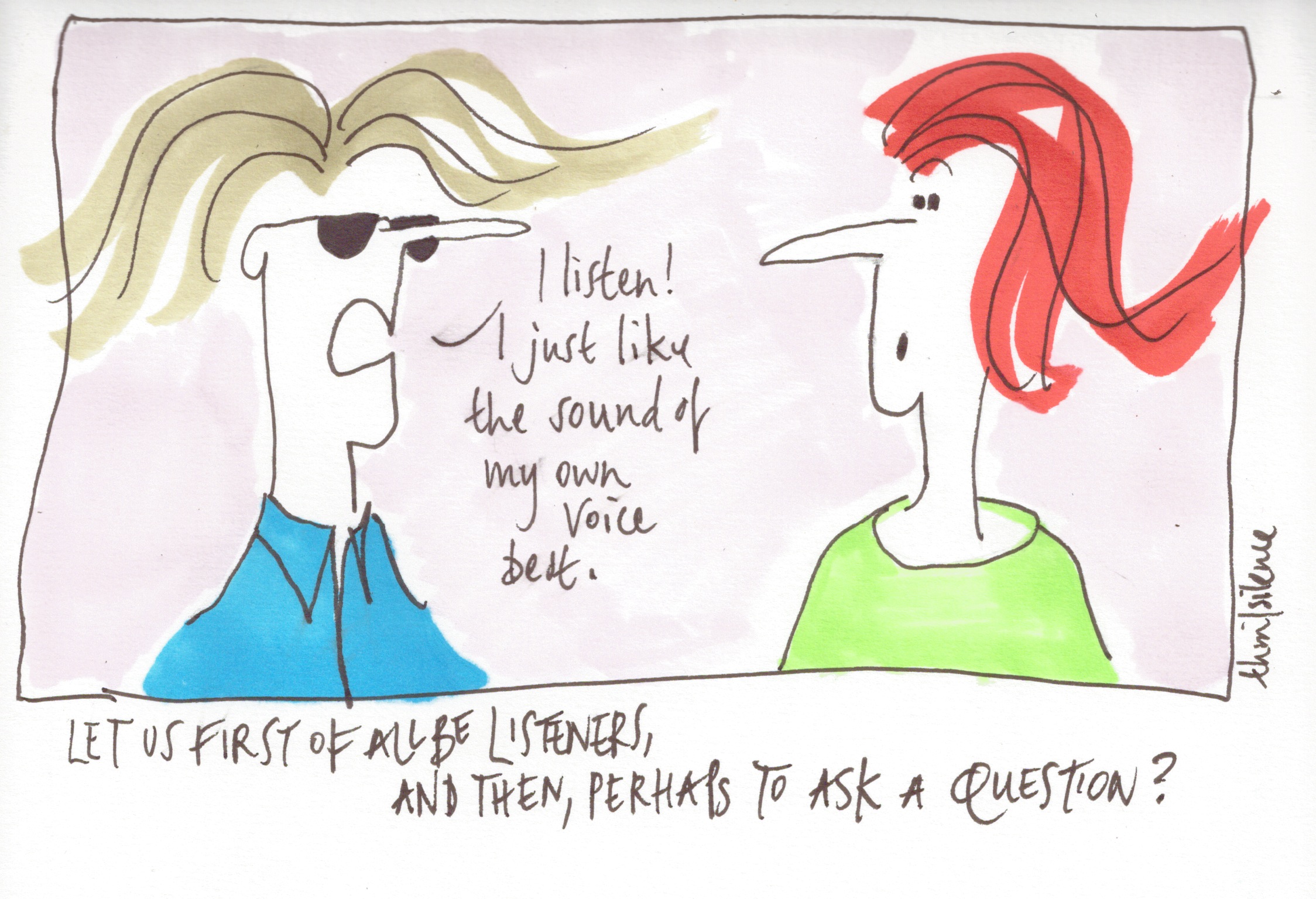
3 may we first of all be listeners ...

Our senses are wider than we imagine, the means by which we cross thresholds into each other’s worlds, into the world, into our future Self, and, if we have a god, into our god too.

The wide sense of listening not only allows us to hear the sounds but also the silences which exist between the sounds.  These words from John O’Donahue caught my attention when I came upon them at the birthing of today:

All good sounds have silence near them, behind and within them.

Do you listen for the silences?

In a conversation shared with a friend, each is listening to the silences within the other?

When the sounds of traffic and manufactured things abate and the silence of nature breaks in, listening to you, its child?

When all the talking inside your head ceases and you lean into the thinness?

When the bad noise fills our lives to excess we are aged before our time.

But if we can catch the silences and learn the new things which come to us, tee might find ourselves renewed, able to renew others through our listening to them.

This wide sense of listening is slow, or deep.  It mustn’t be hurried because there’s something else to be listened to.  How many times have we misunderstood another, or undervalued nature because we have not slowly listened?

Whilst this may all sound magical or mystical, truth is, it’s all held in small habits which we form – and which we love – in ways we are able to inhabit daily.


whatcha looking at?

6june

Something visible and you’re need to focus on?  You can’t look up, no distractions

Or maybe something invisible you’re trying to find?  This might help.  Here’s a camera which makes the invisible visible.  Except you need to know where to point it and you don’t always know which way to look.

When we’re looking at something, we’re not looking at something else.  No-one can see everything all at once.  Take a walk along your street and see how much is real but you do not “see it,” being on the periphery of your vision.  You’d have to turn towards it in order to see it.

What if we are walking through life and missing a whole load of things which would change the way we live our lives?

There’s always been so much to see; we simply have more ways of seeing everything now, and all of this is delivered through people.

We often need others to see more things – including the things which are right under our noses.  And life just seems to get bigger when we invite people into our lives who don’t see things the way we do.  We’re exploring more and more ways of becoming visible to each other – through online and onsite means: Facebook, Pinterest, Twitter, LinkedIn, Meetup, Tumblr.*

We’re still playing with these but they promise greater seeing; Austin Kleon makes the plea: ‘Don’t show your lunch or your latte; show your work.’

At least show me your work as well as  your latte, because it may just help me to see something that excites me, it may just help me to stop focusing on something that is taking up too much of my attention making me miss something more important.  Sometimes we need to be distracted.  As Seth Godin would want to remind us, the future is connected.

There are at least three ways of seeing:

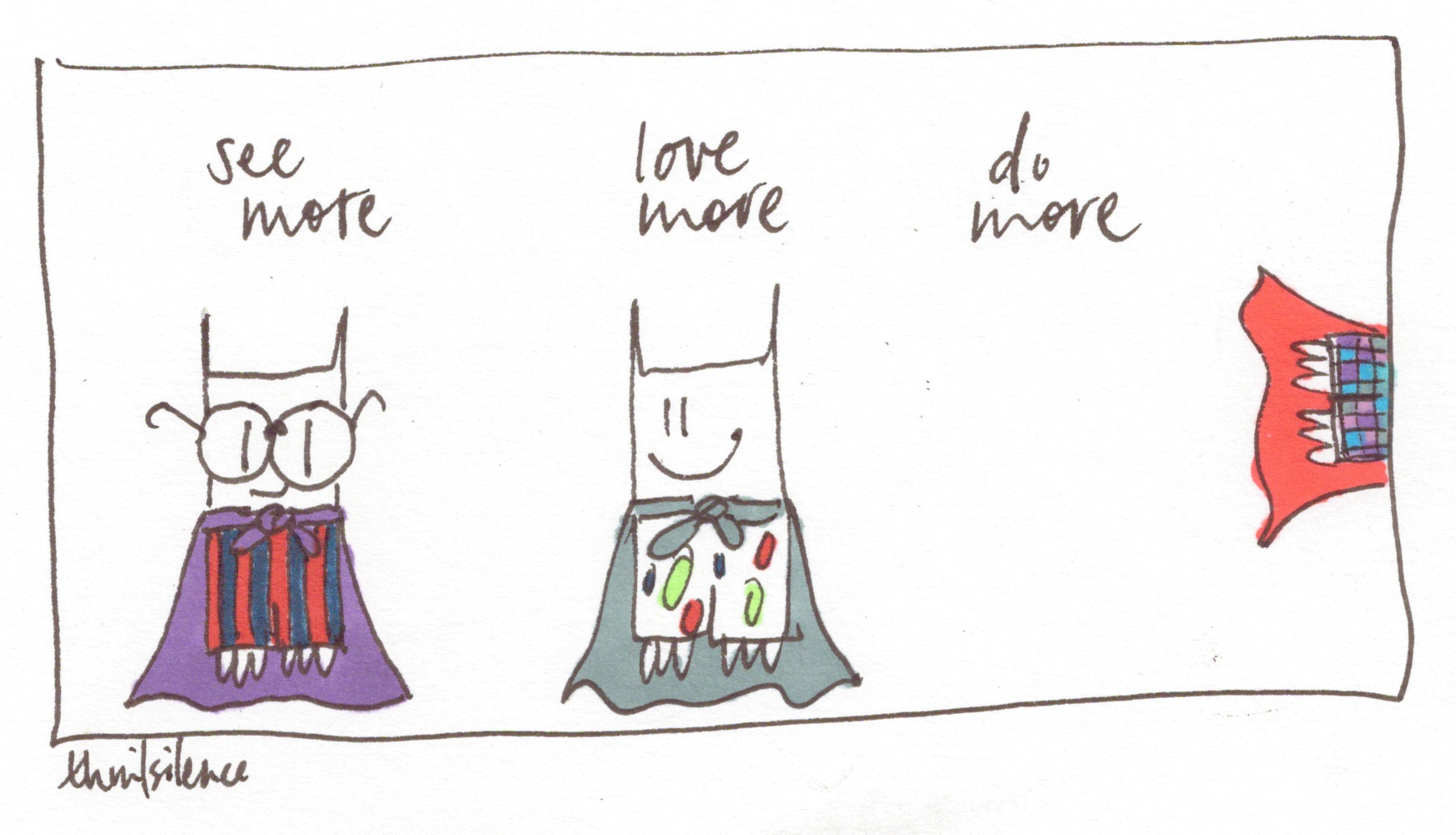
I can see and understand something more … but I’ll likely forget a lot of this and it won’t shape my life.

I can see something deeply by feeling it … something excites and it becomes part of me.

I can see and feel and see what I must do with it… and then I can show what I have made to you.

To the loving eye, everything is real.

 (*Just today I received a request from someone through change.org, asking me to sign a petition for recognition and commemoration of all those who lost their lives in building the football stadia for this year’s World Cup.  The daughter of one of those killed says nothing was offered at the opening to remember them.  I remember the story vaguely from some time ago of the roof at Sao Paulo’s stadium collapsing, but this brings it all closer to home; you can sign the petition here if you wish.)