i just knew you were going to say that

10 tell me more 1

I often find myself saying something and having to explain, There’s a question-mark after that, by the way.

Conversations with purpose are transformative; I am intrigued to know what you’ll say if I say this or that.  I’m testing out thoughts I’ve read or have come to me.  How long can we keep the conversation going?  What will you say and what will happen in me as a result?  Will you play the game of infinite conversation?

The finite player wants to say something which will end the conversation, win the argument, they are already certain of what they will say.  The infinite player wants to say something to continue the conversation – who knows what will be uncovered as people listen to them and they listen in return? – and though they know sometimes the conversation must end, it is always in the knowledge of the infinite conversation within which it takes place.

I play this game poorly but I want to play it better.

Finite language exists complete before it is spoken.  There
is first a language – then we learn to speak it.  Infinite language
exists only as it is spoken – when we learn to speak it.’

10 tell me more

explanations and narratives

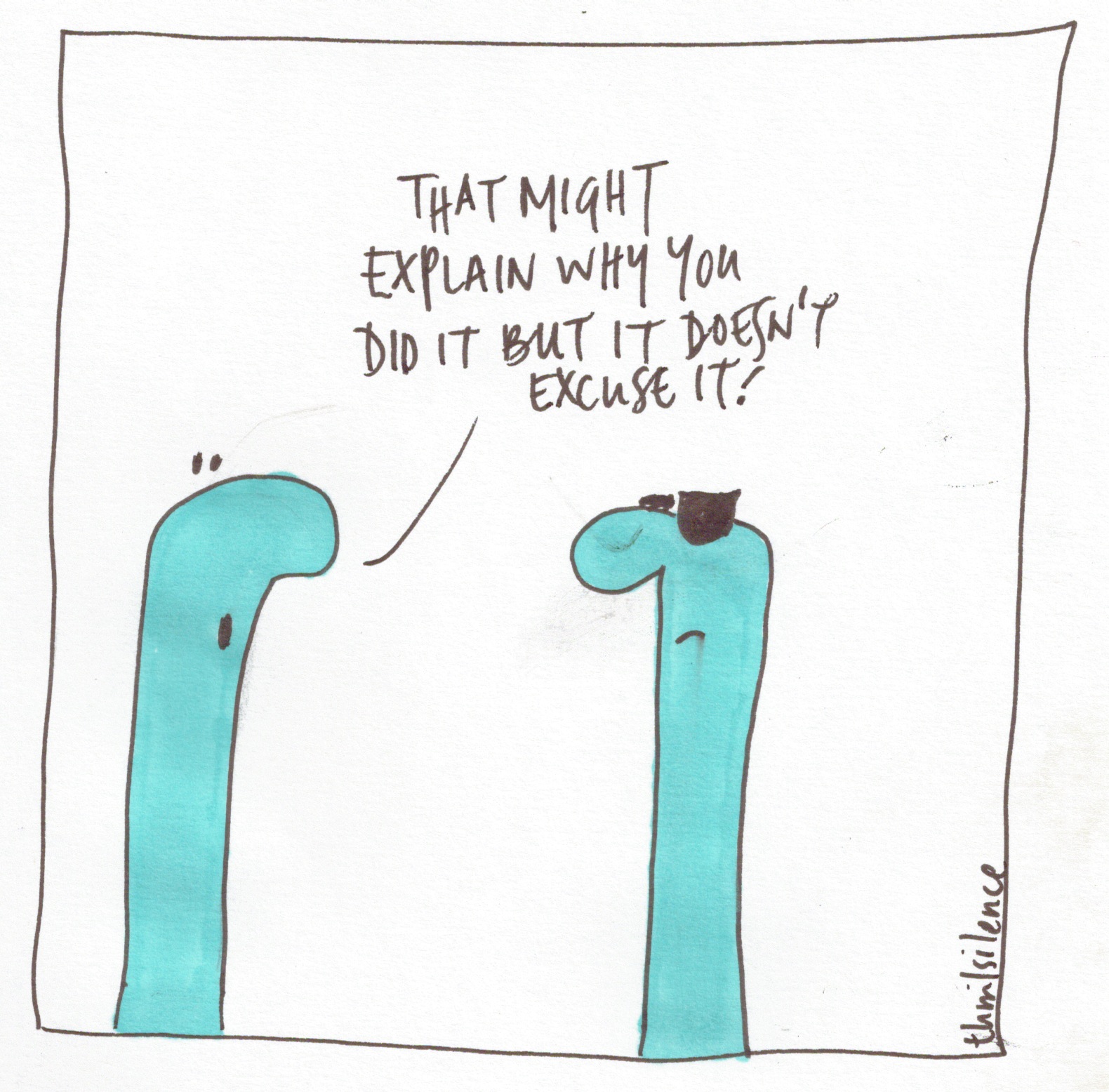
9 that might explain

They are different.

Explanations aim to tell us why something has happened in the way it has; usually end of argument.  Explanations are very helpful in the right places, but not in the wrong places.  The temperature of boiling water at sea level is 100C, but at 9,068 metres is 71.3C and there’s an explanation for this.

Narratives don’t try to tell us why something has happened in the way it has, but only that it has.  They can be very open-ended, leaving us with unanswered questions which need to be explored.  I know that as we meet at an elevation of 229 metres hot water will boil at 99.2C, but why have you asked me to share a hot cup of tea with you at that height?

Wisdom is not only an accumulation of explanations but of narratives too.  It’s what I’ve called complexipacity: the capacity to thrive both with what we can see and is explained, and also what we do not see and is random.  We believe we think or feel or behave in the ways we do for reasons we understand, but often we don’t.*

We’re all prone to this.  It’s a wonder we survive.  Nassim Taleb has written about how hard we find it to keep our lives open to more input and insight – to be what he calls sceptical empiricists – as we want to move towards a conclusion; Daniel Kahneman warns us that our inquiring thinking process is lazy, not only finding an easier answer but even substituting the question.

Perhaps we can say, explanations promise objectivity; narratives admit subjectivity.  You’ll probably guess what I’m trying to write is more narrative than explanation.  Where does this take us?

Narratives are open to experimentation and innovation and failure and learning and development in which I am changed as well as being a means of bringing change.  Through practices and rhythms held within these narratives we find ourselves changing: our brains rewire, we integrate the energies of body, mind, emotions, and spirit.  I am more open to others and to my world and to my future Self.  I am becoming slowly but surely – I call it a slow journey in the same direction – more aware of who I am and why I do the things I do.  I have no illusions of being able to do what others are able to, only to do as much as I can with who I am.

(*You may read something in my words today and respond  in a particular way, but it may not be what I’ve said but a memory I’ve triggered of what someone else has said or done.)


critical times

 8 ask open-ended questions 1

When you begin something which is different to expectation, when you stand up for something you believe in, when you take a divergent path, then criticism will follow.

There are two kinds of criticism.

There is criticism which is helpful to you; it will always give plenty of great detail for why you need to keep working on something or adapt it or maybe focus on something else.

There is also criticism which bludgeons you and your ideas.  The most vociferous comes from those who are against many things but struggle to articulate what they’re for – it’s a way of life.  Because they’re against rather than for something, they struggle to be creative themselves.  You won’t be found amongst their peers; they prefer to hang out with people who don’t question their thinking or behaviour but offer mutual reinforcement.

Delivering your art to a world in need of the good and right things you want to bring will require you ignore the second kind of people.  If you have the first kind of people around, you’re blessed.

We also need to recognise criticism is a scale thing rather than a black and white thing – we’re all on it somewhere.  An infinite artist is mindful of this, how we are Human Becomings, not-yet-arrived people, inviting as many into play as possible and keeping the play going for as long as possible.


gross local happiness

7 no matter how much technology ...

I like this phrase a lot.  It was offered in a group I’m a part of as we closed a conversation about how we can create spaces for people to flourish.

Here are some interesting quotes which caught my attention as I was thinking about people having opportunities in their localities to thrive.

I’ve mentioned Bhutan’s Gross National Happiness (GNH) Centre before, established in Thimphu in January 2013, it is an attempt to move beyond Gross National Product (GNP) as the only means of measuring a country’s progress and development.  The metrics are coming together, as Bhutan’s Prime Minister Lyonchen Jigme Y. Thinley explains:

We have now clearly distinguished the “happiness” in GNH
from the fleeting, pleasurable “feel good” moods so often
associated with that term.  We know that true abiding
happiness cannot exist while others suffer, and comes only
from serving others, living in harmony with nature, and
raising our innate wisdom and the true and brilliant nature
of our own mind.

It’s been pointed out that whilst our technology advances our dependence upon it means our development of the person lags behind:

“I’ve dealt with many different problems around the world,
and I’ve concluded that there’s only really one problem: over
the past hundred years, the power that technology has given
us has grown beyond anyone’s wildest imagination, but our
wisdom has not.  If the gap between our power and our wisdom
is not redressed soon, I don’t have much hope for our prospects”
(United Nations senior officer at the International Institute for Applied Systems analysis).

The flip side to this is the notion we can have that we can only develop with technology, yet this can’t be true:

Our basic way to expand our efficiency is through modern
science and technology.  But another is through integrated
(emotional,mental, physical, and spiritual) growth and enhanced
wisdom.  This means growing our sense of connection with nature
and one another and learning to live in ways that naturally cultivate
our capacity to be human.

In the face of empire-building economies and markets, the idea of developing neighbourhoods of gross local happiness offers opportunities for us to reconnect us to our world – groaning beneath the pressures of what we’re able to do with present-day technology* – and to one another as we seek to find new ways of connecting beyond the nuclear family.

We can all be generators of GLH.


(*The old adage rings true here: Just because you can doesn’t mean you should.)

games with time

6 if the goal of finite play ... 1

Different to games in time.

The finite player aims to complete things in time.  The infinite player is more aware of what is yet to be done, how incomplete things are.

Each of us has a finite player and an infinite player within us.  We get to choose how we will live with time.

Next month I will be fifty-five years old.  The finite player in me bemoans how the best years have gone, how my energy is waning (tell my legs it ain’t so), and, whilst I have my dreams, there’s not enough time in which to pursue these.  I have elected to believe that it is time which gives me freedom to live a fully Human life of creativity, generosity, and enjoyment.

The infinite player in me knows that age is not the issue, rather my “purpose, passion, and pleasure” are the most important life-dynamics, and most hindrances can be overcome with courage, generosity, and wisdom.  My dreams increase.  I have elected to believe that it is freedom which affords me time.

This freedom is found in the energy we find at the centre of our lives, in knowing who we are and what we have and how we hardly know yet what we can do with these; there is also freedom to be found in knowing we are far from perfect, we are not complete, and we have farther to go.  I’m cool with this, I hope you are too.  I’ve never been happier and perhaps this is ‘the paradoxical engagement with temporality that Master Eckhart called “eternal birth”‘*

You may enjoy this story I came upon this morning:
An Elder had finished preparing his work of baskets with handles for market when he heard his neighbour saying, “What shall I do?  The market is about to begin and I have nothing with which to makes handles for my baskets.”  The Elder removed the handles from his own baskets and gave them to his neighbour, saying, “Here, I don’t need these, take them and put them on your own baskets.”

Content with incompleteness, I think he chose to be an infinite player playing games with time.


(*If you’re younger than me and get this, you’re laughing.)


what society?

5 friend, i have ...

This morning I read a supposed quote from Margaret Thatcher which asserted, “There is no such thing as society; there is only the market.”*

It is certainly true that people can find themselves both consumers and consumed in a finite game.

Consumers may want more and create a “healthy market,” but also lay themselves open to the needs of those supplying their consumption – who want to be bigger, produce more, and have more.  Those who want more need an audience or world to notice how big and successful they are, and in turn are vulnerable to the beliefs, feelings, and behaviours of the audience:

‘No one determines who an audience will be.  No
exercise of power can make a world.  A world must
be its own spontaneous source.  “A world worlds”
(Heidigger).  Who must be a world cannot be a world.”

Because the aim of a finite game is to win, markets focus on time amongst other things, and time appears to be in abundance at the beginning of a venture but in short supply towards the end – and that’s when mistakes are made.**
(Notice how your age can be very important in a finite game.)

The infinite player recognises both society and market as expressions of finite games, and whilst recognising that sometimes they will need to play in various finite games, infinite players aim to include as many as possible in an infinite or open-ended game (whether people are older or younger, it is someone’s contribution of art – through their experience and willingness – which is most important).  Two things then follow.  The audience become players (see how companies are now seeking to include customers in a story and produce what customers want), and, infinite players appear to have more time – and could be said to generate time because they are able to continue where others stop.


(*The quote most often comes up with the alternative ending: “There are individual men and women, and there are families.”  See Dan Ariely’s Predictably Irrational to see what happens when a societal transaction is turned into a market one.)
(**Perhaps politics are the ultimate finite game.  Peace talks over three to four days can struggle towards the end of negotiations as time slips away – for some reason a small number of people from a number of countries cannot be given by their nations to stay as long as necessary, instead being required to return home – apparently because they have something better to do there.  It just seemed strange to me when I wrote it down in this way.)

who do you think you are?

4 always fly in your sweet spot

It’s difficult to know sometimes.

This is usually  question usually voiced or thought when we’ve said something or done something we shouldn’t have.

We’ve stepped out of place.

Yes, some people cause problems because of too high an opinion of themselves, however, there are many who struggle with having a high enough opinion of themselves.

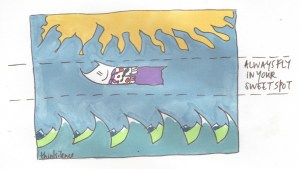
The myth of Icarus* tells the story of the escape by a master craftsman and his son from the island of Crete.  Daedalus advised Icarus not to fly too close to the sun, but that’s exactly what Icarus did – full of hubris, the wings made of feathers waxed to a wooden frame fell apart and the son died in the sea.  But Daedalus also told his son not to fly too close to the waves, else the wings would clog and he would not be able to fly high enough.

Not too high and not too low = sweet spot.**

More people are got by the waves than by the sun.

Every day, I try and help someone to know more who they are so they can find their sweet spot and fly free.  It may sound like make-believe, like a story of gods, a tale of mythological proportions and not to be taken seriously, but the thing about myths and legends is they’re explorations of real life.  Dreams, then, are dangerous things when we audaciously and tenaciously pursue them, because they can make the world better, including more Human.

They begin in our imaginations only because they do not exist yet, but to imagine something is the first creation.

This is slow and patient work.  It requires that we journey to our centre, to find our genius, our art.

Your life wants to do something, to find its sweet spot of not too high and not to low; if you give it the right space it will get to it.  Every person is an artist, which isn’t to diminish art, but to elevate life.

Don’t let the waves get you.

You can begin by noticing the things which most energise you, over the next week – who are you with, what are you doing, why are you doing this, when are you doing this?  How can these things be turned into an open-ended game, developing into more and more?

(*Seth Godin’s The Icarus Deception is a great look at people flying higher than they think they ought.)
(** This is different for everyone.  Your joy comes not from being like someone else but being like your future Self.  The distance from sun and waves isn’t a physical one, but one of being in the right place for the right reasons – you will flourish using the skills and passions you have in ways which keep pushing them farther.)

border crossings

3 prophetability

Here are a few more descriptions for prophets of hope.

Prophets are permission givers; because they’re doing something to “cross the border” and make a difference others can too. They see a bigger world than the one defined by borders – so they question and play with and sometimes reject the borders, whilst others are constrained by them.

Here are three major borders: between what we see and understand now and a bigger world which is invisible to us;  between knowing about something and experiencing it; and, between experiencing and actioning.  The prophet helps us cross each of these borders.

Prophets are living prototypes of an emerging future.  They haven’t got everything figured out; they are simply willing to give some tentative expression to what they’re seeing and hoping for and communicating.

Permission is more general and inspirational; a prototype is one possibility – it isn’t the way of living the future but  a way.  The more prototypes of the Human future the better.  As such, they’re not sealed off from their environment and the company of others in some personal certainty, but are increasingly open to and learning from as much as possible from every direction.

Prophets are connectors.*  Their lives are places in which otherwise disconnected artefacts, ideas, and people can come together,making it possible to redesign old worlds and design new ones.

Connectors are important because they challenge the prevalent ideas of disconnection which separate and adversify.**

Prophets see the repeated mistakes of the past and try out a new song: “Forget the former things, behold the new,” they sing with all their might, even if they’re sometimes off key or forget the words – then, hope isn’t perfect.

(*Sorry there isn’t a third “P”.)
(**I don’t know if this is a word but I’m thinking of how we make adversaries of people and organisations.)

prophets of hope

2 profit versus prophet

Prophets imagine and describe possibilities others are unable to.

Living within the same reality as we do, they paint a picture of a different future – messengers from beyond the present, bringing to us things we do not know we need and seeing in us what we cannot see ourselves.

Perhaps they appear as questioners, dissenters, innovators, even competitors, but this comes from being energetic positivity when it comes to Human potential and what we are able to shape.  We don’t know what we are capable of yet.  My friend and mentor Alex McManus asks the teasing question, ‘What if the goal of the Universe is to produce a Human?’

Following a near fatal heart-attack, senior officer at Intel David Marsing, shares:

“In the hospital and during the months afterward, I
discovered that my true purpose was to help people
realise that they have more potential than they ever
imagined they had. … I wanted to create environments
for people that would help them see their true potential.”

Marsing decided to go back into the highly stressful environment which had contributed to his heart-attack, to help others find a healthier way of  working which he himself would practice, protecting colleagues from the stresses large organisations can produce.  What he became was a prophet of hope with a message from beyond (literally, as Marsing had clinically died in the emergency room before being revived).

This underlines what I suggested earlier, prophets of hope have faced the same things as everyone else and have seen a different possibility which they bring back for others.  This is the classic hero’s story.

I resonate with Marsing’s goal of wanting to create environments for people to realise their potential – a small part of what we are striving for as a Human species.  I do this, not because of a heart-attack, but many years of struggling in situations where the last thing anyone was helping with was identifying potential.  If you look at it from this way around, what is your discontent you must respond to?

This caught my attention because I see how I am trying to create all kinds of environments for this to happen, on my own and with others.  We are all capable of being prophets of a better future, providing environments within which people can thrive.

Be prophetable.


help from beyond

1surprises happen when hearts connect 1

I’ve just sent a thank you to some people who’ve become a significant part of my life – part of my help from beyond.

Some of us first met three years ago – the result of meetups set up by Seth Godin as part of his Tribes initiative – whilst others have joined our conversations with purpose that began on the 31st May 2011.

As part of our journey, we’ve all taken steps and leaps forward in making ideas and dreams reality.  The commemoration, though, is not backwards but forwards, into the more of an emerging future as we understand ourselves to be Human Becomings more than Human Beings.

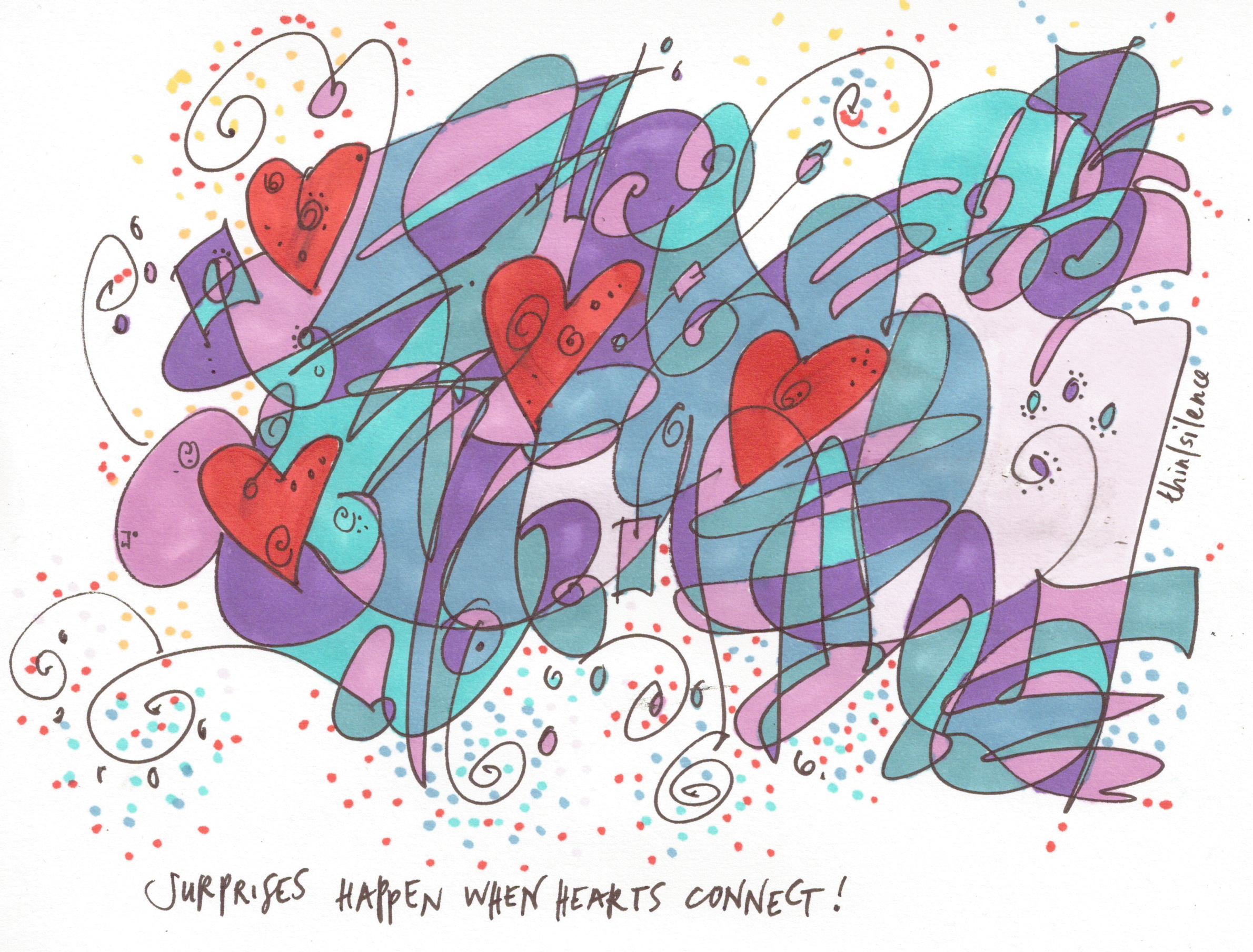
James Carse writes about how we touch one another in a reciprocal way.  It is the surprise for both which comes from a generous act.  I cannot move myself – that would be inauthentic, and I cannot force you or move you to something I have in in mind for you – the surprise is the result of act towards one another with one’s whole heart, (then we ‘ll be surprised by belief or change or action).

Yesterday, I wrote how three exercises enable us to see the emerging future more clearly; here are some questions tying in with how our help comes from beyond:*

Exercise one: Towards knowing who we are and what we can do: What are your talents (try listing ten and ten double this, and then add another ten)?; what are you passionate about (everything)?; What gives you energy?; What do you want to do something about?; What are your top five values and beliefs?; Then, what has time proven you’re not talented at (begin with ten again)?; What leaves you could (the things already in your life)?; What drains you of energy?; What have you tried to do something about but found you’ve not been energised by?

Exercise two: Towards seeing your resources: Who are the most important people in your life and what do they bring to you (e.g., are they a companion, do they open your thinking, do they help you through situations, or work with you)?; Picture your home and how you can use it (who could you invite around, what kind of meals could you share, what could you do with your garden if you have one)?; What are the artefacts you have and how can they help you to produce your art for others (books, computer, equipment, tools)?; What about your finances and/or what can you barter to make a difference or get hold of things you need)?; What’s in your fridge and how could you make something to share (and how)?

Exercise three: Towards habits of activity: Begin mixing the things you’ve listed in exercise one with those in exercise two, coming up with as many possibilities as you are able, no matter how ridiculous you think these are; Begin trying these ideas out, making a space or time or connection (especially the connections as  our help comes from beyond); if you experience failure you’ve learnt something valuable making it possible to try again in a different way.

In each of these I know my help comes from beyond – the complementary passions and talents of others, the questions and contributions others make into my life, and, the conversations with purpose which enable me to action something.

(*Writing these things down will have real benefit for deepening our reflection and creation.)