seed people

21 wanted seeds of possibility

Each of us is a place through which a possible better future can emerge.

Henri Bortoft suggested, ‘The part is a place for the presencing of the whole.”  Our future needs people who will offer themselves as such a place.

Them when people come together, offering themselves as a greater place, the possibilities grow immensely.

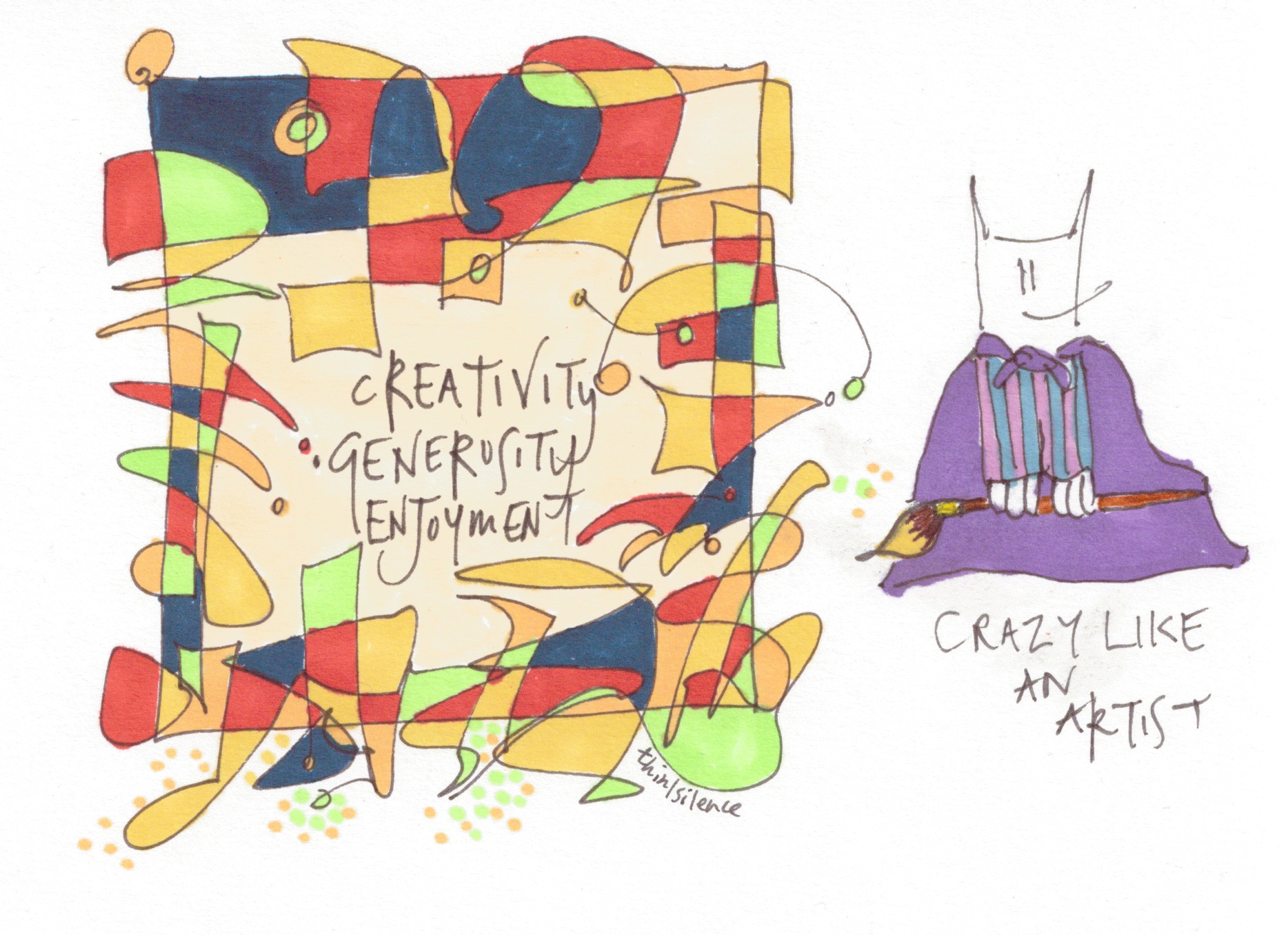
I was part of such a group last night.  For quite some months now, we’ve been meeting and talking in ways intended to sense some possible future we can help to shape, meeting to practice the means by which we will make it possible for people to live with creativity, generosity, and enjoyment – what we believe to be the possible for every Human – each bringing something different to our times together.

Some of the most profound things were sharing how, for a number of days following our conversations, he was a “better me.”  That ‘s what it’s about.

Then I read this morning, from Bernadette Jiwa: ‘How can your business be about making [your customer] live as a better version of themselves?’

It’s a great question, one asked by seed people.

Why seed people?  Because a seed doesn’t contain everything the future plant will be, but is a place where all that is necessary for the future can converge from the soil and from the sky.

We all can be such a place, though all different, according to that thing we each do – our art.
not ready

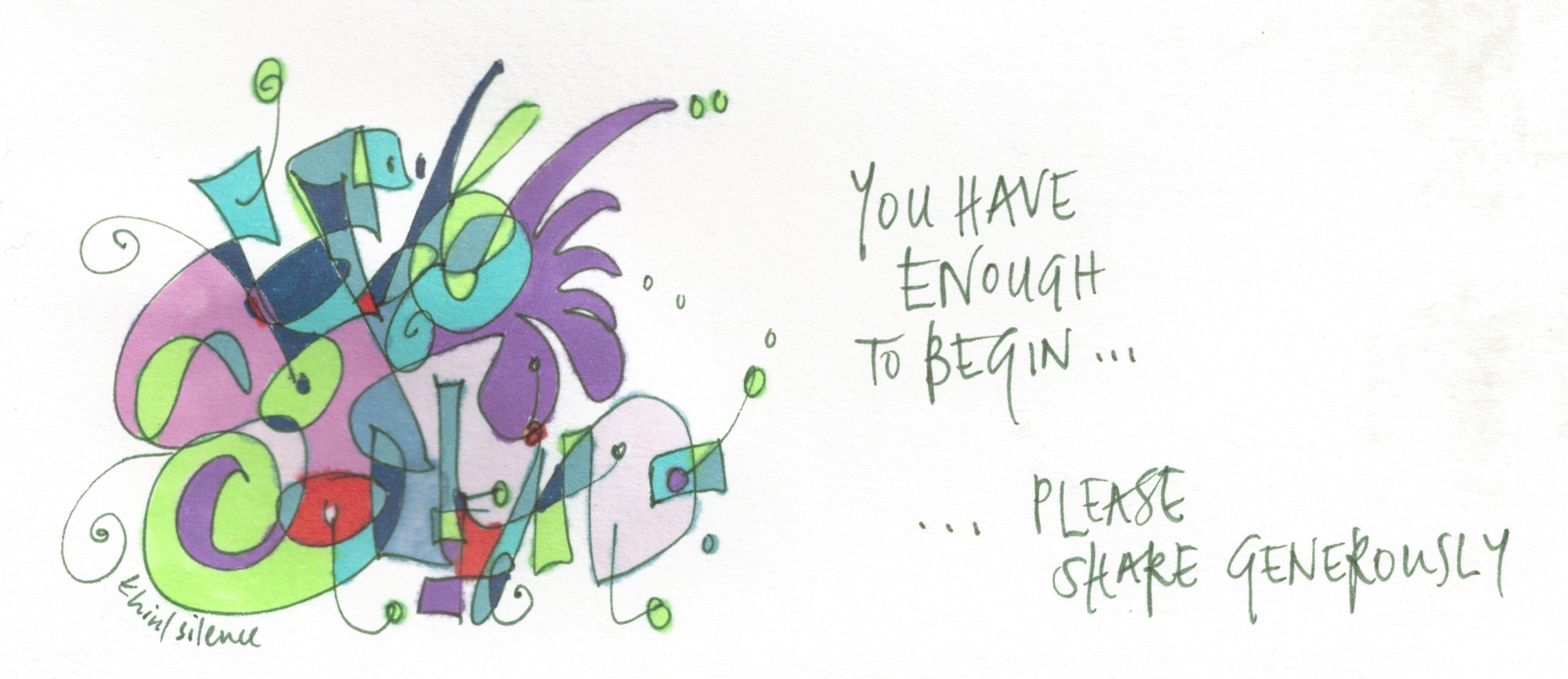
20 you have enough to begin

I come across many people who need more (fill in the blank … time, training, information, money) to begin.  (I’ve met members of my own organisation who are in their 80s and are still saying this!)

I also come across many people feeling a deep pain because they want to make a difference but don’t know how to.

Reality is, we are more ready than we know.

Over thirty years of doing my particular job tells me, those in the first group will never be ready – they don’t want to be and will always hide behind this or that excuse, including how it’s your fault they’re not able to and you ought to be doing it anyway.

The second group only need to connect their pain with who they are and what they do and take a step: we find purpose where our deep gladness meets the world’s deep pain.

The tragedy is, the people in the first group have most of the time and help afforded to them and the second group carry their pain, often in silence.

Which are you?

Another thing to add, is you won’t know exactly what you need until you do begin.

repeat?

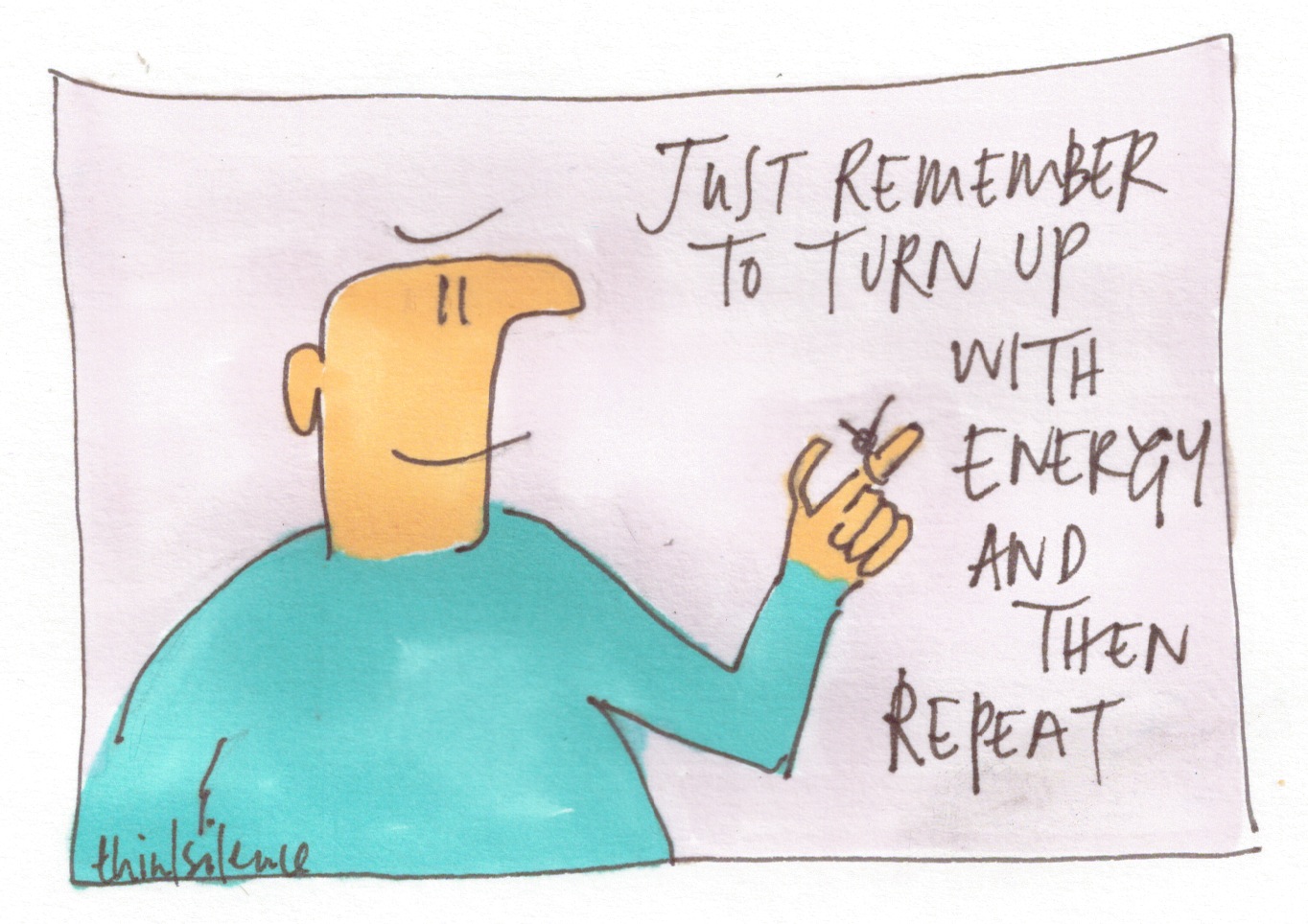
19 just remember ...

It depends on what it is.

Hugh Macleod offers:

‘There is a famous old quip: “A lot of people in business
say they have twenty years’ experience, when in fact all
they have is one year’s experience, repeated twenty times.”‘

In fact, there’s evidence to show that doing the same thing over such a period of time sees the quality of performance reduce – you’re worse at your job at the end than you were at the beginning.

Not the kind of repeat we want, but add some freedom to do your art and something interesting happens.  It’s now impossible to do the something in exactly the same was as you did before, no matter how you try – a different: colour, note, line, movement, idea, context, juxtaposition, person, speed, culture … – and you can’t repeat.

Which for most of the time is good, though it can also be frustrating.  I didn’t say it wouldn’t be hard.

Two things that repeat in a good way: 1) you turn up every day, ready to contribute your art; 2) your ‘constant potential for renewal’ turns up on a similar cycle.*

(*Ken Robinson argues that life is not linear but cyclical – opportunities come back around.)


like crazy ones


18 crazy like an artist

We’re not prepared to accept the story as read to us.

Those who’ve believed in and seen a better future have always been looked at as being strange, or hopeless, or crazy.

We hope and act, making it possible for more to discover and bring their art into the infinite game of open-ended life is worth everything we can bring to it.

“When return on investment is measured by delight instead
of sales o conversions, there is a lot more freedom to create,
to be bold, or maybe event to be creative and bold.”  
(MailChimp Non-Profit Brand Manager Lain Shakespeare)

Here’s to those who never give up on being courageous and generous with their art.


reality

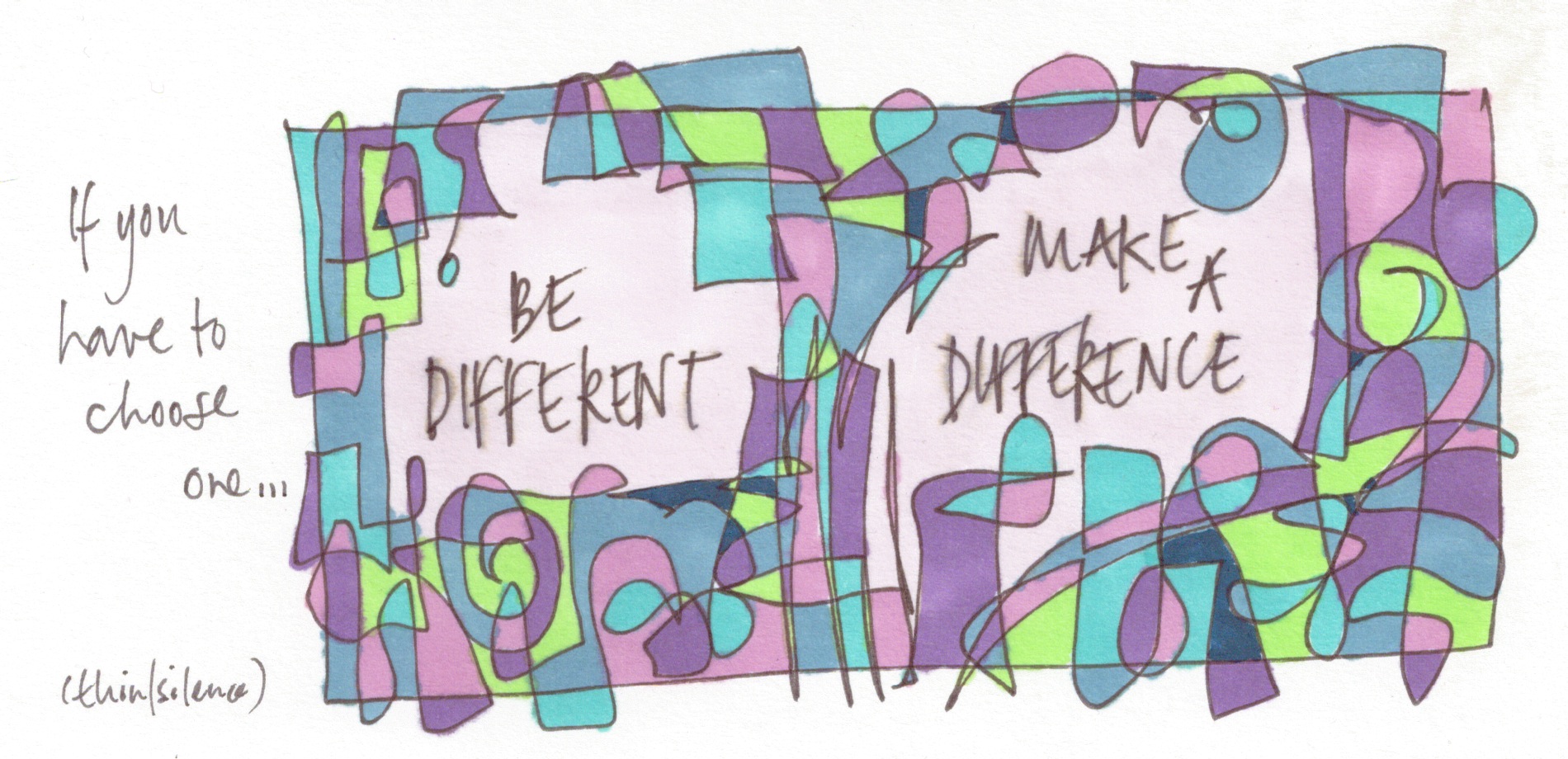
17 … make a difference

Really?

Or are you just making this up?

It’s a good question.  We’re exploring how to produce our art in an infinite game.  It sounds more like fiction, right?


We might be surprised, though, by what’s real and what isn’t.

Is repeating the past (behaviours, policies, marketing, process, thinking … ) when it hasn’t worked, really an option for our future?*  Or is trying the untried alternative not as crazy as it first appears?

Individuals and whole societies can create stories which are unrelated to reality.  (We can behave as though we live in a world where our nation’s behaviours are impeachable, that everyone really could have clean water, freedom from disease, enjoy education, live in security, but we don’t.)

I really believe in the goodness of people and often find myself saying “People are amazing,” but I know many are not good or do right, and  too many choose selfish over selfless, but I also see people who live to make a difference; I typed “Stephen” in my browser and here’s the top result.

Some just know there’s another reality and live towards it.  These people change the rules.  Different can often be good, but can be another shade of same, but making a difference is about something which changes a person’s life, often beginning with our own.

We often think real means tangible, but Humans can value what they feel about something even more highly.

So is your art real, or delusion?  You can check it out by asking the following?

Am I successful at what I do (what’s the difference I make)?

Do I do this intuitively (does it flow from my life)?

Am I growing as a result of doing this (is there a difference in me)?

Do I need to do this to be satisfied and fulfilled ?

Your stuff which makes a difference is real.

(*I was one of the naive ones who watched the televised debates leading up to the British election of 2010, hoping for a new politics, but it turned out to be more of the same.)

strong

16 to know yourself is strong ...

Strong is not the same as powerful.

A lot of my work (that is, my art) is helping people to identify and develop their Strengths* – patterns of skills and passions in their lives through which they experience energy.

Power wants to control these things in others for its own benefit; strength wants to make these things available to others so they can soar.  There’s a big difference between wanting to control the world and wanting to change the world.

Power plays within the limits of the game; to do otherwise is to risk diminishing or losing power – in this we can proffer power is about repeating the past.  Strength plays with the limits of the game because its focus is not on what has been but on what might be – the future.

Power has a fixed mindset, often struggling to adapt, a blunt instrument seeking to repeat past success with increasing force.  Strength has a growth mindset, not only knowing it must adapt, but through hard work, together with others, it can.  This is why strength often wows us but power does not.

You may not be powerful but you are already strong.

I cannot force you to play  this infinite game – it instantly ceases to be play for you – but I can invite and encourage you to bring your art.

‘If you needed permission, think about the mentor or coach
or friend who gave this to you.  Someone is giving you
permission: … hired you, funded you, trained you, encouraged
you – all so you could see something that needed to be done and do it.’

(*I call this dreamwhispering (mentoring, coaching, directing, positive listening and more), and since being helped by someone to identify my own Strengths, I’ve really enjoyed working with more than 300 people.  Just get in touch if you want to find out more.)

powerful

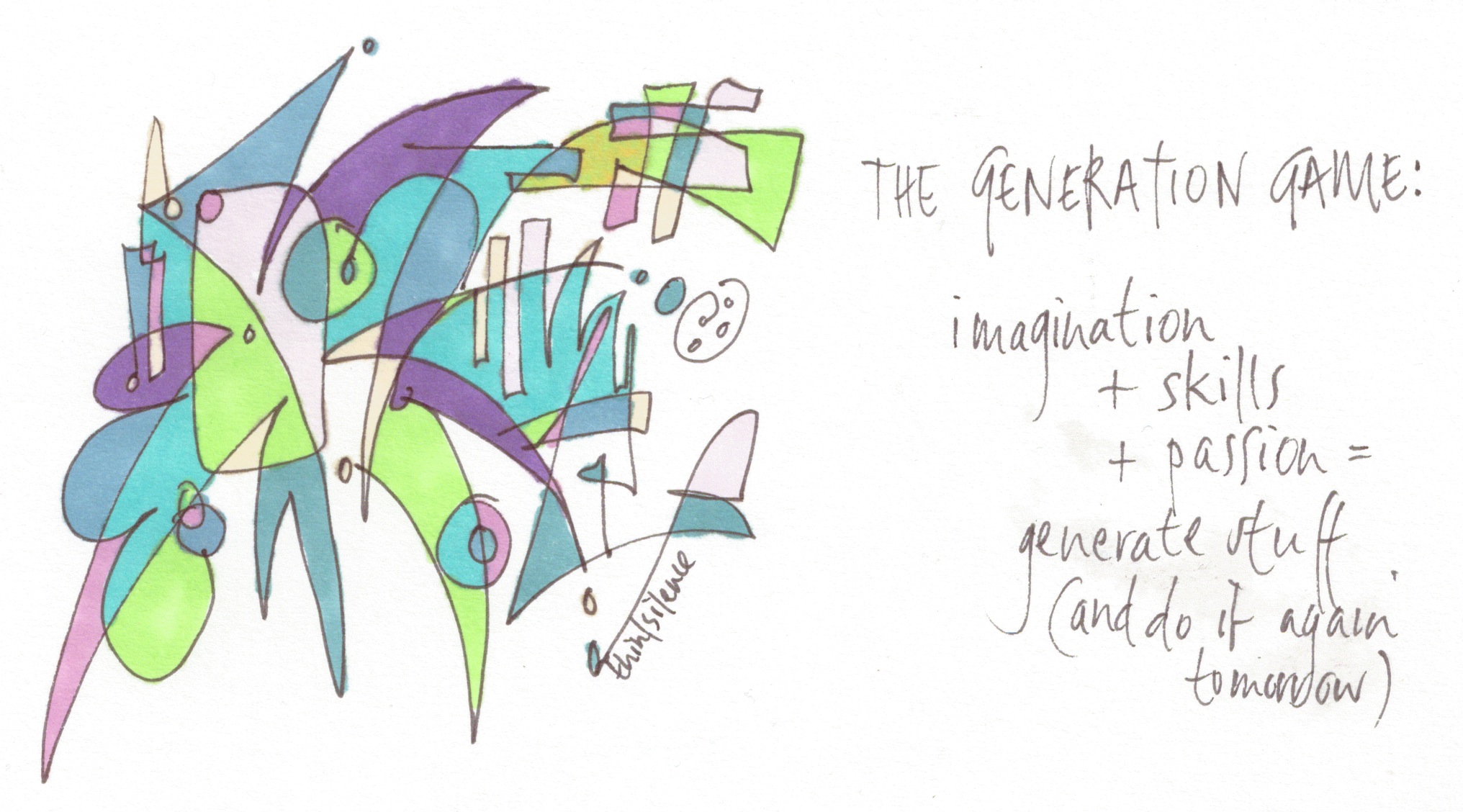
15 the generation game

Who?

The people who want to get what you’ve got, or the people who want to give what they’ve got?

The infinite player plays for others to be able to play, the infinite artist gives so others will also give their art; they know they themselves will only be able to play if others also play.  Being able to be creative and generous towards others, enabling their participate, is intrinsically enjoyable.  Strange, because there is something deeply sacrificial in beginning what we cannot finish:

‘Our futures enter into each other.  What is your future,
and mine, becomes ours.  We prepare each other for surprise.’

These words from James Carse beautifully express the presencing journey Otto Scharmer describes, from the worldview of I-in-me, through I-in-it, through I-in-you, to I-in-us.

We each play by daily bringing our best.  A title or role conveying power means less, and perhaps even nothing, in the infinite game – we are not our titles.  In finite games, to gain a title of power can be the endgame for some players; to win usually means others have lost and don’t gain the title of honour.  In an infinite game power is what is given away against a common enemy: a disease or attitude or Human need.

We don’t have to get power, we already have power; the game is about releasing this for others.  Knowing who we are and what we can do, and, knowing who we are not and what we cannot do, is power., enabling us to contribute our art without trying to grasp power from others.

Some of the biggest games in the world are finite games and no one really wins in a finite game.  The United States took over the control of the seas from the British, but terrorists attacked the United States by air, flying planes into the Pentagon and World Trade Centre towers.

The ultimate power we can wield is power to yield by bringing others into the game.

the art of deep inquiry

14 the 3 flaneurs exploring ...

It’s an art and it’s a choice.

Someone is sharing with me something important to them.

Do I disagree or question them negatively?

Or, do I choose to say, “Tell me more,” and ask questions positively?

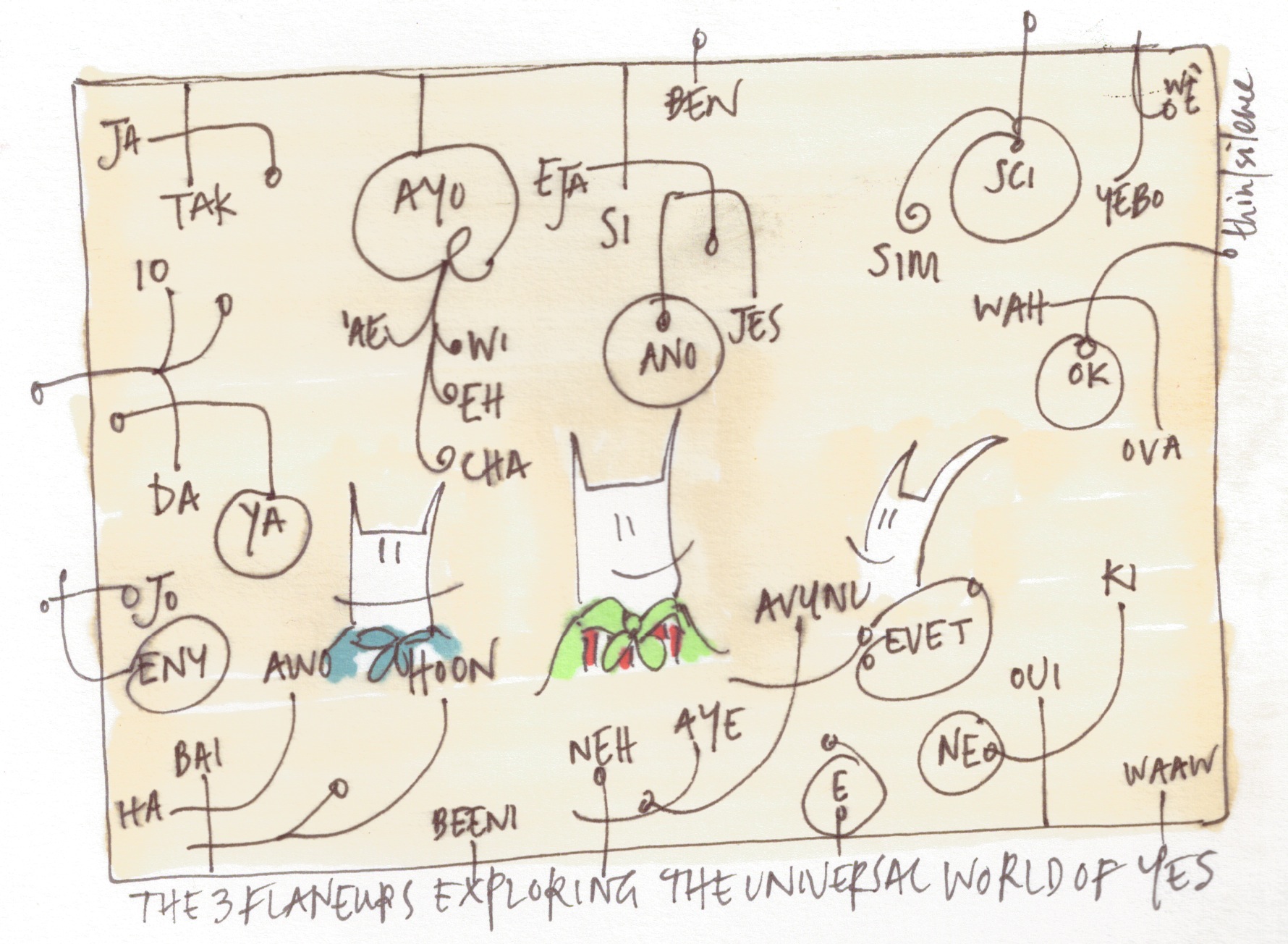
We all know people who immediately close possibilities down.  The infinite player seeks to keep the conversation open for as long as possible, wants to say Yes to a person so they too can be in the game if it’s at all possible.

There are  many lives which would look quite different today if they’d met someone who opened up a conversation of possibilities rather than closed it down in the moment they made themselves and their dreams vulnerable.

The good news is, everyone get’s to have another go: dreams can be rediscovered and we can all learn to positively inquire of others.

Many conversations develop as if we’re in a finite game – “Let’s sort this nonsense out and focus on the goal” – when, really, life in its truest sense is an infinite game.  How often do we find ourselves with people, in all kinds of situations, and really know what the goal is?  The infinite player or artist orientates ‘toward the open, toward the horizon, toward surprise, where nothing can be scripted.’

‘It’s more like, the better the idea, the more “out there” it
will initially seem to other people, even people you like
and respect.  So there’ll be a time in the beginning when
you have to press on, alone, without one tenth of the
support you probably need.’

what do you want?

13 don't do what i do ...

Apart from my email address and my website, these are the only words on my business card.

Many believe they are looking for something “off the peg” – What can you give me?

It’s the wrong place to look.  The answer is already inside you; the question simply offers an opportunity to speak it out.

Coming from within an infinite game,* the  question invites you to be more who you are and do more of what you must do.  You are embraced as a player, no longer an observer, your greater curiosity leading you deeper into the game – the aim of which is not to win but to play, and to play for as long as possible.

When you play, you give others permission to play, to identify their art, because it’s about being free to do what they want, rather than repeating what you do.**  Hugh Macleod offers:

‘The sovereignty you have over your work will inspire far
more people than the actual content ever will.  How your
own sovereignty inspires other people to find their own
sovereignty, their own sense of freedom and possibility,
will give the work far more power than the work’s objective
merits ever will.”

The infinite game is an attitude, as much as anything else.  It’s baffling by how two people can exist in the same environment, and one can grow and develop their art whilst the other continues in the same old same old, until we understand it’s a way of seeing and playing life, answering the question: What do you want?

Then asking it of others.

(*James Carse’s book Infinite and Finite Games identifies the game as another way to framing the exploration of being Human – others are infinite stories and infinite businesses.)
(**It has been noted, when Humans have autonomy, develop skills, and live for a purpose greater than themselves, they flourish.)

surprise!

12 the early days of a great idea

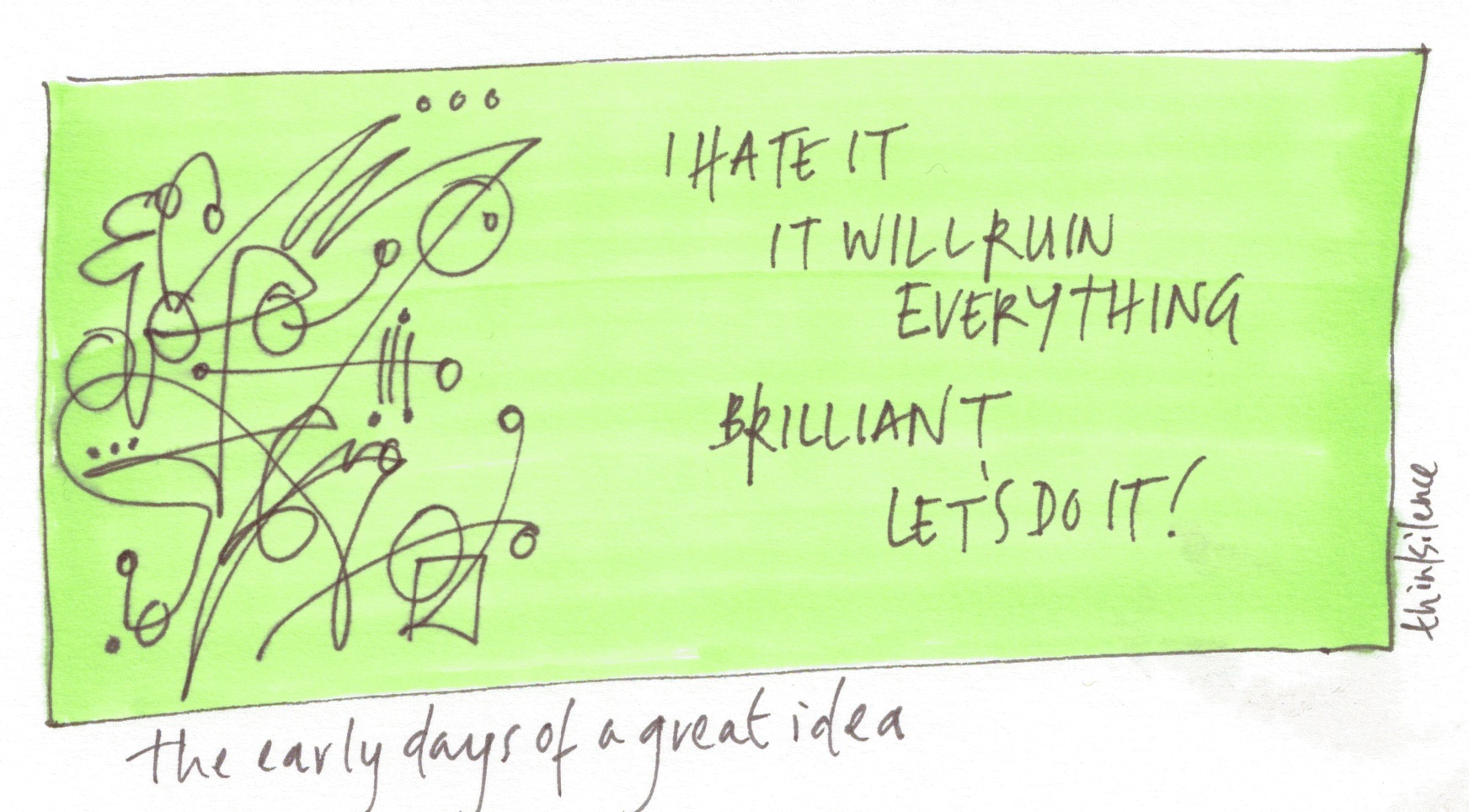
 The infinite player welcomes surprises – surprises keep the game alive.

I wonder whether we’re only using a small amount of our listening capacity.  Perhaps the “listening” devices, embedded in a website’s software, or the loyalty card, or in car tyres (monitoring correct tyre pressure) – a few of the many listening devices in our everyday lives – are enabling us to listen with more than our ears, listening to more than voices and data

The infinite artist listens for the unexpected, attuning her whole life, using what she hears to craft and produce more good and right things for the world through her art.  This “deep listening” makes it possible for her to create and innovate at the edges of her field and perhaps even within someone else’s.  Who knows where this might lead?

Surprise is the game.  Openness to surprise nurtures openness with others, sharing discoveries so more are able to participate – the infinite game, we recall, is keeping as many in the game and to keep the game alive for as long as possible.  Infinite players are not afraid of sharing goodies because they know there’ll be more along.

Not so for the finite player – not only are surprises the reason deadlines are missed, the unexpected jeopardises the deal; if there have to be surprises, then they must be ones the finite player aims to use as control – experience over inexperience, gaining advantage and winning the game.  Ultimately, surprises are about a different future to the one the finite game desires, and finite players want more of the past.

It’s always important to be open to surprises, the infinite game trumps the finite.  The infinite player or artist understands this.  Theirs is a world of abundance.  They will play finite games at times, but they understand there is a bigger picture.  Those who can only see the finite game, believe the world to be one of scarcity.

I’ve previously mentioned three attitudes or practices helpful for producing our art.  They’re useful when it come to listening for surprises too: humility opens us to listen to others, to see the small, the hear what different species and our planet are saying to us; gratitude allows us to value as much as possible so we incorporate as much as possible, and, faithfulness reminds us that daily turning up  and practicing humility and gratitude is transformational.  How each of us we do this will be an extension or expression of our art.