a time to mourn

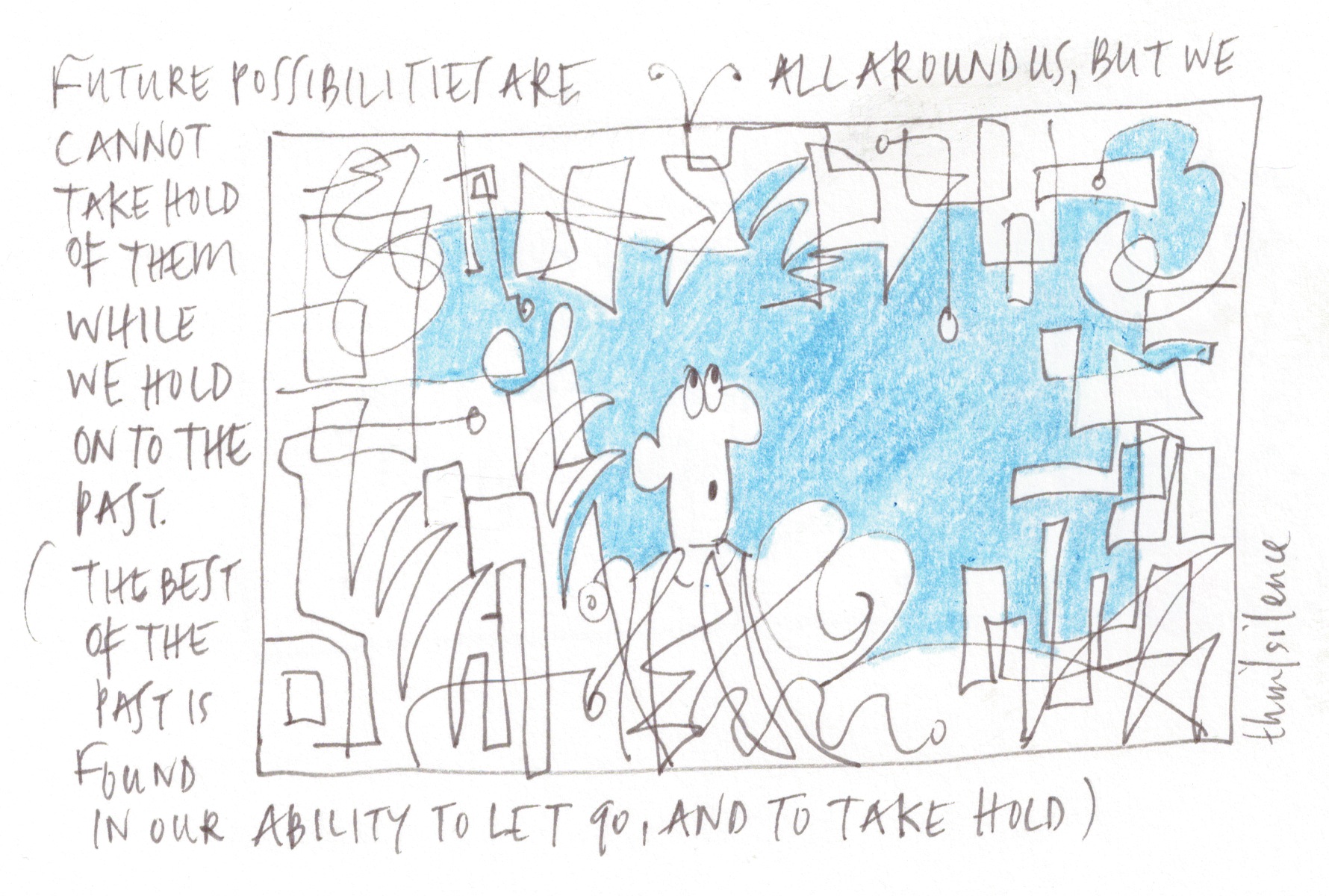
future possibilities are all around us ...

The best time might be now.  Maybe something in your life just isn’t going to happen.  You set your heart on something but it’s not to be.  You keep hoping for something but the door has closed.  You feel some regret like an ache in your soul.  Or something has been taken from you forever.*

To mourn is Human; to mourn makes us more Human.  Not to mourn, holds us to a past we cannot change and away from a future we can.

If being open to the poverty of our lives opens our mind, to mourn opens our heart.

In the movie Elizabethtown, the main character Drew Baylor (played by Orlando Bloom) is given five minutes to mourn for the disaster of a running shoe he designed, so that he might take hold of the rest of his life.**

To mourn is to to be fully open to the truth of the present – the good, the bad, and the ugly.  It is the worst and the best of places.  When we mourn, we do not hide or close up on ourselves.  But when we do, strangely, we come to a place of wholeness and comfort.  We then let go of a past we cannot have over again that we might be free to take hold of a future we can – but have been blind to.


Help people to mourn for who and what they cannot be, so they might take hold and celebrate who and what they can be.

‘Through mourning we can reach a place where the past
remains the past and no longer contaminates the present.’


(*Most of all, I’m thinking of the serious and longed for things we’ve not been able to do with our lives, the opportunities we so hoped for.  I do not trivialise the meaning of mourning.)
(**I love illustrating from cheesy movies.  How on earth could one person be blamed for the failure of a shoe from design to production?   But then, there wouldn’t be any film if it got scrubbed in a meeting of the design team.  The film does have a stonking soundtrack.)
overcoming resistance to openness

to be generous

Long-running TV dramas create crisis after crisis for their characters.  If these people moving from one ordinary, repeatable day to another there would’t be ugh of an audience, so the writers give them a push to see how they’ll deal with this or that – anything from a relationship breaking up to a train-crash.

The remarkable happens to us,rather than being something we choose of our own volition.

In a movie, the main character is shaken out of her routine by an initiating incident – usually within the first fifteen minutes; she then spends the rest of the film trying to get back to where she was, but in the course of the adventure or challenge, ends up in a better place.*

We are engrossed by these stories, not realising it’s often in our hands to initiate something remarkable.  But how to get there?

Openness to adjacent possibilities** can be hard to find because of the  resistance we encounter when we want to hit the pause button, to in stop and take notice of how our lives are often pushed along relentlessly and unquestioningly.  When we stop and look around, we might be alarmed at just how much we don’t know and haven’t seen, but this admitting our poverty is positive and good.

Resistance fears it because it thinks it’s an end, as if we’ve been found to be wanting, but it’s really a beginning.  When we are open, we are open to more; we’re ready to embark on something remarkable.

One of the things I’m always on the lookout for is how to support people in finding the ways and means of moving towards something they want.  Openness is a starting point.


(*Not all films ends in this way – just like life.)
(**Adjacent possibilities are alternative life-stories we can live given our talents and our passions – life is more like a palate of colours to be mixed than we realise.)

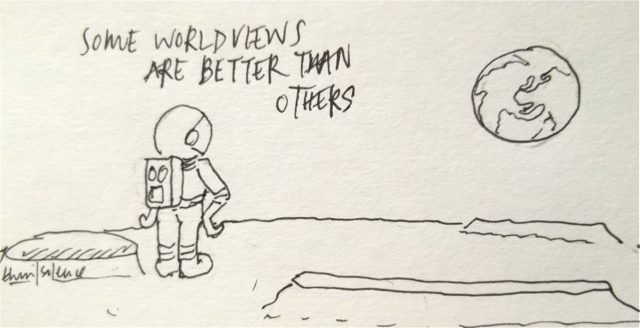
worldviews, mindsets, and attitudes

some worldviews are better than others

All are important elements for connecting – to our world, each other, and, our future selves.

There are many world views.  Generally speaking, mine is a positive one; people are capable of amazing creativity and generosity.  I know I’ll be disappointed many times by people who choose not to be as amazing as they can – and most disappointed by myself – but this way of seeing the world keeps me open to exploring possibilities for becoming more Human.

Carol Dweck informs me there are basically two mindsets: fixed and growth.  The person with a fixed mindset believes they are all they can be and they protect this.  The person with a growth mindset can’t tell you exactly what they are capable of yet, they only know how they’ve been surprised again and again at what they’ve been able to do through hard work and passion.

Attitudes are the dispositions which open or close the day-to-day workings of our mindset.  I’ve suggested Humility, Gratitude, and Faithfulness as three basic attitudes to explore for opening up more connections with one another, our world, and our future.

Each is a choice, so not fixed.  Our worldview, mindset, and attitudes open up or close down how creative, enjoyable, and generous our lives will be.

the future is: connected, artistic, a new story

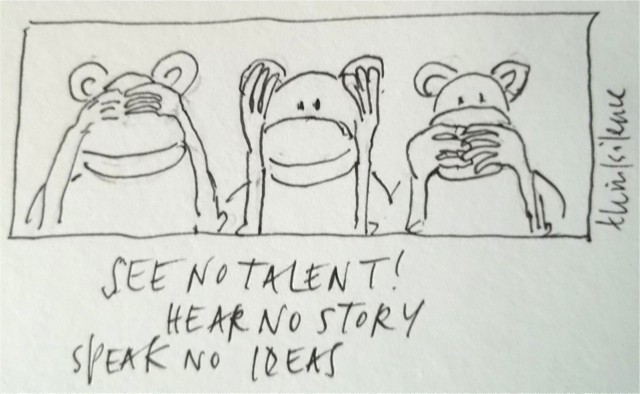
see no talent ...

We each have face down the inhibitors to Human development. (There are more than three but these are three big ones.)

The first holds a worldview of scarcity.

Only some will succeed – those with secret knowledge and privilege (whether it be the factory worker who wouldn’t tell the rest of us how to work the labelling machine so he knew his job was safe, or the inside dealer who’s going to make a killing).  A world of scarcity is a disconnected world, only offering a gloomy future.

The alternative is to bring everything good out into the open and look for way s of sharing.  A world of abundance is a connected world, benefiting more with the ideas we each have.  This ancient inhibitor is gnosticism and it has diminished Human development throughout the ages.

The second inhibitor is also ancient, demanding your conformity in exchange for “bread and circus.”  Governments, factories, and education systems require compliance in return for benefits.

The alternative is to connect with our values, and value  the beauty of our art in a long tail world – in which everyone can find a place for lovingly expressing their individuality in service of the community.  We face down the “smoke and mirror” obstacles which tell us we have no talent, we are not ready (including, where would be find the time?), and how we’ll drop off the edge of the world if we push on.  This enemy is empire, and the Roman’s promises of circus and bread, keeping its vast population subdued, are alive and well in the twenty first century.

The third inhibitor is the lack of a cohesive story.  Stories are increasingly important in a world accelerating in complexity.  Personal stories are vital, but, more crucially are those which enable us to uncover the emerging future together.  For many years now we have been questioning modernity and found it to be wanting in an Oz-like way.

Our questions have been important in deconstructing what is – and a good question will always be worth a thousand average answers – but we must need to begin reconstructing a story which will lead us into the Human future in a better world.  We do this by listening to one another, discerning together what we must do when we answer prime questions such as, What does it mean to be Human?  This inhibitor is postmodernity; it has served us well but cannot lead us into our future.

Which all encourages us to connect more, value our art, and create a new story together.

many cities

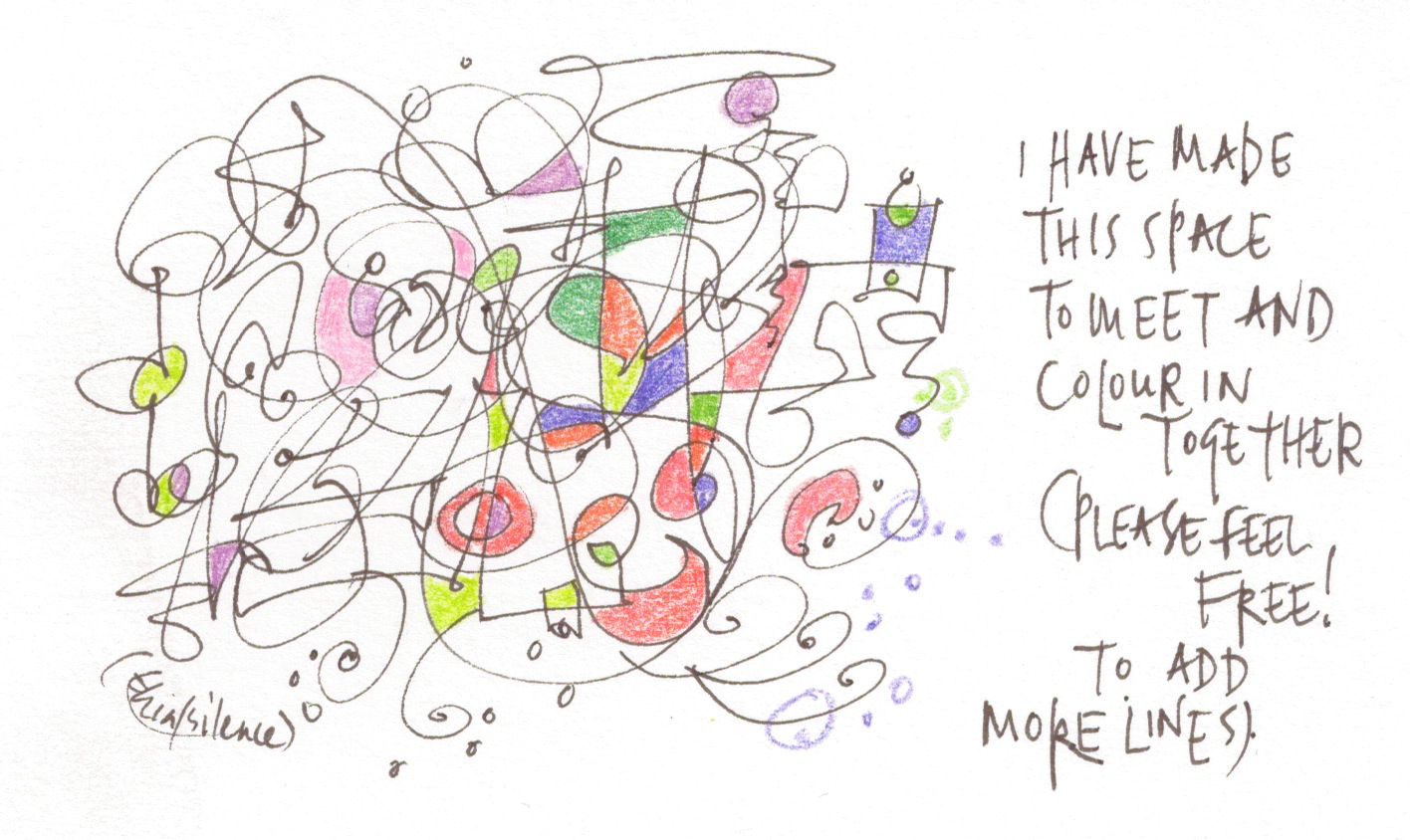
i have made this space ...

Cities are amazing places – as are villages and towns.  Cities call us to be creative, and, the greater the population the more likely this is.

Often, we mishear or misunderstand the invitation these grand artefacts make to us: come and play.  More than buildings and spaces, cities are people – some have even said they are the ultimate Human creation.   I can’t argue with that.

Maybe it’s a hope and maybe it a truth, but I suggest we’re all city-shapers.

We have the opportunity to create spaces in which everyone can thrive.  We can’t make people thrive, but we can craft the spaces for this to happen.

I don’t create people’s dreams, but I can offer a space in which they can dream.

And whatever that thing you do, it somehow makes space for people to thrive in.

‘Figure out what you are meant to contribute to the world
and make sure you contribute it.’ (Quiet, by Susan Cain)

gracefulness

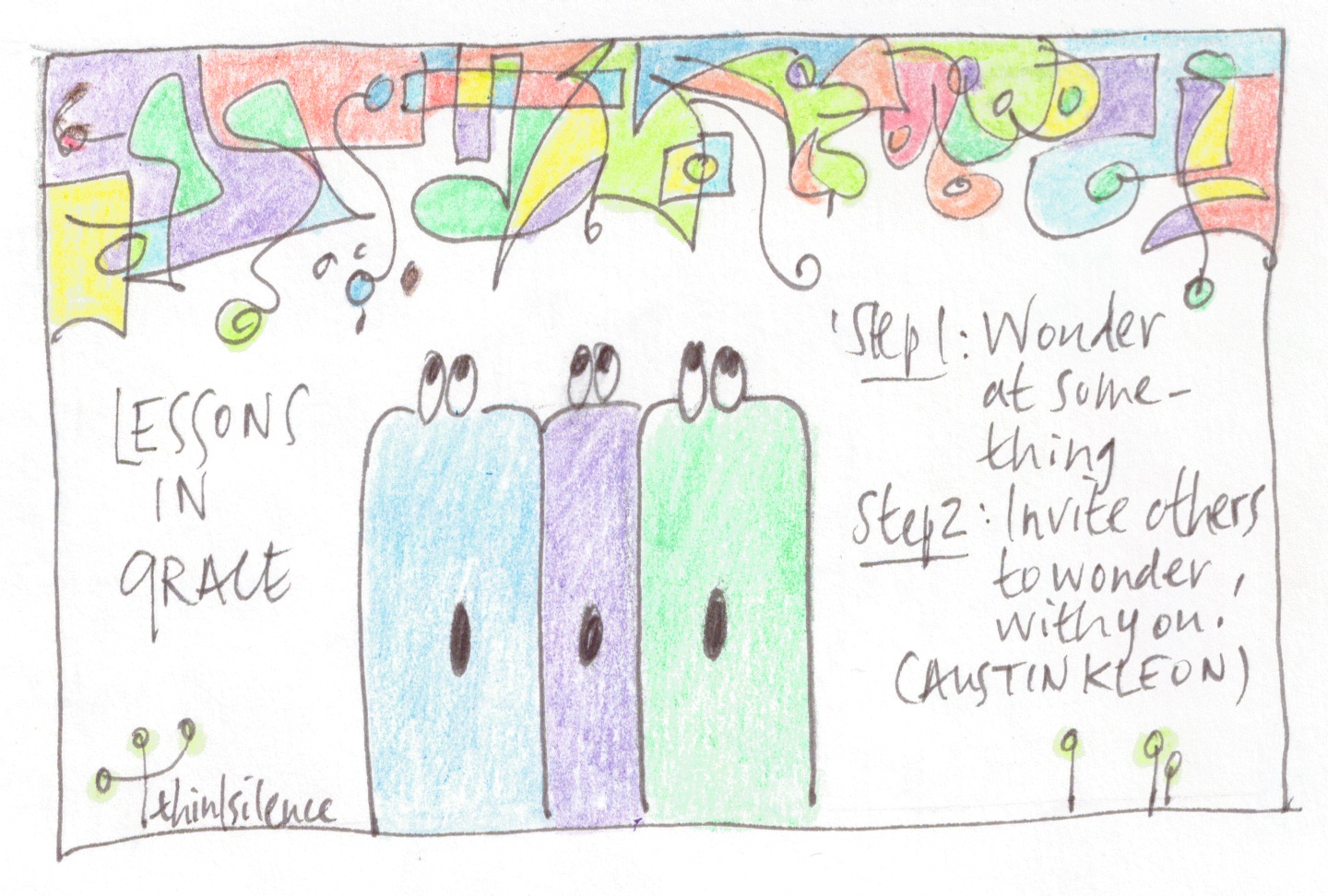
lessons in grace

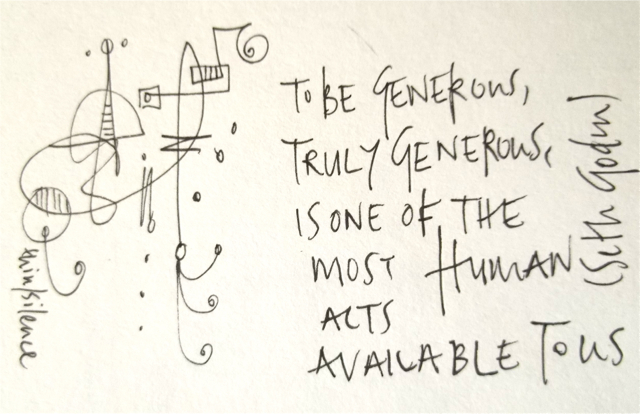
I’m trying to live with more – as Seth Godin reminds me, I wasn’t born with grace, it’s a choice.

It’s about giving to others the best of who we are and do – we can all think of people who have been graceful to us.

We can also bring to mind people who have not been graceful.

Grace is beautiful and truthful .. and gritty.

We know a world with more grace in it would be better one – which is why its important for us to know it’s a choice.

Yesterday, I found myself rereading some of Godin’s thoughts on grace – on a bus, trundling along, I thought to share these today:

“To be willing to do new things you don’t think you’ll like requires
you to prefer the unknown.   Not just to tolerate it, but to prefer it.

‘One way to achieve that is to set out to experience things you’re
sure you won’t like.

‘To have conversation that are frightening.

‘Becoming generous beyond measure, just to see what happens.

‘And most of all, setting out to fail.  Failing helps you see how far
is too far, failing helps remind you that failing isn’t fatal, and most
of all,failing opens you up to succeeding.’

As Godin says elsewhere: ‘Art  is a personal act of courage – something one human does to create change in another.’

Something Dan Ariely shares about his honesty experiments helps us to see grace more sharply.  Ariely tried out a little test involving the contents of a common fridge, placing a pack of cokes in (all gone within 72 hours) and then a plate of cash (still there after 72 hours).  He then created a measurable experiment to see if people were more willing to take (steal) if it was a step away from cash.*  He found it was the case.

When his Skype account was hacked into and he ended up paying for someone else’s calls, Ariely was sure this person didn’t think they were really stealing – they weren’t stealing money.  His concern is, we’re moving towards a world in which ‘the days of cash are coming to a close,’ meaning people will be increasingly disconnected from cash and, at the same time, have more temptations to face.**

Gracefulness is about giving more than we take in everything we do.  The choice is going to be more important than ever.

(*Three groups.  The first (control) group received cash directly from the person checking their answers (solving 3.2 problems).  The second group could self-check their answers for cash (claiming they’d correctly solved 5.9 problems).  The third group received tokens for their correct answers which they could exchange somewhere else (and claimed they’d correctly solved 9.4 problems).)
(**James McQuivey suggests we’re entering an era of digital disruption: ‘innovators+infrastructure=digital disruption.  Massive digital disruption, at a scale and a pace most are simply not prepared for.’
(Cartoon quote from Austin Kleon’s Steal Like an Artist.)


priming and honesty and art

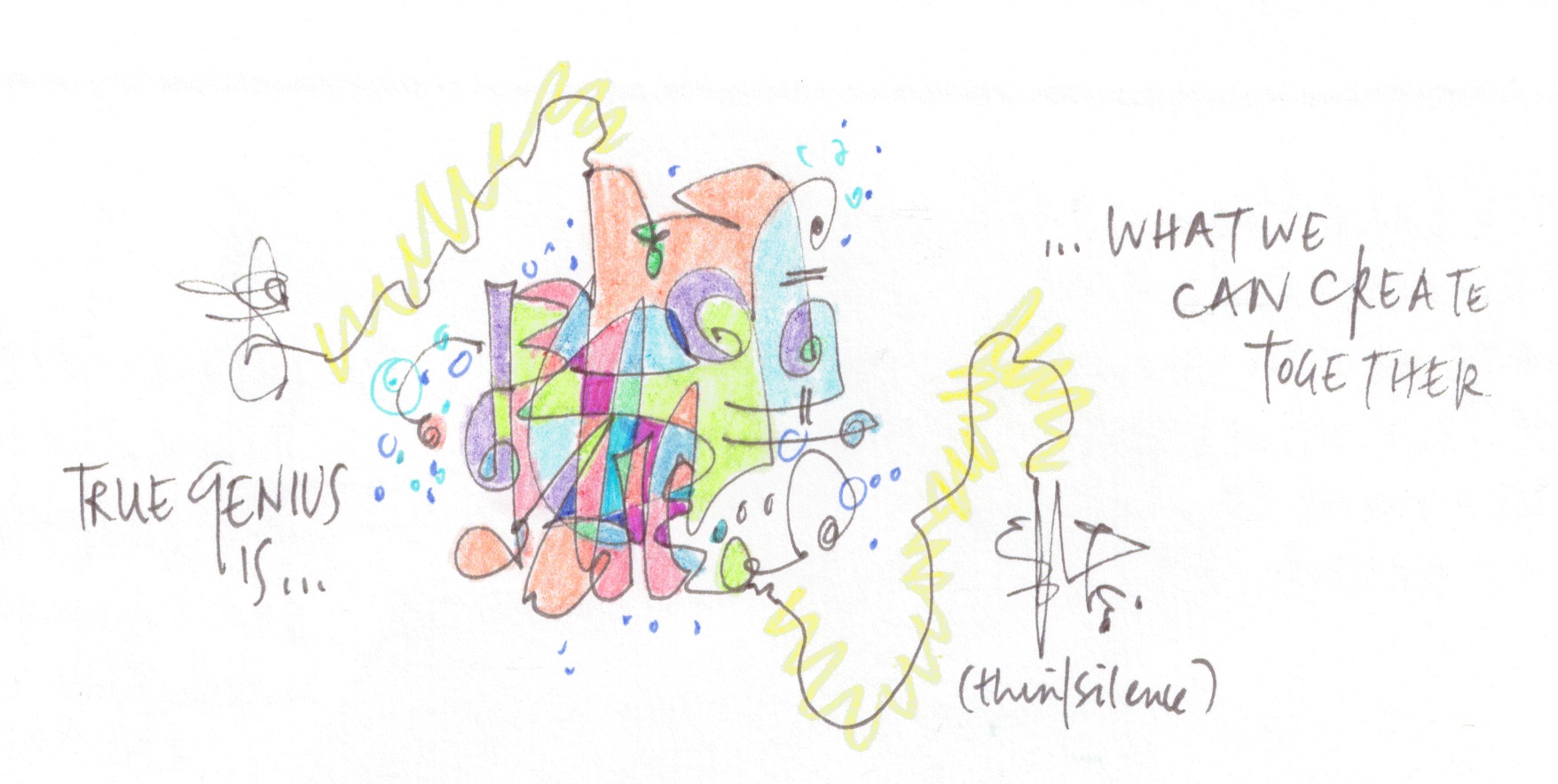
true genius is ...

This is the second of two posts on honesty.

Honesty because everyone benefits – honesty as an outcome and means.

Dan Ariely caught my attention with another of his experiments exploring the hidden things at play behind the choices we make.  This time he was seeing if he could influence people to be honest.  The experiment had three groups tackling twenty problems.*  Two of the groups were primed before they began – one would write out ten books the participants had read in school, the others would write out as many of the ten commandments as they could remember.

The results.

The first group which couldn’t cheat because someone else checked their answers solved an average of 3 problems.  The group asked to write down ten book titles submitted their own results, and claimed an average of 5.5 problems solved – they’d cheated.   The group asked to write out commandments submitted their results and claimed an average of 3 problems solved – no cheating.  Ariely then tried it again with an honour code substituting for the ten commandments – the same results: ‘a moral reminder  eliminated cheating altogether.’

This piqued my interest.  Just yesterday, someone who’s been exploring their Strengths** with me shared how a summary of the things which energise her – held on her smartphone – had kept her on track during what could have been a difficult experience.

Then, what if priming ourselves at the beginning of the day – with the things which are important to us – keeps us true and honest to what we really want to do.***  Or, to put it another way, what if these reminders get us into the rhythm of our life and art so we’re not deflected and will not compromise?

As I mentioned in the first of these posts, my interest in honesty is as something which means everyone benefits, including ourselves – being connected with our story and producing the art we love to make.


(*The first would answer questions and have to hand them in for someone else to check, those who wrote out the books or commandments could check submit their own results and tear up their answer sheet.)
(**Strengths are what occur when passions and skills combine.)
(***Journalling, statements and mantras, images, and even physical exercises – imbuing meaning to each movement with words about our art.)

honesty, and the stories we tell ourselves

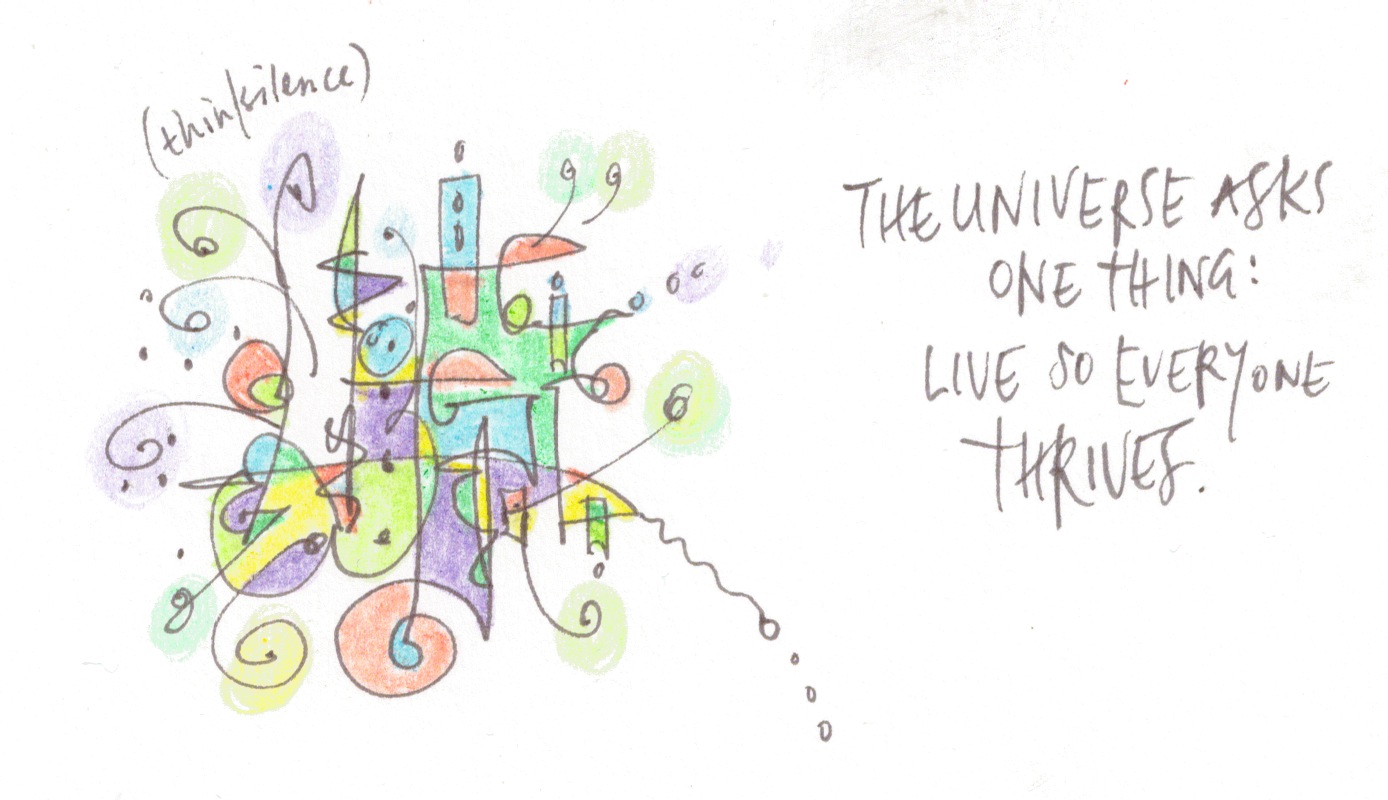
the universe asks one thing ...

If you were to pass a stall today bearing the sign “Free Money,” would you pick up a crisp new £5, £10, or £20?

An experiment run by Dan Ariely would suggest only around 1 in 5 of us would for the largest of notes.  The reason being, we don’t trust the offer, there must be strings attached.

Are we distrustful by nature, or because we have some bad past (direct or indirect) experiences which makes us look the “old gift horse” in the mouth?

If I google list of least trusted people, I get 137 million results.  When I check out who are on some of these lists, there are the usual suspects: politicians, estate agents, bankers, car salespeople, insurance sellers, journalists … .

This is about how honest we think others are, but how honest are we?

One source gives UK card crimes, burglaries and criminal damage at a cost of around £400m, another suggests fraud in the workplace costs £20b.

If we suspect someone is being dishonest, we can find ourselves adjusting our own behaviour so we don’t lose out.*  At the same time, we want to think of ourselves as being good people, so we justify our behaviour by telling ourselves a story – I stayed a little longer at work so I can inflate the expenses a little.

Honesty is something full of nuance and subtlety, a lifeskill honed each day, and none of us get it right all the time, but people love when our stories come through – what we say connects with what we do – and, better still, if there are any surprises, let them be good ones.

Whether we want it or not, dishonesty creates inconsistencies within our life-story – we look at it and think, “Hmm, that doesn’t work” – and a disconnection occurs within us.  Honesty begins with connecting to our story each day – to our values and purpose and ways of expressing these.

The reason I’m exploring this is because dishonesty means we all lose out.*  To love our stories and to live them is the best way to make life better for everyone, including the person tempted to be dishonest.

(*Ariely’s example goes something like this: if four people all have £10 and can put into a pot which doubles, and the pot is then divided back equally, it means each will have £20 after the exercise.  If one person doesn’t put in, meaning there’s £30 in the pot, doubling to £60, then each gets £15, but the dishonest person has £25.  Suspecting something’s not right, next time around, the others determine to put in £2 each, which doubles to a £12 pot, meaning each gets £3 back.  The three end up with £11 each, and the dishonest with £13 – so each falls far short of the £20 possible.)


it’s everywhere i go

every day ...

It’s written on the wind.  It’s everywhere I go …

From Love is all around me.

And so are placebos.  (This is my second of two posts on placebos.)

Dan Ariely bemoans the uncovering of Airborne as a placebo when it comes to countering the potential illnesses following flying (the company has had to change it’s advertising): ‘Oh why, why did they do this to me.  Why did they take my wonderful placebo away.’  The placebo had worked for him and he was investigating placebos!

In the Wizard of Oz, the wizard promises a heart, a brain, and courage to the travelling companions of Dorothy.  He’s offering a sugar pill and they swallow it, and discover they have the things they seek all the time.  Charlatan or placebo-wise devotee?

(Interesting again are nocebos, which may even cover the good effects of a real drug – the doctor who tells of all the side effects can lead to a patient experiencing less benefit.)

We all get caught out.  I don’t like car showrooms – stressful places.  Two recent experiences.  I needed to visit a Mercedes garage – a problem with my ten year old Smart car! – and I was seated by the receptionist in a very comfortable waiting area better than many cafes, brought a drink and biscuit, given internet access, then led to a table by my suited service advisor – all very relaxing.  Compare this with the industrial experience of a large chain of garages where sales desks are lined up in functional rows and there’s a coffee machine you can help yourself from.  The first is telling me a story, the second is not.  Is there that much difference between what I may or may not be paying for.  Probably not.  The first is a placebo experience and it worked for me.

It’s okay to create a story for what you do as long as what you are creating and providing and contributing is real.  As Seth Godin* reminds us, it’s not good enough to get just one of these right: the great art which never benefits anyone, or the great story without substance.  When we have the two together, then we’re zooming.**


(*This is a link to an excellent little ebook to stretch thinking on placebos.)
(**Zooming is a phrase from Seth Godin I’ve loved ever since I came across it several years ago; it means taking the amazing stuff you do further.)

placebo and story


Interesting.  Two of the sources I’m reading at the moment are looking at the effects placebos have on us.

Dan Ariely tracks how higher priced drugs and placeboes have a greater perceived effect on people than lower-priced drugs; there are ‘blurry boundary lines between belief and reality.’

Seth Godin is looking at how marketing is really a placebo.  Here’s his short ebook Placebo, which he’s making available free.

This is where story comes in, because it can be argued the story I tell myself about my life is really self-marketing.  How we see things, then, individually and collectively, may not be how things really are.   Yet somehow they work, and work very well.  This is not the same as living a lie – a story lacking integrity – but is about the things we believe and love and value affecting our reality.

All of this is leading me here.  If Dan Ariely is right about what we believe really does affect how we feel, then we hardly know what the Human mind is capable of achieving, we hardly know what we are capable of, and perhaps the key to unlocking more is the story we choose to live.

The power of story is something that’s long been of interest to me for some time now, and it could be that it is the way of releasing Human potential.  And who knows, maybe the technology and genetics and pharmaceuticals may all prove, to some degree, to be placebos for releasing what Humans have always been capable of?