do you have to go?

you left too soon

When a space seems empty, the ideas aren’t coming, the words won’t flow, the problem won’t solve, sometimes the best thing we can do is hang around a while longer – when the temptation is to move on.

What happens next might surprise us.

By hanging around, I don’t mean twiddling thumbs and whistling.  Maybe the best thing we can do is some hacking – I like this definition from Mitch Joel:

‘Someone messing about with something in a positive sense, that is using playful cleverness to achieve a goal.’

I find myself inviting others into the empty space to play, people who see things differently to me, people who help me to see what is invisible to me:  books I’ve read, conversations I’m involved in somewhere or other, videos I’ve seen – mix them all up and see what happens.  (I journal as I go, keeping a light trail of thoughts.)

Not always, but sometimes, the best thing we can do is hang around for a little while longer and play.  If nothing else happens, you’ve learned how to hang around a little longer with playful purpose and that in itself can be huge.

the business of you

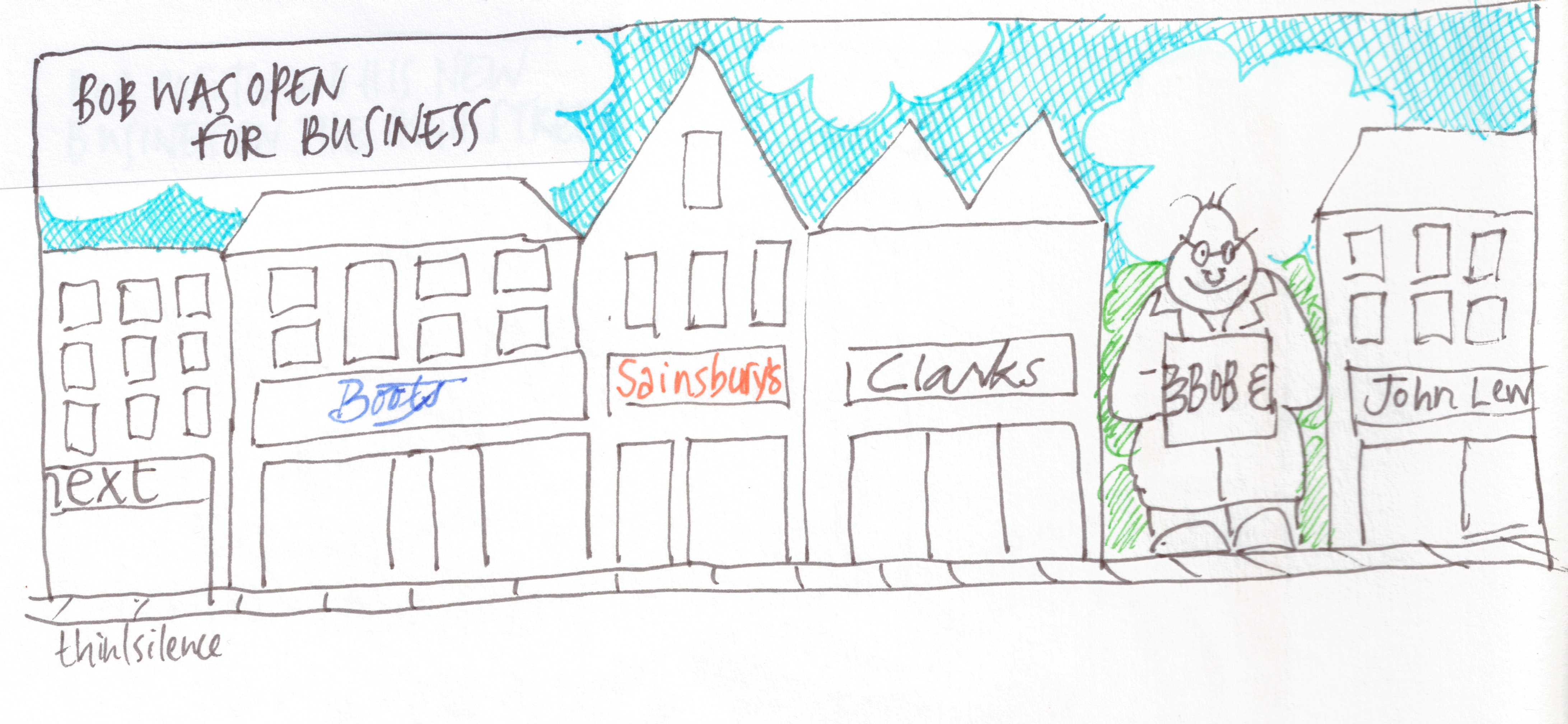
bos was open for business

You’ve just identified a resource or commodity no one else is aware of.  Maybe you found it under your house or in the walls, but you have sole access to it.  And it’s virtually limitless, so what are you going to do with it?

Maybe start a business?

Who will help you in your business?
Who’s it for – your customers – and what will they get out of this?  
How’s this unique and how you’re going to repeat something unique, again and again?  
Will you keep the day job?  
Will you charge for it or make it a charitable start-up?

By the way, this isn’t hypothetical.  It’s for real.

The commodity or resource you have sole access to is you and what you do.  It’s just a different way of seeing things because we need to see things differently when we get stuck – and we’re more often stuck than moving.

The questions, above, still work for our lives as a business start-up.


don’t wait for perfect

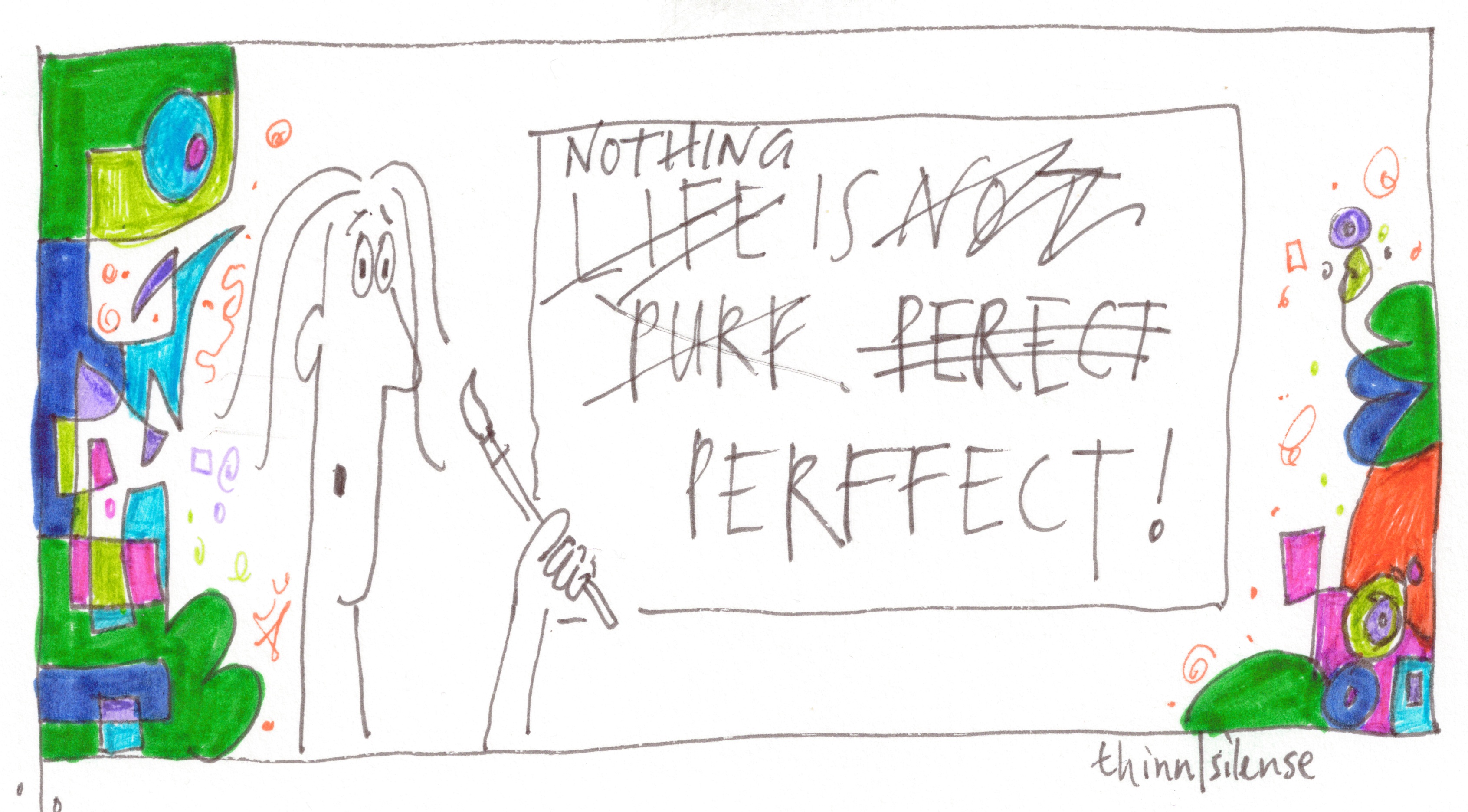
nothing is perfect

Nothing is perfect, either as we think we need it to be or it ought to be.  But we can be shocked at what can turns up in the imperfect, and we can be surprised at what can be done.

If you’re prepared to face the truth and reality of who you are, and to connect with this – I mean the deeper stuff you might not even know yourself at the moment – then you’ll see you have enough to do something quite extraordinary.  The trouble is, you’re waiting for perfect – perfect skills perfect feelings, perfect opportunity.  Well, it’s not going to get better than right now.

Anyway, it’s likely the thing you’ve just got to do is in response, or is a reaction to, an imperfect world – something you want to see working better than it does right now.

There are two kinds of imperfection.

There are unreal perfections.  These are when you’re over-criticial of yourself, most likely because of what others expect or want of you.  These are doubly crippling when you buy into them.  Firstly,  they don’t connect with your inner motivations – so they they don’t fulfil or satisfy you – and, because you’ve accepted them from a person or institution, you probably feel you’ve never don well enough.  Secondly, there’s part of you who doesn’t want to do these things, so you rebel and sabotage.

The real imperfections are your talents and abilities, your concerns and passions which really are who you are, which energise you and capture your attention again and again.  These provide an antidote to the other imperfections.

So, to sum up, the world’s not perfect, there’s no perfect time to do something, your skills and your motivations aren’t perfect.  Now we’ve got that out of the way, why not do something which will shock us at what can happen in the imperfect, and surprise yourself with some joy?

rhino world

when ideas collide

Someone has actually sat down and worked out how the more densely populated a city, the more actual collisions take place, leading to more patents being registered – roughly speaking, the moe people we encounter, the more ideas we have, the more new things happen.

I love this.  The industrial mindset removes such collisions, making it possible for you to stay focused for long periods so you’ll be more productive.  But our work spaces are changing, they are becoming more creative.

The industrial workspace is often single location, fixed spaces, isolational, routinised.  Creative workspaces are multiple, adaptable, communal, freewheeling.

Yesterday morning I sat down with a plethora of entrepreneurial* and imaginative people from a  range of businesses and interests who’d gathered in an artisan coffee shop because they wanted to meet other people like them – not knowing what might happen, they were willing to invest one to two hours in order to do this.  Interesting.

I find myself imagining the possibility of adaptable space being made available where people like these can bring their laptops and iPhones and cameras, plug in for a few hours and also meet others doing the same – bring on the collisions.  (And it’s doesn’t have to be only those who earn their income in these ways, but also people who are pursuing something in their free time which matters to them.)

If you’re anticipating a meeting with someone, try a different space.  If you have some work to do, why not find a cafe somewhere … or the museum or art gallery?  If you have some spare space, why not open it to people who would normally work alone but could pay you something to work in a communal environment for a while?  If you normally work alone, why not google out some possibilities for meeting with others?  If there’s nothing around, why not start it?

Rhinos can run at thirty miles-an-hour but can’t see thirty one feet in front of their horns.  That’s why they’re collectively called a crash.  Brilliant.  We could name them the mascot for entrepreneurs in the creative age.

(*I like Mitch Joel’s definition of an entrepreneur – it’s big and wide and potentially includes everyone who’s ever had an itch about anything: ‘A true entrepreneur is someone who has an uncanny desire to create the future; someone who sees inefficiencies in the work we’re doing – day in and day out.’

place the mask over your nose and mouth

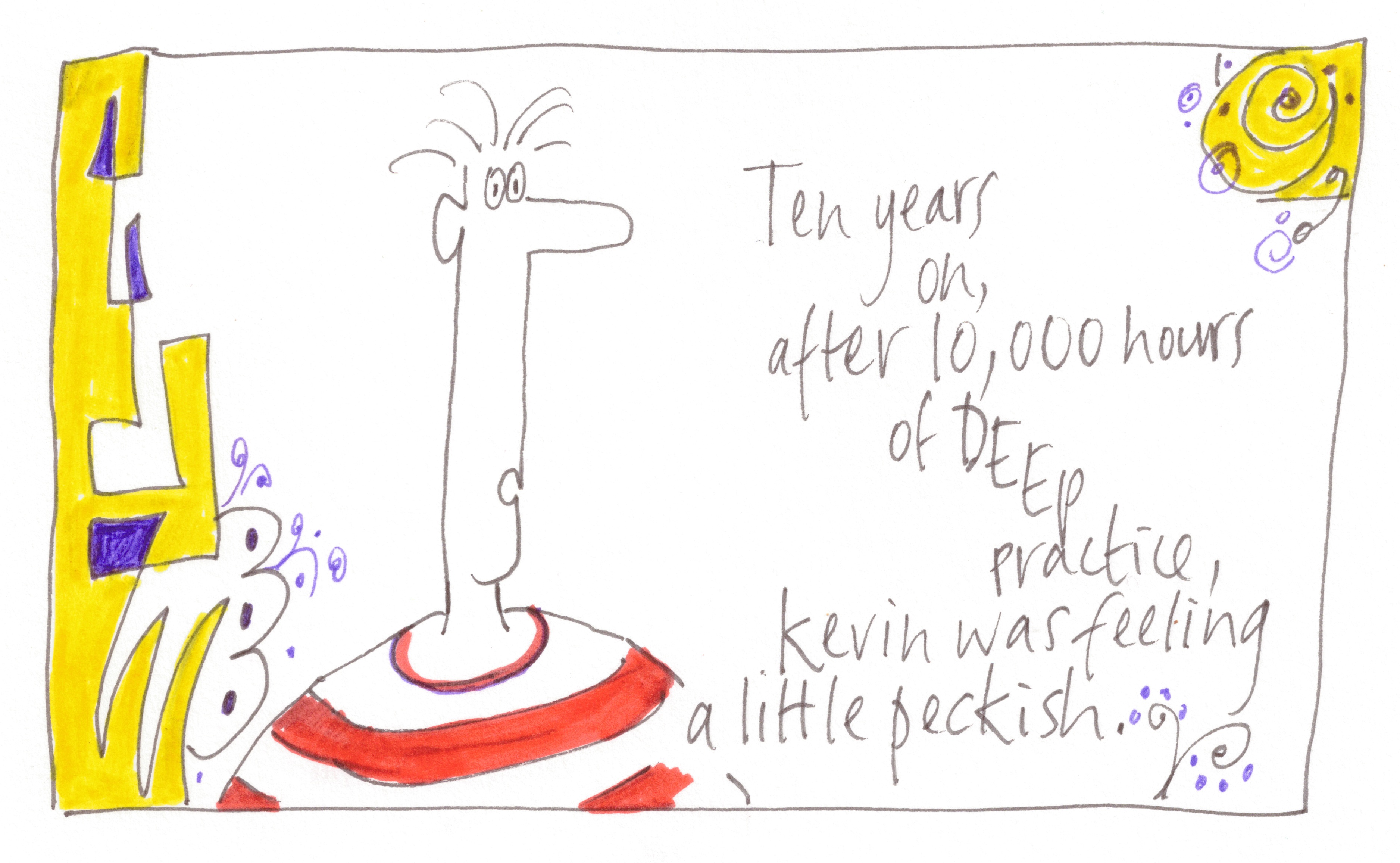
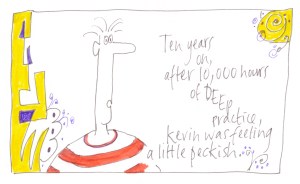
ten years on, after 10,000 hours ...

Yesterday, I wrote how finding your voice is important for others to find theirs.  Today, I thought to sketch out a little of offer some of the thinking behind this.

Steven Covey‘s eighth habit for becoming highly effective people is about finding our voices and helping others to find theirs – something akin to the flight safety presentation reminding us, if oxygen masks are deployed, we must secure our our own before helping others to secure theirs.  The presentation, presented by a bodiless voice or video, reminds you of what you must do

Who helped you find your voice? Or, who is helping you?

Mitch Joel offers six ways to become more digital; he’s really offering six ways to find your voice:

Learn it
Read more
Create more
Love it
Live it
Practice it

The first two catch my attention.  Learn it and Read more are about finding help from outside of ourselves – because when it comes to finding our voice, being creative, no one is an island.  Something captures our attention and we want to know more, so set out to learn about it, we read as much as we can (or watch as many TED videos as we can – so we involve as many people as possible in this exploration.  Then we can push on and begin playing with new possibilities and Create more, trying and trying and trying, but only if we Love it.   So we begin to Live it and breathe it, and we get to where we we put our art out there and see what others make of it as we daily Practice it.

Within this, but I pull it out here in order to underline it, is the truth that finding your voice won’t come easily or comfortably.  It will become a quest thousands of hours long, trudging through the tedious and multiple failures but then trying again (this is why you have to love it).

Another things to draw out from this is, whilst we need others to help us, they cannot choose what it is for us; many have been pushed in a direction which is not of their choosing, by parents, friends, teachers, employers, or something more numinous like culture or society – what comes from outside must resonate with what lies at the centre of who you are.  Your authentic voice can only be identified and developed by you.

In this post are hidden five great books – all of which can be seen as help from outside; here’s a quote from a sixth book:

Anyone who would spend ten years absorbing the
technologies of their field, trying them out,

mastering them, exploring and personalising
them, would inevitably find their authentic
voice and give birth to something unique
and impressive.

By the way, the benefit of ending your voice?  You’re not waiting to be picked; you’ve just picked yourself.

(Here’s a seventh, because my cartoon is often inspired by Hugh Macleod.)

finding your voice

the world is a choir of beautiful voices

Your voice can be recognised by your family, friends, and colleagues in what feels like a fraction of a second.  It’s your unique signature. 

So here’s a few things about voices.

We talk about finding your voice to mean identifying your unique and authentic contribution.  This is where we get the idea of vocation and calling from.

I can recognise your distinct voice from the things which you’re curious about, from the skills you hone, from your personal touch, and your approach to life, no matter what you’re doing.  It’s your life signature.

But what if you couldn’t recognise your own voice?

You may be trying to impersonate someone else, to “sound” like the person your parents or partner or employer wants you to be.

Hear of voice development?  Just like your speaking voice can be developed, so can your life-voice.  But if you don’t know your voice, you can’t develop it.

Finding our voices and developing them excite me a lot, but the third thing excites me even more.  When we find our voices, we help other to find theirs.  And that can change the world.

Someone once said, the world doesn’t need a second someone else, it needs the first you.

(*vo·ca·tion  (vō-kā′shən)

n.

1. A regular occupation, especially one for which a person is particularly suited or qualified.
2. An inclination, as if in response to a summons, to undertake a certain kind of work, especially a religious career; a calling.

[Middle English vocacioundivine call to a religious life, from Old French vocation, from Latinvocātiō, vocātiōn-a calling, from vocātus, past participle of vocāreto call; seewekw- in Indo-European roots.])

the ancient art of dreamwhispering

so much to liste to

This is the title I’ve given to what I’ll be sharing at an event for the free sharing of knowledge.

Dreamwhispering is ancient art with a timeless dynamic in Human development, listening deep within – though we’ve lost the art in modern life.

Here’s a short initiation into the mastery of this ancient art of listening more deeply.

First there is our normal listening – this is the “same old same old” listening many people are trapped in – listening only to what confirms the things already known.

To go deeper we must cross a threshold, suspending the way we see and understand.  (We must allow for this to be disorientating, as we’ll discover there is much more to know about everything, and everything is way more complex than we know.)

This brings us to factual listening – we understand there is far more to the world, to the people around us and to our selves than we thought.

To go deeper we must cross another threshold, redirecting our listening from the outside of things to the inside – this too is disorientating for us as our thinking includes the thinking and feeling of others.

This brings us to empathic listening – we’re seek to understand from the perspective of another (another person, another species even, and our planet).

There is another threshold to cross, letting go of our old ways of seeing, understanding,and behaving, in order to take hold of one which is more satisfying and fulfilling to ourselves and makes a dent for good in our world and universe.

This brings us to generative listening – we identify the emerging future we’ll be involved in bringing into being through a connected collaborative.

Admittedly, the ancient art of dreamwhispering is not an easy journey, and to complete it – if we can ever say we do – requires us to find the things which motivate and energise us.  When we do, we find we have something unique to accomplish through our lives, we have all we need to do this, and, we can go further than we ever thought we could … we may even have to rethink what we mean by life.

The times before us are exciting because we are rediscovering this ability to hear what our lives are saying to us, as well as the lives of others, and the world in which we live.

people from the future

The future is already here

We are shaped by something which does not exist.

I’m rushing as I write.  Why?

I know I’m going to be heading out on a hike through the Pentland Hills in a little while – a 50th birthday trek for a friend.  And there’s loads to do first, so I’m rushing.

It hasn’t happened yet.  I’m just imagining it.  We are shaped by the future which doesn’t exist.

We can only live now, but we cannot live well now without the future.  And there isn’t just one future, there are multiple futures, which means there are multiple nows.

We are describing what it is to be Human.  As far as we know, we are the only species to see and understand life as past, present, and future; we are able to imagine what does not exist, but we can miss how amazing a thing this is.

The future is the fuel for what makes us feel more alive or engaged in our lives – autonomy (freedom and choice), competency (skills and mastery), and relatedness (purpose beyond ourselves) – we are people of the future.

The future is already here: when we look more closely and we open our minds, when we step into the worlds of others, when together we begin to see what the world can be and within this know what it is we must do, when we are willing to try and fail and keep trying, the future will appear amongst us and we will call it “Now”.